The shortlisted works across all 13 categories of the British Fantasy Awards have been announced! Find out who’s in the mix over on our blog. Winners announced at Fantasycon in October.

For all things fantasy, horror, and speculative fiction
-
Announcement:
Ask an Expert: August 2026
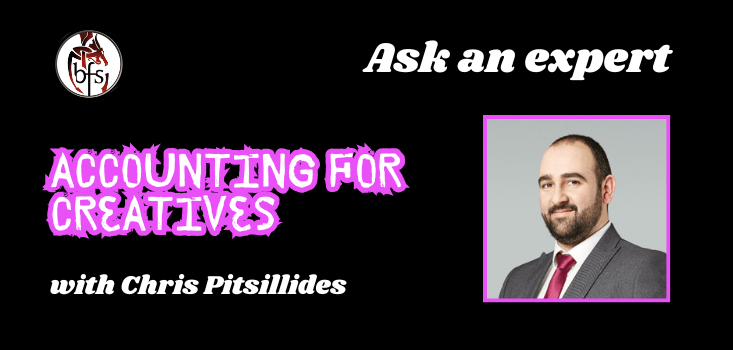
In this monthly column, we pose your questions to an expert in a specific field of speculative fiction and the wider ‘industry’. This month we pose your questions about the dreaded business of accounting for creative work to Chris Pitsillides, Director of AuthorTax.
This month: Accounting for creatives, with Chris Pitsillides
Name: Chris Pitsillides
Specialism: Business accounting
Website: www.authortax.co.uk
Follow: LinkedIn
Chris Pitsillides is the founder of AuthorTax, a specialist accounting firm primarily built for authors and the creative sector. With more than 20 years of experience working in tax and accounting, Chris advises clients of all sizes from international best-selling authors, social media influencers and authors just starting their self-publishing journey. He specialises in the industry-specific tax rules and quirks that traditional and self-published authors face. His aim is to help his clients streamline their accounting so they can focus on creating, while ensuring they keep more of their income and stay fully tax compliant.

Important disclaimer: Please note that any answers or information provided are for general informational and educational purposes only. Because everyone’s financial situation is unique and tax laws change often, the information shared today does not constitute professional financial, tax, or legal advice, nor does it establish an accountant-client relationship. Please consult with a professional before making any financial decisions based on today’s discussion.
At what point is it worth hiring an external accountant as a writer/creative worker?
This depends on several factors, however generally I would suggest speaking to an accountant in the following circumstances:
- You want to operate as a limited company
- You are not confident in submitting your own self-assessment tax returns
- You are not sure on how to deal with foreign withholding tax forms or certain claims on your tax return
- You are running at a loss and want to claim tax relief against your employment income
- Your income has spiked or dipped significantly over two tax years and you want to look at Authors Averaging
Is there a benefit as an author to operate under a limited company or is that only once you hit the big leagues? Do you need to set up a business?
This depends greatly on the wider financial circumstances of the author.

The benefit of operating as a limited company has been significantly eroded by recent tax changes. You can still obtain a good level of tax saving via a company if you use it as a “money box”. This involves leaving the bulk of your profits in the company and restricting your takings to specifically avoid higher rates of personal tax. This means limiting your drawings from the company to the basic rate allowance level. Depending on the level of profits there might be scope to take further income out but this depends on circumstances. If you need access to all of the income that the company will generate then it’s usually better to stay as a sole trader.
If your company will generate significant profits and you have a spouse who is not working or earning very little there is scope to pay them dividends. More details are available here.
Care must be taken as usually the author owns the copyright and the rights to any income. It is important that the right to income is legally transferred to the company; without this step HMRC will argue that the income does not belong to the company at all and should be assessed on the author personally. As the company and the author are connected, all transactions need to take place at market value. If transferring the copyright, this can potentially wipe out any benefit from operating as a company. More details are available here
What can you claim for? Events like FantasyCon? Food, travel, accommodation at events like FantasyCon? Books? Do all books count as research when you’re a fiction author as they’re all filling the creative well? At what point can you start claiming them as expenses? Do you have to actually be earning money as an author? Can you claim FantasyCon as an expense for example if you’re querying and trying to build connections at events to get an agent?
If you are an active trading author, you can claim tickets for events, travel, accommodation and a reasonable amount for food. Care must be taken when sharing a meal as if you have another author with you the meal will be classed as entertaining and not tax deductible.
If you have not written a book or generated any income as an author/writer and do not have an agent, you should still log these expenses. You can account for these expenses as you go along each year or you can bring in seven years’ worth of pre-trading expenses in your first year of trading. If you make continued losses for several years, and have never turned a profit, HMRC could argue that you are a hobbyist and disallow the costs, especially if you have been offsetting these as losses against your other taxable income.
Books for research should be tracked to a project that you are working on or directly linked to your activities as an author.
The general threshold for tax allowable expenses is that they are “Wholly and Exclusively” for business. You can find a non-exhaustive list of expenses and author could claim on my website here.
What about if you’re not (yet) looking to publish a book but perhaps write short form fiction—when can you look at claiming expenses/tax relief etc for writing-related things? And same questions as above about what you can include?
The key element that HMRC will look at is profit motive. If you are trading with the intention of making a profit, then you can start trading and claiming expenses. As mentioned above, making continued losses without any profits will probably lead to an HMRC enquiry where the expenses will be struck out as a “hobbyist”.
What receipts should you be keeping?
Strictly speaking all receipts should be kept as you need to evidence what you have spent the money on. My recommendation to all the self employed is to operate a separate bank account for all business transactions and link this to some accounting software like QuickBooks or FreeAgent. Both of these software offer a receipt capture feature which is a great help with record keeping and assisting with any HMRC enquiries.

If you have an unrelated day job on PAYE, would you have to somehow declare that you have a second job to the payroll people or are the two things completely separate?
PAYE and self-assessment are separate; you don’t need to disclose to your employer that you are a freelance author unless your employment contract requires this. When completing your year-end tax return, you need to report all income and expenses on this form—that includes all employment income, self employment, savings and investments.
I’d like to know about using a pen name and claiming expenses etc. Are there any complications to be considered?
There is generally no problem using a pen name; when completing your tax return you should indicate that you are “trading as [pen name]”. I have seen issues with payments where a bank account has been opened with the pen name as opposed to the legal name. This is actually more of an issue for VAT—to reclaim VAT, the invoice needs to be in the name of the VAT registered business.
I feel like I mostly enjoy an ‘ignorance is bliss status’ with accounting and probably shouldn’t. One thing bugging me is do we as authors in the UK need to be keeping track of/separately filing for taxes for online sales in different countries? And does this vary depending on the sales platform (i.e. is sales tax on Amazon handled differently to direct sales on a personal website)?
For income tax you don’t need to keep separate records or file in different countries if you are a UK resident taxpayer. You do need to include this income as part of your self employed profits as part of your tax return. If there is any foreign income tax deducted you should also claim this as a tax credit NOT AS EXPENSES on your tax return.
With regards to VAT this depends on the sales platform and if you are selling books or merchandise. Amazon typically will take care of the reporting and filing requirements for you. If you operate your own website or use a platform that does not deal with the overseas sales taxes, you will need to report EU sales via the EU VAT One-Stop Shop (OSS). This can be time consuming and complex depending on the reports that your platform generates.

If and when I get a deal from a publisher, when do I tell HMRC in the UK so I do not incur a fine—especially if the agent and publisher is from, say, the US?
The deadline for income tax to inform HMRC that you are trading is 5 October following the tax year in which you started trading. For example, say you received some income in September 2025: this falls in the tax year ended 5 April 2026, so you have until 5 October 2026 to register for self-assessment. However, as an author you have the ability to use Authors Averaging; it’s important to note that if you only declare your trade and start trading when you receive your first deal you will not be able to average these profits. Averaging cannot be used in the first and last years of trading, which is unfortunate as most authors only register when they get their first deal and typically that is the year with the highest profits. It is better to register as soon as you start trading to start recording losses, which can then be carried forward and used against your first year’s profits.
VAT is different. There are two potential deadlines depending on the circumstances. The most common trigger is that you have to check your turnover looking back 12 months at the end of each month; if you breach the VAT threshold of £90,000 of UK sales, then you have 30 days to notify HMRC and you will be registered on the 1st of the following month. For example you breach the threshold in the month ending 31 March, you have until 30 April to notify HMRC and you will be VAT registered from 1 May.
The not so common trigger is if you expect to go over £90,000 of UK sales in the next 30 days alone then you have to register as soon as you become aware of this. This scenario is common when a significant UK deal has been signed and the signature advance will be in excess of £90,000 alone.
What’s the tax implications for getting an advance from a publisher? It may be more than a year from the advance to book publication or earning out.
Advances are basically royalties paid up front; these will form part of your taxable income that you will need to report on your tax return based on when they are received/contractually payable. You would typically prepare a profit and loss account and pay tax, National Insurance and student loan repayments if applicable on the profits. The timings of advance payments are set out in the publishing contract. You might need to consider VAT if you have a significant UK advance.
Given that presumably you cannot personally give tax advice to the whole of the BFS, what’s the best way to go about finding an accountant to work with, so that we’re not just Googling “single accountants in my area”? Is there a society/guild/list of registered or accredited accountants? A review website?
There are lots of accountants out there and it really depends on your needs. They all have a different approach and working style. As with all working relationships, some of these styles will fit better with authors than others. I suggest looking for a firm that has experience with or specialises in dealing with authors. I am aware of several authors groups on Facebook and other platforms where accountant recommendations are made. All members are welcome to book one of my team in for a no obligation consultation here.
Imagine a rather chaotic, ditzy person who is utterly clueless about how tax returns really work and also finds them quite intimidating. Bearing in mind that this hypothetical person makes way too little money off their ‘self-employed’ side hustles to afford hiring an advisor, where would you suggest they even start with doing their tax return in the best way they can?
There is lots of guidance out there on how to complete your own tax return. If your affairs are simple, I recommend operating a dedicated bank account for your author activities and look at FreeAgent which has a module that can also help you complete your tax return. If you have a small amount of profits and minimal expenses, you can also claim the £1,000 trading allowance. There are only a narrow set of circumstances where this approach is recommended.
Is there a minimum threshold of income you need to reach before it’s worth hiring an accountant?
There isn’t really a threshold but in my opinion the accountant needs to “add value”—whether that is peace of mind, streamlining your bookkeeping or a tax saving. I have clients that make losses most years and others that earn seven figures. Every client is unique and every client has a different set of needs; there really is no one size fits all.
Disclaimer: Please note that any answers or information provided are for general informational and educational purposes only. Because everyone’s financial situation is unique and tax laws change often, the information shared today does not constitute professional financial, tax, or legal advice, nor does it establish an accountant-client relationship. Please consult with a professional before making any financial decisions based on today’s discussion.

Read previous columns
Ask an expert
- July 2026: Writing for children, with Eric Huang
- June 2026: Writing asexual characters, with Lexy Hudson
- May 2026: Subgenres of Sci-Fi, Fantasy and Horror, with Tiffani Angus and Val Nolan
- April 2026: Staying creative while life happens around you, with Shona Kinsella
- March 2026: Writing comedy and being funny, with Richard Sparks
- February 2026: Writing romance, with PS Livingstone
- January 2026: Writing TTRPGs and working with existing IP, with Alasdair Stuart
- December 2025: Creative coaching, with Dr Rachel Knightley
- November 2025: Crowdfunding, with Fio Trethewey and Georgia Cook of The Holmwood Foundation
- October 2025: Creating darkness, with Daniel Willcocks
- September 2025: Working with book bloggers, with Kayleigh Dobbs of Happy Goat Horror
- August 2025: Websites for creatives, with E.M. Faulds
- July 2025: Anthologies, with Dan Coxon
- June 2025: Self-publishing, with AK Faulkner
- May 2025: Indie presses, with Black Shuck Books’ Steve J Shaw
- April 2025: Being a traditionally-published author with Adrian Tchaikovsky
- March 2025: SFFH artwork with Jenni Coutts
Ask an agent, with Laura Bennett: