The winners of the British Fantasy Awards 2026 were announced at Fantasycon. Find out all the details on our blog.
For all things fantasy, horror, and speculative fiction
-
Announcement:
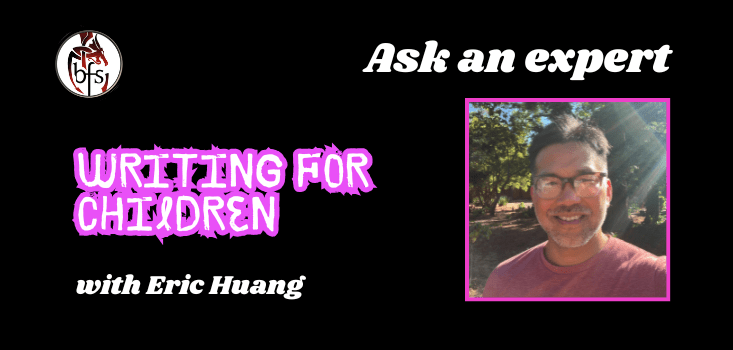
Ask an Expert: July 2026
In this monthly column, we pose your questions to an expert in a specific field of speculative fiction and the wider ‘industry’. This month we pose your questions about kidlit to acclaimed middle grade fiction author Eric Huang.
This month: Writing for children, with Eric Huang
Name: Eric Huang
Specialism: Books for children
Follow: Instagram | Linktree
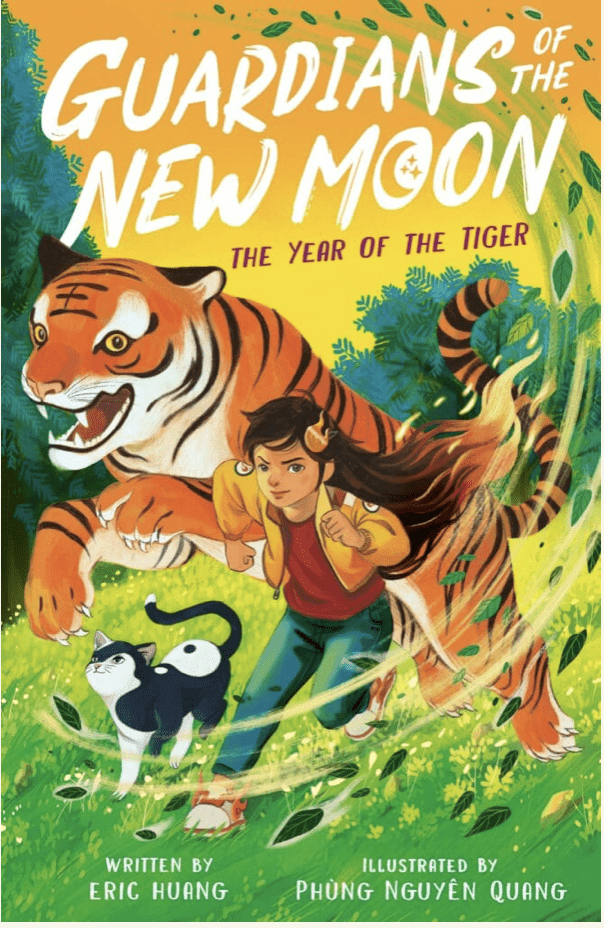
Eric Huang studied palaeontology. Unfortunately, field work didn’t live up to his Jurassic Park dreams. Several soul-destroying roles later, he landed a job as secretary to the Creative Director of Disney Publishing, launching a career in books. Since then, Eric has held editor and publisher positions on three continents, including roles at Penguin Australia and Penguin UK. Eric is the creator of Saint Podcast, a historical exploration of saints’ stories. He’s the author of the middle grade fantasy series, Guardians of the New Moon. And he’s Deputy Programme Director for City, University of London’s Creative Writing and Publishing Master’s programmes.

On the children’s book sector
How in tune with the kids do you need to be to write commercially viable children’s fiction? Or to put it another way, is it feasible to write a middle grade book as someone who almost never interacts with children of that age range?
I don’t think it’s absolutely necessary to be totally in tune with kids to be a successful children’s writer. The interactions I have with young people at book events definitely help me understand their interests (capybaras, video games), their sense of humour (silly, slapstick), what they’re reading (graphic novels), and how they perceive the world. But tapping into my own childhood self is also super-helpful.
Most of my ideas draw from what I loved as a young reader. The Guardians of the New Moon books reflect my childhood love of mythology. Lean into what interested you when you were a kid. Write the story you want to tell from that perspective.
Consider adjusting details to reflect current market trends later, if it makes sense to do so.
What does “commercially viable” actually mean when it comes to the various sub-ranges of books for young people?
What’s commercially viable varies greatly from publisher to publisher and editor to editor. Every publisher and editor has their own way of packaging, selling, and marketing books.
From a writing point of view, I’d focus on what feels authentic and meaningful to you. Once you find the right agent and editor, they’ll help shape it into whatever commercially viable means for them and their organisation.
Is it possible to self-publish or indie publish in children’s books, or do you have to be trad pub to make a dent?
It’s absolutely possible to find success as an indie children’s author or illustrator. The same skills needed to make an adult title work apply for a children’s book, whether it’s a picture book, middle-grade, or YA title.
The tricky part of children’s books is reaching the right audience, which usually isn’t the reader but the purchaser. This means targeting adults (parents, teachers, librarians) through social media while reaching young readers through events in schools, libraries, bookshops, and literary festivals—sometimes with different messages. You want young readers to be excited by how cool and fun the book will be, while you want adults to feel the book is worthwhile, educational.
With an adult book, you can promote it directly to the readership.
(Photo by DOKYUNG KIM on Unsplash)
What changes are you seeing in kidlit at the moment, and how do you think it will change in the next few years?
Children’s publishing is finally embracing graphic novels for all ages. Most gatekeepers dismissed them as garbage or not ‘real’ books. Thankfully, more and more parents, teachers, and librarians see the value of graphic novels—and reading anything.
The New Adult category is also back. I think it’s here to stay. The category addresses the increasingly spicy and violent content appearing in YA books aimed at young readers.
Diversity and representation in children’s books have improved dramatically since I worked in publishing nearly ten years ago. There’s still much to be done to properly market and sell books by authors and illustrators from diverse backgrounds, especially given the rise in book bans, particularly against books with LGBTQ+ themes. Overall, I believe the trajectory is forward, despite recent backward steps.
My question is: Is magical realism in MG hot now? If not, what is selling now apart from graphic novels and how does one get one’s foot in as a black writer?
No publisher wanted vampire books until someone took a chance on Twilight. If you have a magical realism middle-grade novel that must be written, write it. Your book could spark a new wave of magical-realism middle grade!
There are many programmes and competitions for writers of colour. Several publishers regularly have calls for submissions from underrepresented voices. Most of these are announced on Instagram. I’d also check out the Black British Book Festival.
That all said, submit your manuscript widely, not just to diversity-focused imprints. Your book sounds like it’s unique. Everyone’s looking for something fresh, even while they jump aboard the latest trends.
What’s the recommended word count for fantasy and magical realism in MG in today’s market?
It depends on the publisher and target age group. I’d suggest checking the page counts of books aimed at the same readership as your story and using those as a guide.
Write the story you want to tell. Use as many or as few words as you need. Your agent and editor will let you know if the manuscript needs more or fewer words.
On writing for children
Do you have to be a big kid at heart to write for kids?
Whether your stories are for adults or children, writing is about expressing wonder and fascination on a particular topic. It’s not about being a big kid at heart per se; it’s about embodying the reader and the protagonist.
The human protagonist in the Guardians of the New Moon series is about eleven years old. I use the language and perspective of my eleven-year-old self to describe settings, motivations, and plot points. I try to inhabit the perspective of characters—whether they’re a nine-tailed fox or a thousand-year-old King of Heaven—and also the young reader in me who might be reading it. How might the characters describe themselves? How might young Eric describe the scene and characters?
For someone who has never written for children before and would love to, how do you recommend we start? I’m particularly interested in writing exercises (or courses) that could help me find my voice for children’s writing! 🙏
My advice is just to write and write and write. If you have a story for younger readers, channel your younger self and write from their perspective. Consider how your younger self might perceive a character or situation. What language might they use?
One exercise to help tap into your voice is to keep a diary as your younger self. How might they describe your everyday adult life—and the extraordinary things you encounter?
Is it hard to find the sweet spot between dumbing things down and being patronising? Like, not assuming kids know either too much or too little, when all kids know different amounts? How to pitch the story at the right level, basically.
I don’t think writing for kids is about dumbing down the language. It’s about adjusting how you tell the story to suit the audience. We naturally change our diction, tone, and pace depending on whom we’re speaking to, whether they’re younger or older, or whether they’re your boss or your best friend.
When I write for kids, I try to write from the protagonist’s point of view and the point of view of my younger self. The word choices, sentence structures, and content are naturally different than if I were writing for a 49-year-old audience. And it’s not about simplifying vocabulary or avoiding jeopardy. It’s about making adjustments to reach the perspective of that audience.
What do you think that writers for adults can learn from writing for children? Even if they only intend to write for adults.
The main thing I’m learning is how to navigate gatekeepers. Every writer embodies their characters and readers, regardless of genre or age target. Being a children’s author means writing for the readers (young people) while remembering that an adult audience (the purchasers) will filter what the reader can access.
I’m conscious of what caregivers, teachers, and librarians might think about the plot or character because they’re the gatekeepers. Adults want to know that the book they permit access to is worthwhile and not harmful. This is very subjective—and political. When I agonise over a word choice or plot point, it’s usually to address how to balance the often different expectations of two audiences.
When I think back to being a kid in the ’80s, the books and TV I watched seemed a lot darker. Do you think that’s true? If so, what brought about that change? How dark is too dark for young people?
I was also an ’80s kid. I think there are still plenty of dark and intense books, shows, and video games today.
Everyone has their own definition of ‘too dark’, including teachers, editors, booksellers, and caregivers. My limits are based on my younger self and what might be too much or traumatising for him. When writing, I consider whether a dark element is necessary for the plot. Is it there simply to shock? If so, can the same emotion be achieved another way? But if it’s essential to understanding a character’s motivations, I’ll keep it—and fight for it.
How would you approach writing horror for younger audiences (middle grade?)—any advice?
I’m working on a horror story for ages 10+ right now. It’s told from the perspective of my ten-year-old self and Ojas, my best friend at the time. I’m judging the level of horror against what would have been too scary or traumatising for us at that age. If I stay true to that perspective, the story should work. We’ll see what my agent and editor say!
If your horror story is one you genuinely want to tell young readers, be faithful to it. Embody the protagonist and adjust the level of horror based on what feels appropriate for them. Let the agent and editor do the rest.
On industry politics
Has the proliferation of “celebrity authors” in kidlit had as much of an impact as we suspect on new authors trying to break in?
While many publishers commission celebrities to write and front children’s books, many are also looking for new voices. Every editor has different tastes and strengths. Rest assured that there are many who aren’t looking for celebrity books at all.
How this affects new authors is the need to be on social media and cultivate your own audience. But this can simply be built upon your existing friend network: people who have kids. When you become a debut children’s author, there are numerous author groups on social media platforms who will follow and engage with you—as well as librarian and teacher communities.
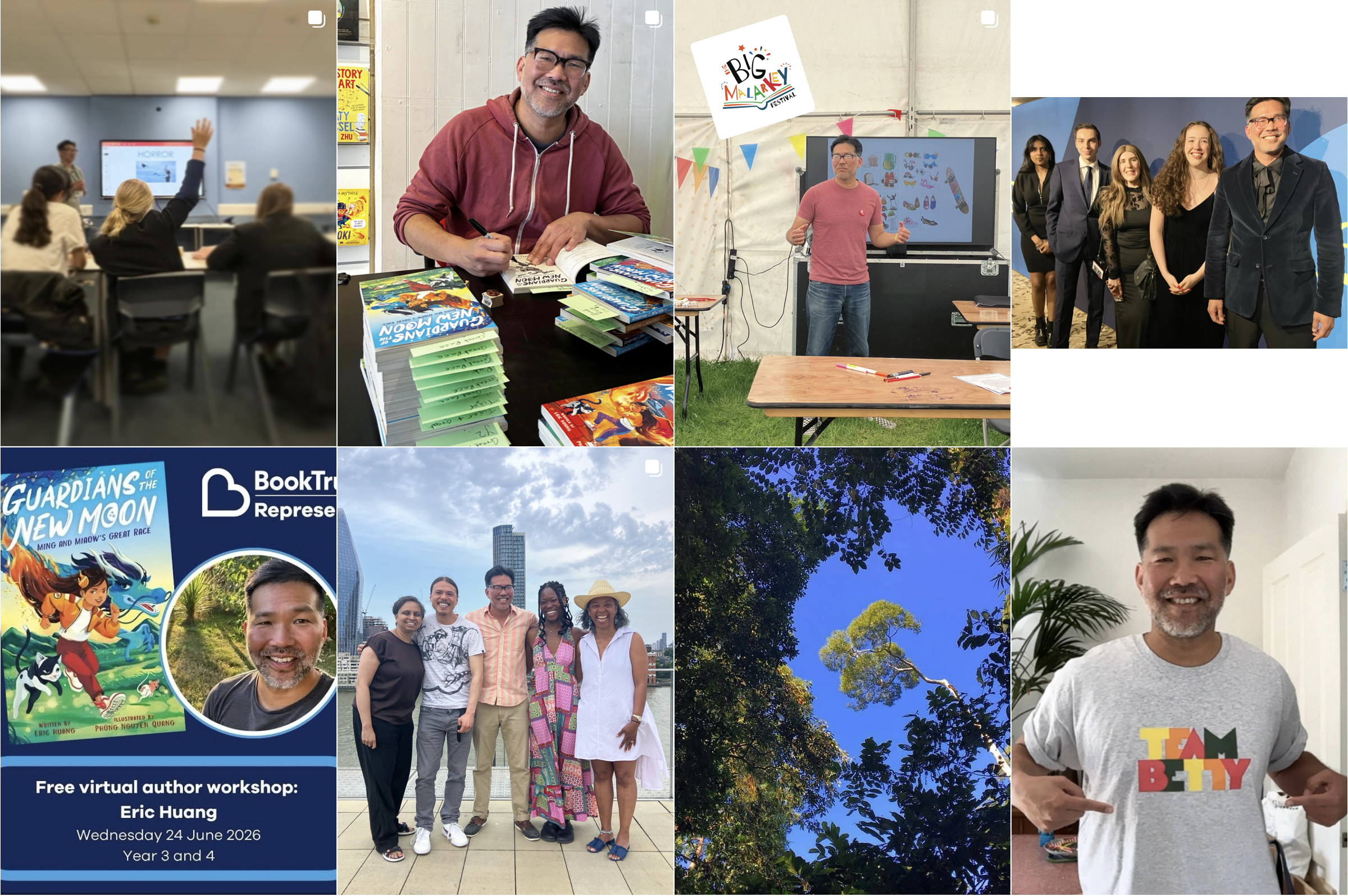
You do have to think more about a distinct children’s author social media persona, though. The caregivers who follow you—and the young people they allow to access your feed—might not react well to photos from a night out, snaps from a holiday, or anything that isn’t about your books and the person they perceive you to be. I’ve started a new Instagram account (@erichuangbooks – see image above)) which is book-related with personal photos that are relevant to what I write about and who I am when I run workshops at schools, libraries, etc..
My question is related to the rather frightening outspokenness of the right wing and related book bans. How is this impacting kidlit publishing? Are publishers more reluctant to entertain books with queer or POC characters? And how can authors wanting to write authentic and inclusive characters and storylines in kidlit fight back against this?
Publishers and booksellers are overwhelmingly supportive of queer and POC characters and writers. Many are actively commissioning books that represent these communities. There are issues, of course, but most everyone I’ve encountered is well-meaning—even if sometimes misguided.
The more challenging part is the public. In 18 months of events at schools, libraries, literary festivals, and bookshops, the only issues I’ve faced as a queer writer of colour have been from parents objecting either to a gay man visiting a school or to my books not being British enough, whatever that means.
People working in schools, libraries, festivals, and bookshops have been incredibly supportive. Fellow authors have been great, too. Your first discriminatory complaint from an angry parent is a sort of levelling-up these days.
Read previous columns
Ask an expert
- June 2026: Writing asexual characters, with Lexy Hudson
- May 2026: Subgenres of Sci-Fi, Fantasy and Horror, with Tiffani Angus and Val Nolan
- April 2026: Staying creative while life happens around you, with Shona Kinsella
- March 2026: Writing comedy and being funny, with Richard Sparks
- February 2026: Writing romance, with PS Livingstone
- January 2026: Writing TTRPGs and working with existing IP, with Alasdair Stuart
- December 2025: Creative coaching, with Dr Rachel Knightley
- November 2025: Crowdfunding, with Fio Trethewey and Georgia Cook of The Holmwood Foundation
- October 2025: Creating darkness, with Daniel Willcocks
- September 2025: Working with book bloggers, with Kayleigh Dobbs of Happy Goat Horror
- August 2025: Websites for creatives, with E.M. Faulds
- July 2025: Anthologies, with Dan Coxon
- June 2025: Self-publishing, with AK Faulkner
- May 2025: Indie presses, with Black Shuck Books’ Steve J Shaw
- April 2025: Being a traditionally-published author with Adrian Tchaikovsky
- March 2025: SFFH artwork with Jenni Coutts
Ask an agent, with Laura Bennett: