The shortlisted works across all 13 categories of the British Fantasy Awards have been announced! Find out who’s in the mix over on our blog. Winners announced at Fantasycon in October.

For all things fantasy, horror, and speculative fiction
-
Announcement:
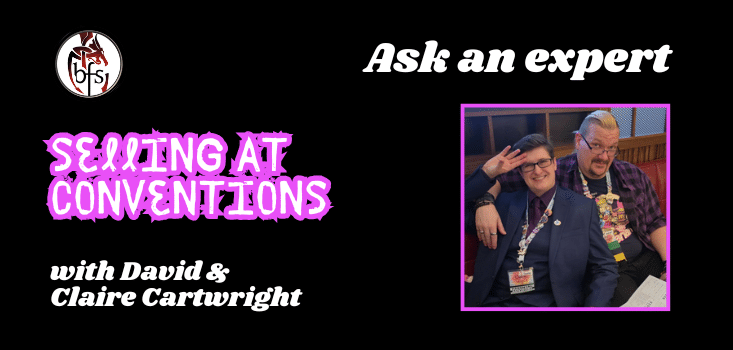
Ask an Expert: September 2026
In this monthly column, we pose your questions to an expert in a specific field of speculative fiction and the wider ‘industry’. This month you wanted to know more about running a stall at conventions, so we asked con stalwarts David and Claire Cartwright to take your queries.
This month: Selling at conventions, with David & Claire Cartwright
Name: David Cartwright and Claire Cartwright
Specialism: Convention stalls and sales
Website: davidcartwriter.art.blog
Follow: BlueSky | Instagram
David Cartwright is a Hampshire-born author with an enduring love of fantasy, horror, humour, and flannel shirts. Born in 1981 into a golden age of Saturday Morning cartoons, David Cartwright grew up surrounded by fables and tales of morality. Such commentary, from tales of Camelot and Terry Pratchett, to George Romero’s Living Dead and Martha Wells Murderbot, influence his growing catalogue of work. Claire Cartwright started coming along to conventions in 2015 as a Steampunk milliner in the dealer’s room, and quickly found a warm and welcoming community, supportive of their eccentricities. The business did not survive Covid, but the sense of community did, and now Claire helps on the Con-running side of the conventions.

What has been your favourite con to attend?
Claire: Are we supposed to say FantasyCon…? I feel like we’re supposed to say Fantasycon… Fantasycon is brilliant, but it is difficult to pick sometimes.
Dave: Different conventions are great for different reasons. It’s hard to compare anything with the experience of a Worldcon; you get to meet so many different people from so many different places (and sell them your books).
Claire: You can broadly split them into Trade cons where everyone is there to buy or sell, or Industry cons where we are there for Programme and to spend time with friends in social spaces. You sell less at Industry cons, but they are so enjoyable to be a part of.
What has surprised you most about running a stall?
Dave: There is a lot that goes on behind the scenes. Logistics, insurance, building your stall’s identity. It isn’t just rocking up with a suitcase and throwing books out on the table; it takes a fair amount of planning and administration. Which I lean on Claire for…
Claire: I try to avoid surprises as a general rule! I am one of life’s planners. If I get surprised when I arrive somewhere then things have gone wrong.
What are your best and worst selling items?
Dave: Books.
Claire: Dave you can’t just say books… Ok all he sells are books, so he is technically right. It depends on the event. Some events everyone wants big chunky novels. Some events, all you can sell are short story books. Sometimes they are the same event on different years. You can rarely predict what the customer is going to want.
What else would you like to sell if it was feasible?
Dave: When you are starting out, you sell your books. As you gain recognition then you will have more books, and you start broadening into merchandise. Ultimately what you want to sell, if it’s feasible, are the TV and movie rights to your stories! I probably wouldn’t want to do that at my stall though.
Do you have any favourite experiences from running a stall?
Claire: Oh yeah, that moment when one customer sees something you are selling and makes high-pitched noises because it was exactly what they wanted and never knew they wanted. I have had some great experiences pairing hats with people who did not know that they would ever want a hat until they saw it. Also hat pins to children, which led to a hastily written disclaimer.
Dave: I sold my first trilogy to a couple of German customers at Dublin Worldcon. The next morning, they came back and I thought they were going to tell me they didn’t like it. Instead, they said ‘last night we had to make a choice, to sleep or to read more of your books. Today we are very tired.’ That was a nice feeling.
What have been your least favourite experiences?
Claire: You get the occasional, shall we say Strange customer, who doesn’t seem to be operating on the same plane of existence that you are. Sometimes they try to argue with you, and it doesn’t really matter what you are saying because they are responding to something different anyway… You have to smile and be kind and try not to wind them up.
Dave: I have had to chase people off who were espousing bigotry at my stall. They thought post-apoc meant right-wing. Beyond that, sometimes you’ll finish the sales pitch, and the customer will say something disparaging. Fine, if it’s not for you, don’t buy it, but there’s no need to tear down a person’s hundreds-plus hours of work.
What would you like paying customers to know in terms of approaching a stall to buy things?
Claire: That the person behind the stall is a person, not a vending machine. It doesn’t happen very often. Most customers are wonderful. Very occasionally you get someone who thinks ‘add to cart’.
Dave: As much as we love to see you, and spend time and chat, we are working. If another customer comes up, they are due as much of our attention as you are.
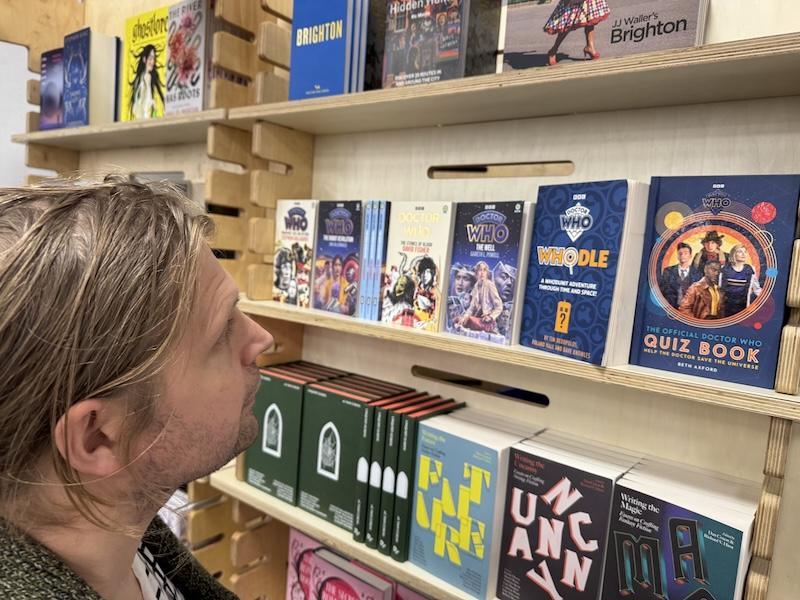
(Photo: Chris Hawton peruses the Doctor Who books on offer at a convention)
What are the best cons to attend in the UK and the ones to avoid?
Dave: You can never tell. We have had some wonderful cons; sometimes we have done brilliantly on a £30 table, and sometimes we’ve dropped hundreds on travel room and board and sold next to nothing. I would suggest, for someone starting out, the best way to avoid a low selling con is to look at the location and the travel links. City cons may be more expensive, but you will get better footfall than a picturesque village convention in the middle of nowhere.
Claire: It depends what you mean by best, really. If Best is in terms of sales, then What Dave Said. If Best is in terms of how you are treated as a trader, then I would advise joining some of the many trader groups there are on social media. There are some bad ones for the second reason. I am not going on record in writing as to what they are. Buy me a drink at the bar and I’ll tell you. I will not put it in writing then either.
How do you price your items?
Claire: Ok, I’m taking this one, I’m the family accountant. Shush Dave.
Dave: Hey!
Claire: You want your profits to meet your costs, but be aware that there is a ceiling price to what someone will pay for an item, particularly books. Look at what others are selling a similar sized book for. Then look at how much it costs you to print it. Then add in your overheads—this is the cover art, the freebies, the table cost of attending. Price to break even, then add a little. If you are selling items you have made—i.e. crochet, artwork—then price for your materials, then price for your time. Do not short-change yourself on your time or your skill. I used to charge my work at £10 an hour when I was selling hats, and that was years ago.
How do you decide how many items of stock to take? Number of books?
Dave: I think about what is going to look good on the table, in my display, and make sure I have copies spare to restock following sales. If I am selling a series, I take four times as many of book 1 as the others, and if there’s a new instalment I take more of those as well.
Claire: I have spoken to fellow traders at events, and some of them have only brought enough stock to make back the table cost. Why are you doing that? You want some profit, you want the time you are spending selling to have a value! If you are limited by carry capacity, try to bring enough to be in profit.
This probably ties into the ‘how do you decide how many books to take?’ question, but any tips for the logistics of how to handle getting books to a con when you don’t have a car? (This is 100% my main hurdle when it comes to events!)
Claire: I know a number of traders who do this, so the expert tip is a pull-along hard shell lightweight suitcase. You pack it inside with bubble wrap or fabric to stop your edges getting damaged. You can take a lot of books in a decent sized suitcase. It’s how we got our stock on a plane to Eastercon Belfast. You can even get your flatpack stall decoration stuff into it alongside your books.
What payment methods do you use to sell?
Dave: Paypal point of sale on my phone. I used to use a Zettle reader, until Paypal bought the company and made the readers obsolete. There is literally no reason to have an extra piece of technology unless you are running a multi-person business and need to take your phone away.
Claire: Cash is always nice. Change is a pain in the arse these days because you can’t maintain a float easily. But a handful of tens and fives is a handy thing to have for when someone wants to pay with a twenty.
Dave: This is why I always joke that the book costs £14.99 and the signature is a penny, so that I don’t have to carry 1ps!
Any top tips for decorating your stall and attracting customers?
Claire: Be different. Try to look different to other stalls. Dave has a signature tablecloth that looks like nothing ever seen in a hotel.
Dave: Be prepared for people to want to buy your decorations. I have stall mascots for each book and some events people only want to buy the mascot…
Are freebees like bookmarks and stickers worth it? Like if you had socials and a QR code on the back of the bookmark?
Dave: Yes. Stickers and badges, especially wearables, can prompt conversation between customers. Someone sees a badge they like, they will ask ‘where did you get that’, and a conversation starts which might include the book. Bookmarks and business cards can provide physical visual prompts for people to look up stuff that they maybe didn’t pick up at the event. Very often I see online sales post-event.
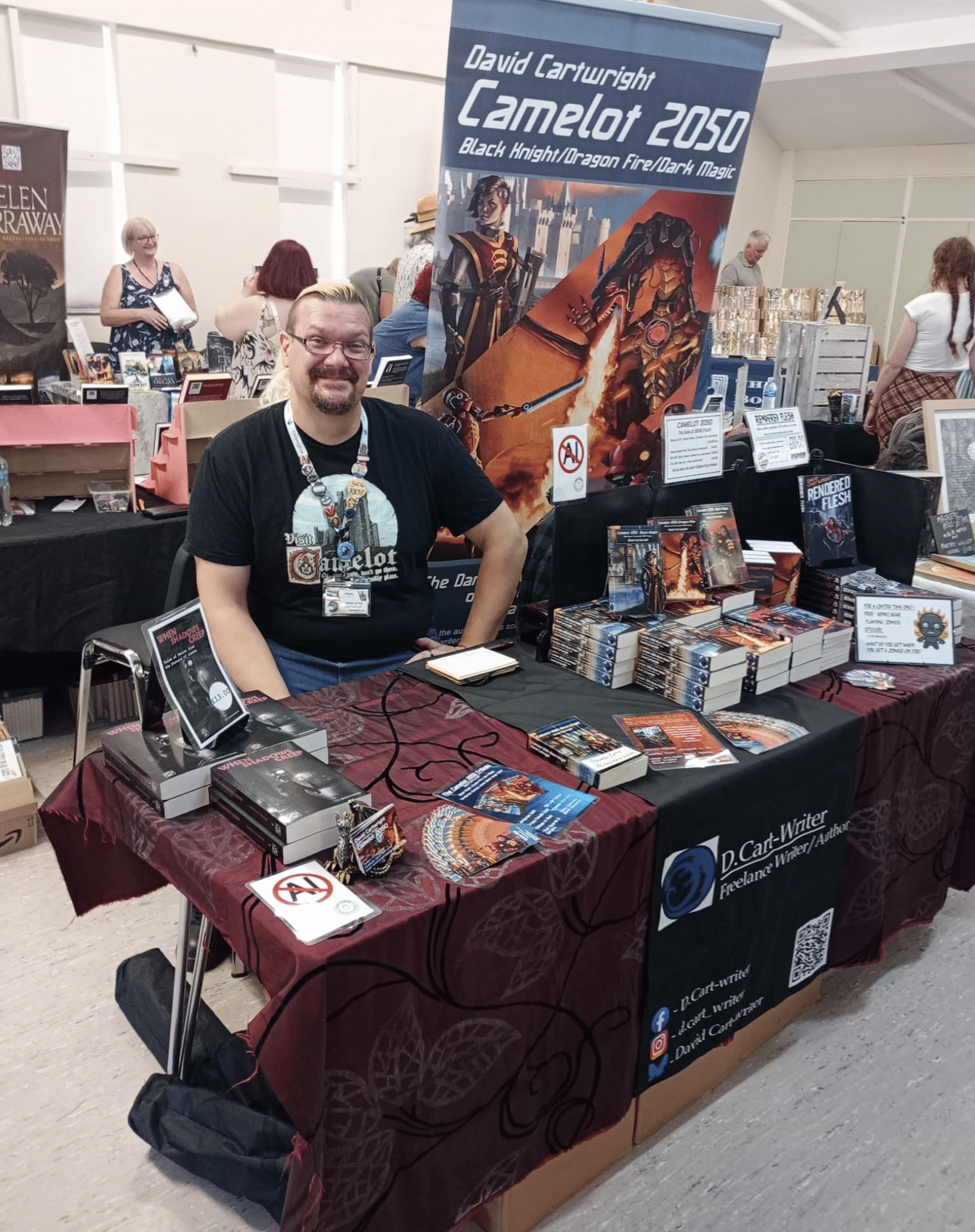
(Pictured: David’s stall at Sugar Pages Thornbury Book Fair last month)
Is it best to stay sat at the stall all day, or take breaks, or take quick walks? I feel like (if I ever get the chance to have a stall) I’d be constantly worried about missing potential customers while stretching my legs, but also I would definitely be in pain staying there the whole day and I’m not sure lying under the table helps much…
Dave: Having a partner is very very useful. However, at a lot of events where there are panels and programme, you’ll find there’s an ebb and flow in foot traffic. You can use the ebb to grab coffee, use the facilities and stretch your legs, which you should definitely do to avoid pain.
Claire: Make friends. Ask those friends to watch for 5 minutes while you take a breather. You don’t have to do it alone. A lot of trade events allow you to bring a helper. Industry cons don’t, because it’s impossible to keep them out of programme and unfair to others who paid full price. It is work, and it is physical work. Do whatever you need to do to get through it. If that means you only trade for a few hours then pass off to a friend, then that’s the way to do it.
Dave: It goes without saying that con vendors are broadly very friendly and always willing to lend a hand.
Claire: That’s especially true at Industry cons; we are all in it together.
Thoughts on sharing a table with a fellow writer in order to help each other out with things like taking shifts, surviving the quiet moments, etc…?
Dave: I think it’s a great idea, and I’ve done it before. As you start building a catalogue of titles it might become less feasible for an independent, but as we said above, even if you are not sharing a table, you can usually find someone to watch yours. You will make friends in the room, even if you don’t talk to each other regularly except at events, because we have all been there.
Claire: It also helps to split costs sometimes.
What degree of the value of running a stall is in selling books on the day versus less tangible things such as making your brand visible, connecting with potential readers on a human level, seeing which covers and pitches people respond to, and just having a nice time chatting to other people who love spec fic?
Dave: Ok, this is why we classify our two different types of event. Trade events such as ComicCons, Book Bonanza, Sugar Pages etc, it’s largely about selling books, and in that way, face to face selling can be a lot more compelling than Facebook ads, which might not turn you any kind of profit. If you can convey your enthusiasm for your work to another person, you have a better chance of them buying it. The value of Industry conventions is about raising your profile, not just with readers but with agents and publishers and other writers. To be seen to be there, putting in the work, is very reassuring to those professionals.
Claire: Dave has a wonderful agent because I made him sing on karaoke at Fantasycon. I’m never not going to be smug about that. He had his first trad published novel because he was sat next to a publisher at Worldcon and sold them on his idea. If you go to an Industry event just to sell, and don’t engage with the social elements of the event, you are going to be disappointed. This is the point of an industry event.
For the avoidance of doubt:
- Industry event: Eastercon, Fantasycon, Bristolcon, Worldcon, Edge-lit.
- Trade event: MCM, Showmasters, Book Bonanza, Sugar Pages, Literary Escape Festival, Pascify, Megacon.
In conclusion
Dave: Getting out to events is a great way to build a readership, but you cannot guarantee that you’ll be in profit. All you can do is your research, talk to other vendors, and take your best shot. There are great communities out there who will help you do this. Vendors are not shy about our opinions! Come and talk to us.

Read previous columns
Ask an expert
- August 2026: Accounting for creatives, with Chris Pitsillides
- July 2026: Writing for children, with Eric Huang
- June 2026: Writing asexual characters, with Lexy Hudson
- May 2026: Subgenres of Sci-Fi, Fantasy and Horror, with Tiffani Angus and Val Nolan
- April 2026: Staying creative while life happens around you, with Shona Kinsella
- March 2026: Writing comedy and being funny, with Richard Sparks
- February 2026: Writing romance, with PS Livingstone
- January 2026: Writing TTRPGs and working with existing IP, with Alasdair Stuart
- December 2025: Creative coaching, with Dr Rachel Knightley
- November 2025: Crowdfunding, with Fio Trethewey and Georgia Cook of The Holmwood Foundation
- October 2025: Creating darkness, with Daniel Willcocks
- September 2025: Working with book bloggers, with Kayleigh Dobbs of Happy Goat Horror
- August 2025: Websites for creatives, with E.M. Faulds
- July 2025: Anthologies, with Dan Coxon
- June 2025: Self-publishing, with AK Faulkner
- May 2025: Indie presses, with Black Shuck Books’ Steve J Shaw
- April 2025: Being a traditionally-published author with Adrian Tchaikovsky
- March 2025: SFFH artwork with Jenni Coutts
Ask an agent, with Laura Bennett:
Leave a Reply