The shortlisted works across all 13 categories of the British Fantasy Awards have been announced! Find out who’s in the mix over on our blog. Winners announced at Fantasycon in October.

For all things fantasy, horror, and speculative fiction
-
Announcement:

Reinventing The World: The Impact of Clive Barker
As the BFS celebrates the return of Clive Barker to publishing, Matthew Palmer reminds the non-horror community that this legend is more than just Hellraiser.
“I have never liked the division between horror fiction and fantasy fiction and science fiction. There is a fantastique genre… in the sense that it explores something which is unlikely, to say the least – something which is an imagined thing… Now, in one sense, all authors reinvent the world, but some of us do it with more enthusiasm than others, with more desire to see the world shaped to our particular longings and anxieties. I do not consider myself a horror writer any more than I consider myself a fantasy writer or science fiction writer. I am a writer who works in my imagination. The only difference in the world in literature, it seems to me, is between the guy who writes out of a perceived reality and the guy who creates one for himself.”
Talking Terror With Clive Barker, by Douglas E. Winter, Rod Serling’s The Twilight Zone Magazine, Vol 7, No 2, June 1987

My mum handed me a copy of Weaveworld when I was around twelve years old. It’s safe to say that was far too early. I had burned through my primary school’s book collection but had fallen out of love with reading in the transition to high school. I’m sure that it had nothing to do with the books that were allowed in the library of the catholic school that I went to.
Weaveworld fascinated me, not just as a story, but as a beautiful object. It had a mesmerising original cover, patterned after the mystical carpet that the story revolves around. Icons depicting the events of the book surround a man on a snowy hill wreathed in flame. The contents of the book were shocking to my young teenage self, horrific, wonderous, sexual and heartfelt.
(Pictured above: author Matthew Palmer)
It was hard not to see myself in the male lead, Calhoun Mooney, torn between the wonderous world of the fey-like Seerkind that he has discovered and the mundane everyday life of caring for his aging father with a girlfriend who doesn’t understand him. There is a wonderful oddness to Cal, with clippings from newspapers plastered over his bedroom walls, a head full of poetry and train timetables. All these years later it’s all to easy to see him as Neurodivergent coded. How ahead of the game Barker was in that, like in so many things.
It wasn’t long before I fell upon the local library to devour all the other work by Barker that they had. Like the delirious Imagica, a masterpiece of modern fantasy, where a forger of fine art, a woman with a mysterious past and a genderfluid assassin cross between worlds to discover the truth about faith, God, and the true nature of reality. In those days it was not easy to find details of a writer’s personal life, so I wasn’t aware of Barkers open homosexuality. Even accounting for that, featuring a genderfluid love interest for your main character in 1991 was visionary.
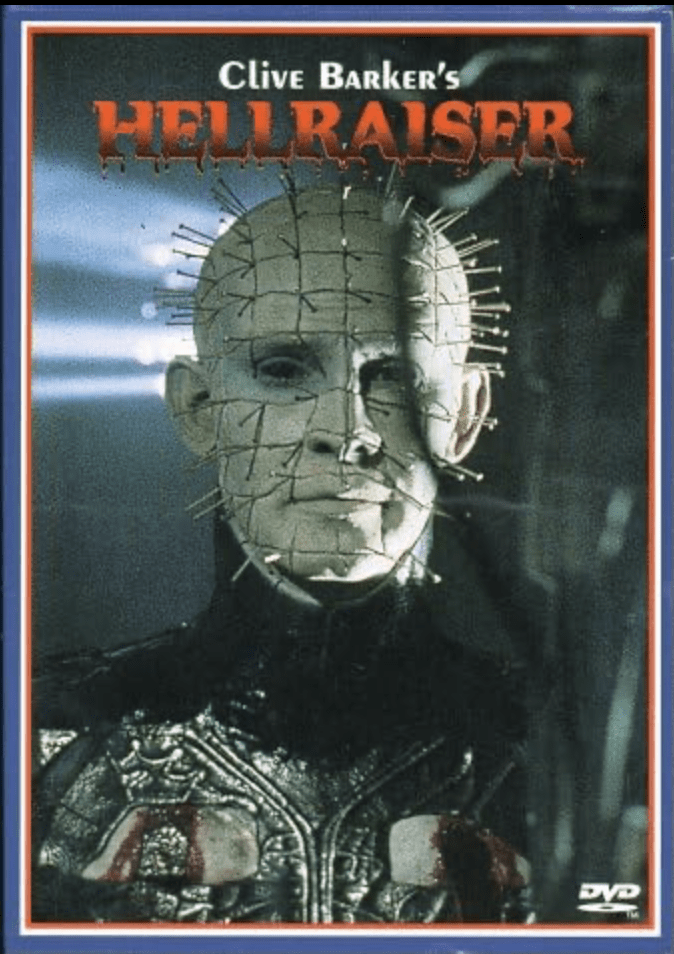
As I grew, I discovered just how much depth there is to Barker: he is a renaissance man of the imagination. I discovered his movies, the seminal Hellraiser, famous for its antagonist Pinhead (pictured), but which I remember more for the scene in which a dead body reassembles itself from the bones up in a brutally gory scene. Those special effects on a shoestring budget in 1987 still take my breath away. No CGI could ever compare.
As I grew, I became increasingly drawn to theatre, a way I could express my creativity. At the time, I believed that the written word was closed to me, given the trouble that I still have with grammar and spelling. Barker was there for me as well, in his two published volumes of plays: ‘Incarnations’ and ‘Forms of Heaven.’ As part of my A-levels, I designed a set and lighting for his ‘History of the Devil’ and discovered Barker’s visual art to guide me.
His work was a constant presence through my teenage years, and it left me with an ongoing love of his particular brand of fantasy. Barker’s work is not a fantasy of escapism; it is a fantasy of confrontation. The worlds presented through his stories stand sideways, not only to reality, but to established genre fiction. There are not vampires, werewolves and demons, at least not traditional ones, but Seerkind, Cenobites, Nullianacs and the inconceivable horrors of the Iad Uroborus.
Despite the monstrous looking creatures that Barker is best known for, it is worth noting that most of the antagonists of his stories are decidedly human, from the callous salesman Shadwell of weavworld to the magic supressing Tabula Rasa society in Imajica and the vicious pairing of Judith and Frank in Hellraiser.
A core theme of Barker’s work is questioning established reality.
The reality around us, and the reality of ourselves. His character’s journeys are ones of enlightenment, where tearing down the illusions that we have built around ourselves proves the key healing the self and healing the wounded world around us.
It was only natural that Barker’s influence would come through in my own writing. I feel his influence in the contemporary setting of my current series. I can also see his influence on Beryl, my abrasive gender fluid punk of a mage. They have a lot of Pie’oh’pah in their DNA, both have magical bodies allowing their appearances to shift, though Beryl’s magic is far slower and more personal than Pie’s and bound to their own desires rather than other peoples.
That is not to say that Barker’s output has been without reproach. His bibliography is littered with unfinished series like ‘The Books of the Art’ and ‘The Books of Abarat.’ We have been waiting even longer than fans of GRRM for the continuation of those stories. In general, there has been a drought of new literary work from Barker, his last published work was 2014.
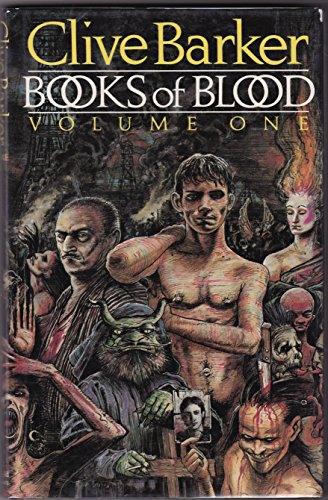
This month, that changes, as Barker has launched a kickstarter for three brand new short story collections, ‘The Library of the Dead.’ This calls back to his first published works, the Books of Blood. These were the home of such stories as ‘The Midnight Meat Train’, ‘In the Hills, the Cities’ and my personal favourite, ‘The Yattering and Jack’, where Barker tells an unexpectedly humorous tale of seasonal demonic haunting.
It seems oddly fitting that this should happen when my own kids are the same age that I was when I discovered Barker for the first time. I won’t be recommending his work to them directly, but I certainly won’t stop them reading if they are interested. The world has changed so much since Barker has been away. I can’t wait to see how he confronts the modern world in these stories, and the new realities that Barker will construct for us to explore.
Meet the guest poster