
In this monthly column, we pose your questions to an expert in a specific field of speculative fiction and the wider ‘industry’. This month, we asked the multi-talented Alasdair Stuart to field your questions about tabletop gaming and working with existing intellectual properties. This one is a mega edition, so strap yourselves in…
This month: Writing TTRPGs and working with existing I.P, with Alasdair Stuart
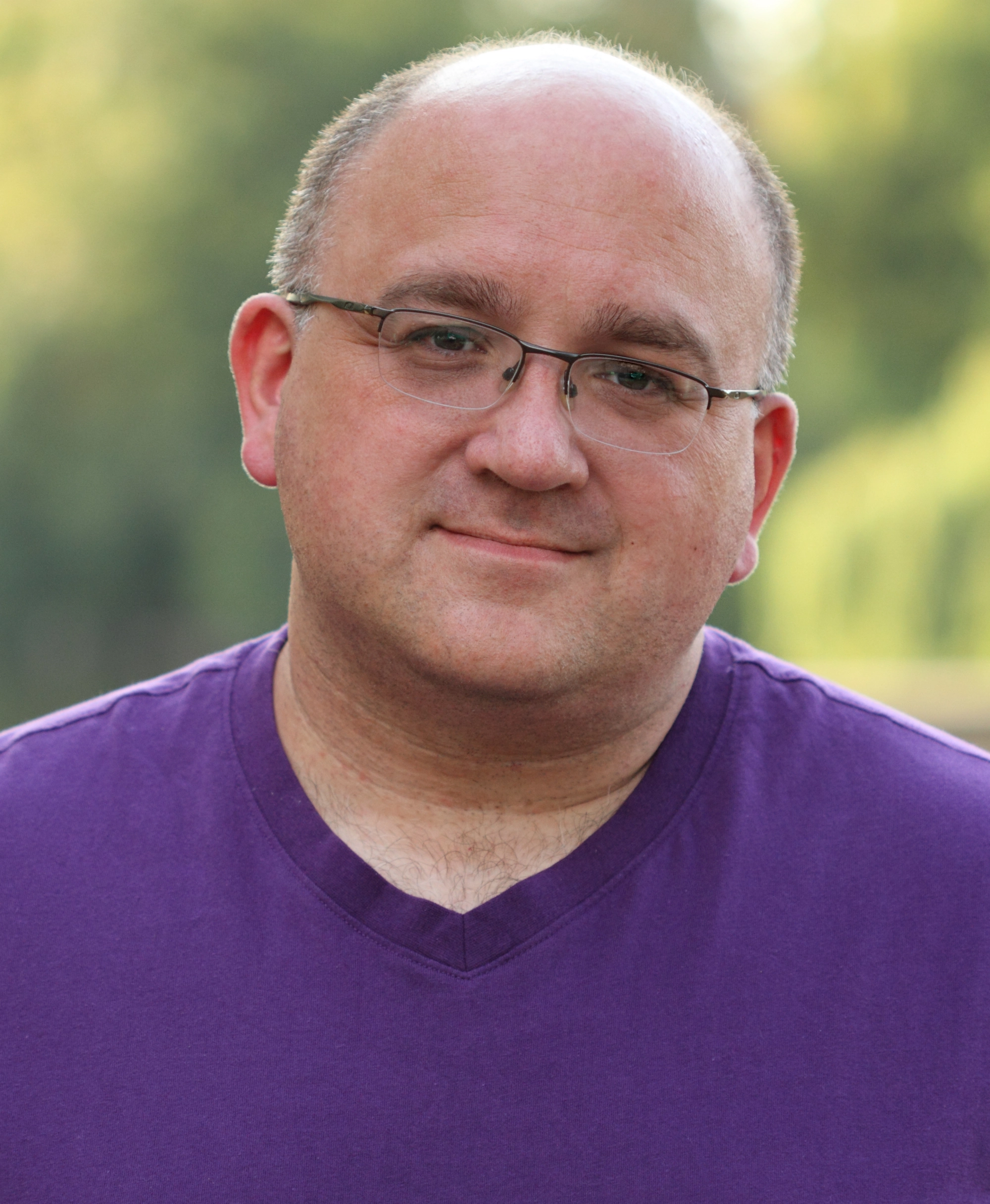
Name: Alasdair Stuart
Website: alasdairstuart.com
Specialism: (For this month, at least!) creating and working with tabletop gaming and existing I.P.
Follow: Instagram | BlueSky | Twitch
Photo: ©Edge Portraits 2019
Alasdair Stuart is a professional enthusiast, pop culture analyst, writer and voice actor. He is a multiple Hugo Award finalists including Best Fan Writer, a British Fantasy Society Best Non-fiction finalist for his weekly pop culture newsletter The Full Lid, and won multiple Audioverse Awards for his voice acting, including Roguemaker, Re: Dracula, Super Suits, The Magnus Archives and Among the Stacks.
He writes regularly for Sarah Gailey’s Stone Soupe and has written nonfiction for numerous genre and pop culture venues, including regular appearances at the Hugo Award-winning Ditch Diggers and for Fox Spirit Books. His game writing includes work for Star Trek, Chill, ENie-nominated work on the Doctor Who RPG, and After The War co-created with Jason Pitre of Genesis of Legend.
He serves on the board of the non-profit Escape Artists Foundation, along with being lead host of their horror podcast, PseudoPod. He’s also a regular on their science fiction podcast, Escape Pod, where he’s celebrating the show’s 20th birthday with a series of flashbacks to some of the ‘big number’ stories of the Pod’s voyage to date. He is a frequent guest and presenter on podcasts, with voice acting credits including Red Valley, Shadows at the Door, The Secret of St. Kilda, and The Magnus Archives.
Alasdair’s most recent longform work is ‘Brasso’s War’, an essay for the first volume of Andor Analysed, a series discussing Andor through the lens of socialism and community organising. He’s written several books for the Black Archive collection of academic Doctor Who treatises by Obverse Books, including providing bookend pieces for their recent volume on Flux. He has two volumes of expanded essays from PseudoPod — as well as multiple short stories — available from Fox Spirit Books.
A frequent awards judge including the Arthur C. Clarke, The Kitschies, Brave New Words and the BFS, he blogs at www.alasdairstuart.com and posts photos of his cat on Bluesky.
On creating for TTRPGs
Is there any IP or series you WANT to make a TTRPG for, but haven’t had the chance to yet? And on the flip side, are there any TTRPGs or systems you think are fertile ground for some stories? As in a particularly interesting world/magic system or similar that you feel deserves some more in depth stories/lore.
Oh HELL yes. The old BBC show Star Cops hit me square between the eyes and I’d love to play around in that world (Either as an RPG or in the audio dramas they’ve released). So much potential there and Mongoose’s Pioneer looks set to at least play in a similar sandbox. I love that sub genre, not hard SF so much as near-ish future. Not the socialist utopia of Star Trek, awesome as it is, but stories set right in the middle of us trying to be better.
Regarding fertile ground for stories, I think we’re seeing a really interesting middle ground start to hit with Actual Play, live Actual Play shows like Critical Role, Three Black Halfings and Dimension 20 and further to that, the various animated CR spinoffs. I could absolutely see more stuff coming from that space out into other genre fiction fields too. My money is on either Never Stop Blowing Up or Cloudward Ho! from Dimension 20 being first…
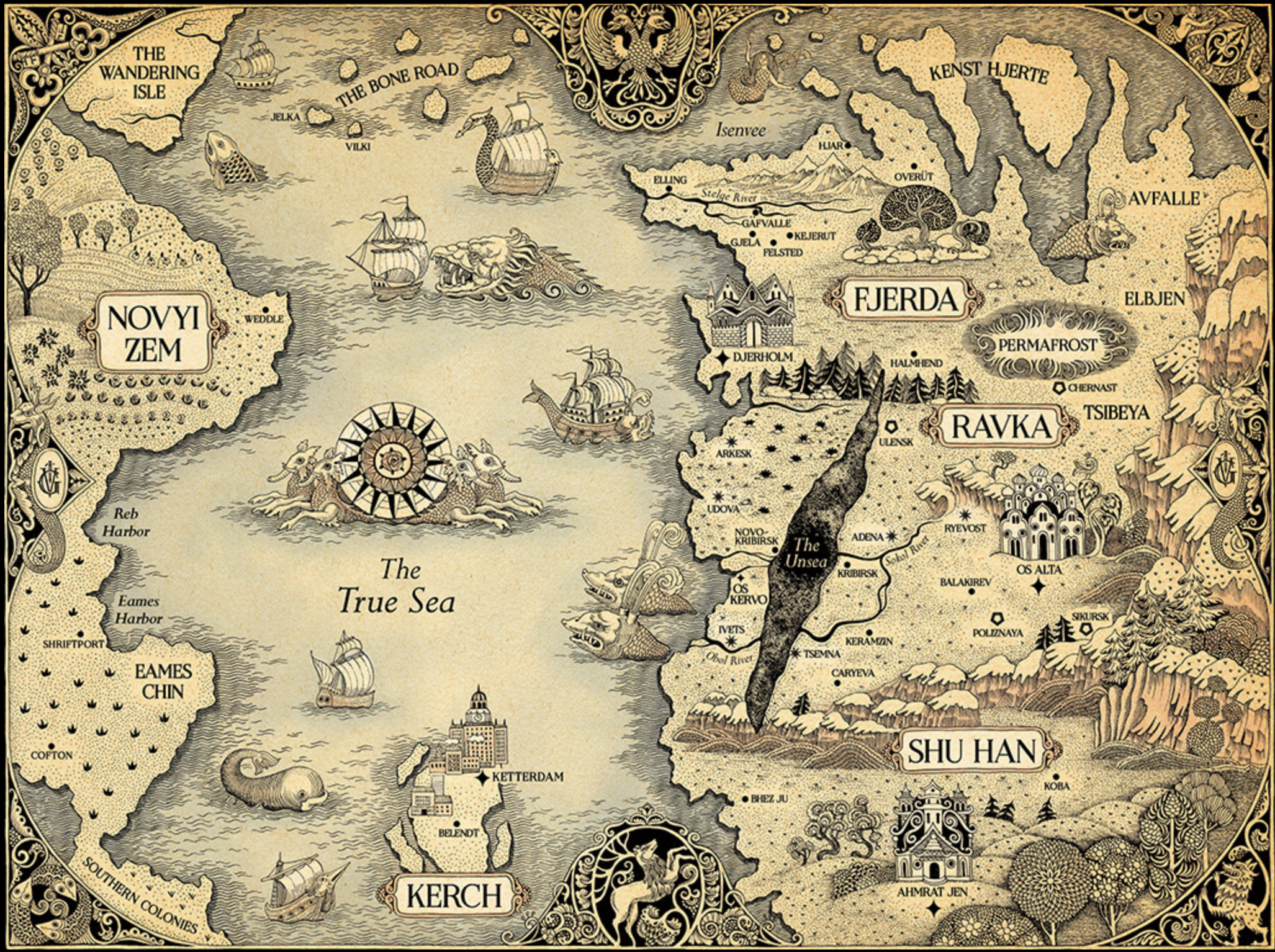
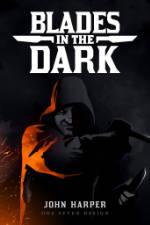
As for magic systems, I’m stunned there isn’t a Grishaverse game because that’s my favourite magic system. I’d love to help out with one, although I’m guessing Blades in the Dark has at least homebrew take on it. Oh hey, here you go!
Writing a TTRPG seems like such an enormous undertaking. Where do you start? How do you wrestle all of that into some semblance of order?
A lot of it comes down to division of labour. What I do tends to be called Narrative Design or Lore. I write the background of the world, or a location, or a group and the rules are done by a different designer. And honestly inside that is the key to getting it done: either in a team or one piece at a time if you’re flying solo.
Also, like everything, the best way to start is the way you work best. I had a very intensive (and entirely accidental) five or six year period where I was what’s called ‘A Forever DM’ meaning I was usually running something. By the time I got to University it was basically a second job, running 3 or 4 nights a week. That gets you very good at iterating very fast, and in my case that melded with the degree work I was doing, and my stage magic training, to mean I got very good at breaking a story down into usable parts. The old Val Kilmer movie version of The Saint for example, got strip mined for like six weeks worth of adventures:)
So basically, you gravitate towards what works for you, and the brilliant thing about the field right now is it embraces that idea and the power of doing what you can instead of trying to do everything. There’s a SciFi game called Mothership that’s immensely successful at least partially because the adventures for it are all written to be in unusual formats. I’ve seen Mothership modules on bookmarks for example and most are in trifold leaflets. Using an established rules system, and a format like that, forces you to avoid scope creep and makes the job easier. Or at least different in a fun way:)
I haven’t played a TTRPG since the early 90s, but I still read and occasionally buy them (and I know at least a couple of other people who do the same). As books, I find they can offer a sense of immersion in another world that’s complementary to the kind that I get from reading prose fiction. Is that an experience you can relate to, and is that an audience you’re conscious of when you’re working on a TTRPG or supplement?
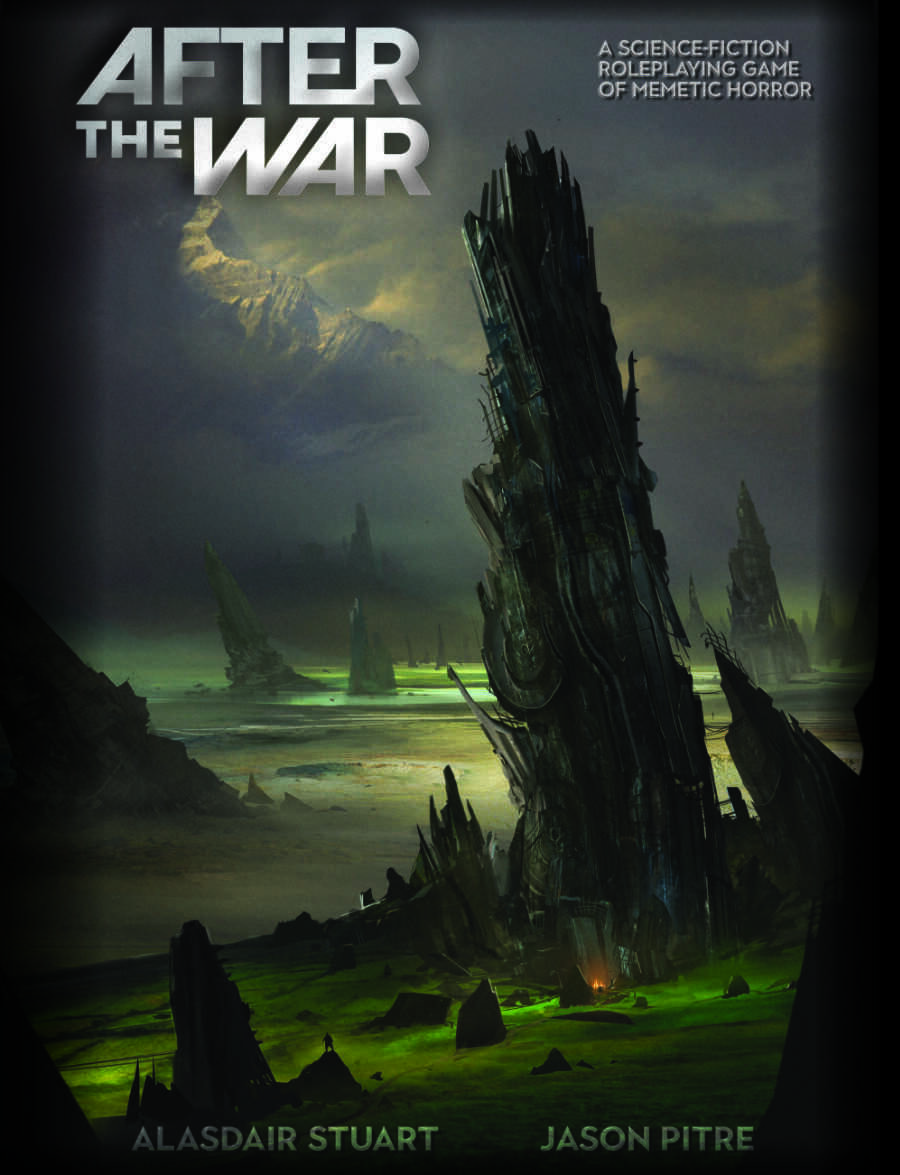
EXCELLENT point. That’s an audience I always keep in mind because that audience is usually me. I’m here for the stories, and the rules come second, which isn’t to say they aren’t vital (They are!) but they’re not my focus. When I co created After the War with my buddy Jason Pitre, we worked on this question a lot. The way we ended up doing it was presenting the entire game as a collection of testimonies from the last great galactic war. So you’d hear from survivors from every race, and a particular NPC would write the sections about aliens, that kind of thing. It was GREAT fun to do, and got me to drop a joke that made Jason spittake halfway around the world and it really helped with immersion too. For me as well:)
How do you deal with representing canon within a product that, by definition, is going to be used to produce non-canonical stories with the world? How does this differ if you’re building on previous work within the RPG itself – such as taking into account the possible endings of another scenario, etc.
I always treat it like the way the Pirates in the Pirates of the Carribbean treat the code. More a set of Guidelines:) Or more specifically, guide rails.
Let me give you an example. One of the Doctor Who modules I did was for the Silurian Age sourcebook. I like the Silurians a lot and they’ve got a really fun background. I pitched an adventure centred on that called Asteroid Day, set on the exact day the asteroid that wipes the dinosaurs out hits the Earth, and throws your players into a Silurian political scandal as the evacuation to the underground cities begins. So that basic idea gave me these toys to play with:
- Silurians
- Dinosaurs
- Ticking clock
- Established Silurian technology
The adventure starts outside with the Doctor (Or other Time Lord), saving a Silurian family from an attack by a terrified dinosaur. As the adventure goes on, they’re dragged into the evacuation, find out the ‘attack’ was a failed assassination and get to help out while also coming to terms with the fact they can’t stop the asteroid, they can just ‘scribble in the margins of history’ and help where they can.
That’s one of the major themes of the show, expressed in a couple of action scenes, some exploration and a little investigation. I can’t, and shouldn’t, legislate for what a group will do but I can provide the GM with solutions for their most likely courses of action. Those solutions map pretty neatly onto the guide rails I mentioned but still give the players and DM a lot of freedom to solve problems their own way.
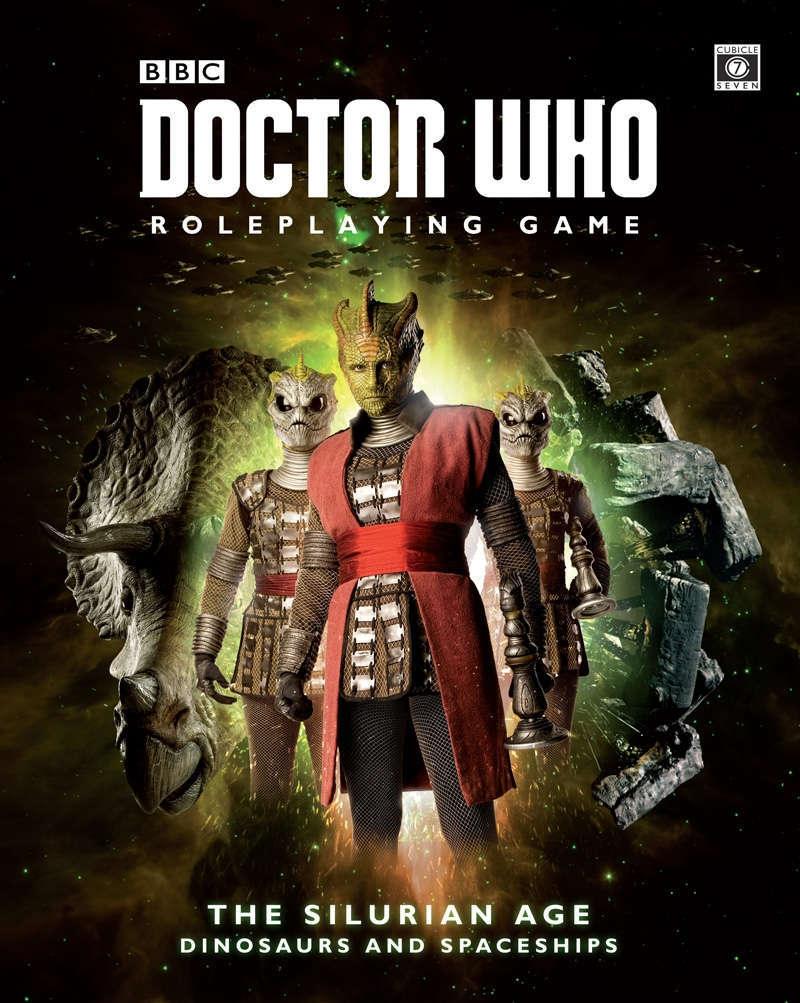
Although, full disclosure, I did pitch the idea of the Silurian child saved in the first scene being the future Madam Vastra and her two dads and was politely told ‘no thank you’. Given how much Vastra showed up in the season after this saw print I get why:)
The follow up is a great question! And surprisingly, the answer is ‘not that much’ for the most part. On a micro scale, an individual module worth its salt is written on the understanding that every DM who plays it is going to pop the hood and tinker around to make it work for them, so I make a point of having multiple entry and exit possibilities.
A big part of that is consequences. One of the other modules I did involved a UNIT time machine in the British Museum and I got to pencil in some fun stuff about possible future uses for it. Likewise, the first module I did had a Judoon obsessed with radio comedy who ended up as a UNIT liaison and he got referenced loosely a couple of times elsewhere. Really, it comes down to giving the GM options, and trusting them to use what you’ve written in a way that works for them. We’ll talk more about that mindset in a bit too.
Which TTRPG writer has had the biggest impact on how you write scenarios, and how did they influence your writing?
All of them. I try and learn from everything I interact with and there’s not a game, module, sourcebook or Actual Play show I haven’t taken something away from. Like GM and scriptwriter John Rogers likes to say, you read every writing process book because there’s always 1% of stuff you didn’t know. Always something new to try or a new way to approach it.
In specifics, I’d say Jason Pitre, Jacqueline Bryk, Marcus L. Rowland and Gareth Hanrahan have all had massive impacts on how I work. They’re all community focused, inclusive folks with wickedly perceptive and entirely different approaches. Go check their work out, it’s great.
Writing for IP in a freeform medium such as TTRPGs can be an arduous process. How do you maintain the players’ agency while preventing the IPs from changing radically by the end of the scenario? Leaving the IP as you found it, as it were.
That’s a great question! And a lot of it comes down to three things:
- Setting expectations
- No glass corridors
- Controlling scope creep.
The first is something you set in session zero. I talk about session zero a bit later but for now think of this question:
Are you playing a game to beat your players? Or are you telling a story?
(Photo by Dan Horgan on Unsplash)
If it’s the first, and there’s going to be an antagonistic energy to the game, you all need to know and agree to that upfront. If it’s the second, great, now you talk about what issues you want to explore, what you don’t, where everyone’s lines are, what lethality level you want to set for the campaign and so on. Basically, you and your players chat, talk about what characters you want, the tone and plot and where you’d like all this to go. Let’s take Doctor Who as an example, and assume you have a player who wants to be the (by my count fifth) person to destroy Gallifrey.
If that fits with what the other players, and you, want, then there’s no reason you shouldn’t do it. The Doctor thought they had at one point, and there’s a lot of fun potential in exploring why a character would want to do that. If they want to do it just to see the world burn, and no one else does (Including you)? Then they don’t get to do that, and if they aren’t okay with that you need to talk about if they’re going to work as a player in the group at all.
If not, that’s fine. Not everything is for everybody and that’s brilliant. But that session zero is designed to be helpful, and honest and allow for potential problems like this to manifest. The only bad choice here is deciding to go ahead with a player directly antagonistic to the rest of the group and them not being okay with it. This is a team sport, and collaboration is a compromise. Make sure you’re not compromising what the majority want for a loud single voice.
No glass corridors next. ‘Glass corridor’ is a design term for adventures where players can see lots of options but are locked into a single one. It’s bad design, but it’s also very easy to design and play and there’s a separate conversation to be had about how sometimes you just want to play a dungeon with a chest full of treasure at the end.
Instead of glass corridors, think about clocks. Blades in the Dark, one of the most influential systems of the modern era, uses ‘progress clocks’, basically circular pie diagrams you colour in whenever a set objective is hit. Once all the objectives are hit, you’re onto the next scene. That way your players can mess around as much as they want (And they will), but the plot structure is still there and still pushing forwards. A lot of Call of Cthulhu scenarios, for a while, used timetables in the same way. Things happen regardless of whether or not your players hit their marks and if the bad guys’ to-do list gets filled out then that’s a whole new, fun set of problems.
So let’s say you’ve got a game where a player is going to destroy Gallifrey. What if that’s the only way to stop a rogue Time Lord intent on living forever by stealing every regeneration on the planet. Let’s say this guy has been active on Gallifrey for millennia, and that a solid third of the population are versions of him.
Now let’s say those incarnations don’t all know who they are, and the campaign is about discovering them and helping the ones who don’t want to be evil. The big finish could be the players working with the Gallifreyan High Council, all set to finally solve the problem and then…
Discovering the entire council are incarnations of this Time Lord and the players’ actions have inadvertently activated their memories.
Depending on how you rig it, the players could have a chance at talking them down and saving the day. But if they fail, then the entirety of Time Lord culture is on the verge of being one, crazed religious fanatic waging a war against the only thing older than him, the universe. Unless the players do the unthinkable…
So you end up where you all want to be but there’s a chance of multiple outcomes, all interesting, all fun, and all agreed by everyone.
Finally, Scope Creep is one of those things that every group has. It’s not a solvable problem, look at recent Dimension20 season Cloudward Ho! for some major examples, it’s just something you work with. Your players will adopt weird NPCs, they will make wild choices. They will hijack the bad guys’ ship and sell it back to them. You can prepare for the shape of that but not the specifics. And you prepare for that by everything above and being prepared to steer things back on track if needed.
Let’s go back to our Time Lord hivemind. Maybe the players don’t quite succeed in talking them down but not every new Time Lord becomes a new version of the bad guy. What if some of those newly activated bad guys decide to win the Time War early, by going back and striking decisively at the Daleks?
Instantly you’ve got two to four fun extra modules, and potentially a massive change to your campaign. You chase them back, encounter the new timeline, discover that here Gallifrey lives but at the expense of individuality and goes on to conquer the universe itself. Maybe throw an evil version of the Doctor in there for good measure. It’s a fun idea but it’s a lot of work for you and a lot of change for your players so…talk to them about it. Explain this is where the game’s going, check to see if folks want that and if they do, great! And if they don’t, talk to them about what they do want.
The adversarial nature of TTRPGs that I grew up with, where the GM’s job was to ‘beat’ the players is bullshit. You have more fun together, you have more fun when you talk. So talk!
As for the IP itself? Your duty to that begins and ends with the group too. Play the game you want, not the game you think the studio would want you to. Plenty of ships in Starfleet, plenty of Time Lords on Gallifrey, lots of Rebel cells. All different, all worthy.
What’s the best advice you can offer to someone hoping to try and start writing for TTRPGs, either within an IP or their own settings?

I grew up an ocean crossing away from the UK and I don’t drink so the usual chestnut of ‘just show up to a convention and hang out’ never worked for me. Even putting aside the assumption of you having the money, it also assumes you don’t have to do the work to get noticed and that’s where a lot of the trouble we’re all currently in starts. Ask generative AI fanboys how much they’ve actually written versus how many ‘ideas’ they’ve had.
Here’s what did work for me.
(Photo by Annie Spratt on Unsplash)
- Work out what work you want to do. I don’t like rules design. I love lore design and adventure building. I want to do that, so that’s what I’ve been hired to do most regularly. It sounds really obvious but working on something fun means you’re going to do better work than working on something because you think you should.
- Does the system you want to write for have a third party license? If so, you can fill it out and sell your work! And that’s great! It also means you’re going to have to find an artist, work out funding and learn layout if you haven’t already. All fun, and all daunting. The good news is you are not the first person to want to do this. Chances are the system will have a discord, or a subreddit and folks there will have answers for you.
- A quick note about online interaction, courtesy of the original Roadhouse. Be nice. Don’t just rock up, ask your questions and leave. Engage with the community, read other people’s stuff.
- READ AND ACT WITHIN THE RULES OF THE COMMUNITY and spend time there. It’ll pay dividends for everyone, especially you.
- Most systems now have what’s called an SRD or System Reference Document. This is the rules, stripped of everything else. Find a system you want to write, find the SRD and get used to reading it a lot. That’s the spine of your work. Here’s the one for Critical Role’s Daggerheart system to give you an idea of what to expect.
- Some, but by no means all, games and communities post open calls. Orbital Blues Month is coming in May and it’s a great example of how indie companies are working with indie creators. Use opportunities like that both to structure your work and time, raise your profile and most importantly, build friends in the community.
- Talk about the work. Be less British if you are, because recalcitrance isn’t modesty, it’s just not believing you’re worth the time. You made a thing! That’s great! Talk about it! Pick whatever social media you’re doomscrolling, post links to your work, including buy links and schedule them, daily, two or three times. It will seem like too much. That means it’s almost enough.
Ask. I walked up to the Mongoose Publishing booth at MCM last year and got talking to them about their new system. I followed up a week or so later and I’m working on some entry pitches for another project for them. It’s not locked in by any means, but it’s a start. Again, be honest, be nice, be approachable and when you are hired, deliver on time. It’s amazing how far those qualities will get you.
What are your favourite TTRPG mechanics?
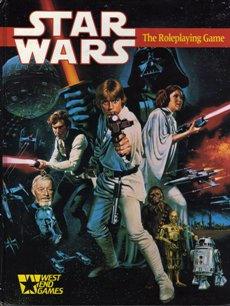
I’m really fond of two old mechanics. One’s from the West End Games, D6 powered Star Wars system and is a results table for how something is damaged. One result is ‘Broken, but will work if hit’ and that’s Star Wars to a tee. Shoot the door to lock, shoot the door to unlock it!
The other is from the first edition of Arthurian game Pendragon which has an Appearance stat. If you add lots of points to it, you’re handsome. If you don’t, you’re Darkly Handsome. LOVE that.
What’s the difference between table top and branching narrative story games?
Aside from one vitally important thing, very little. I use the same tools to design both, most notably clue trees. Here’s a really simple example of how I’d use it in a TTRPG:
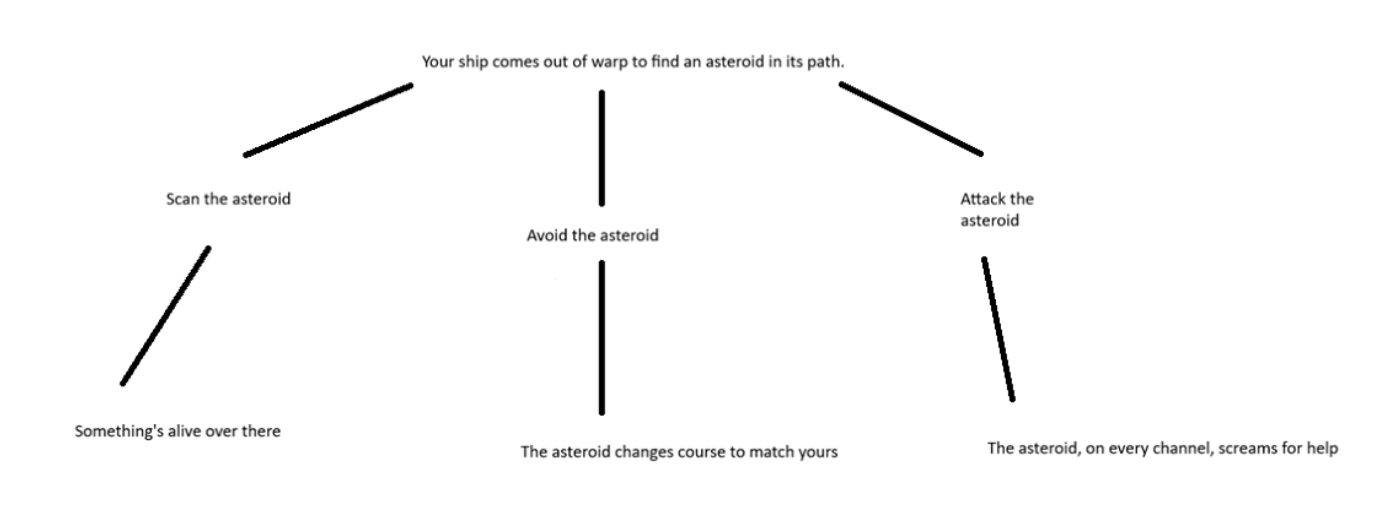
And here’s the top of July 32nd, the branching narrative game I’m working on:
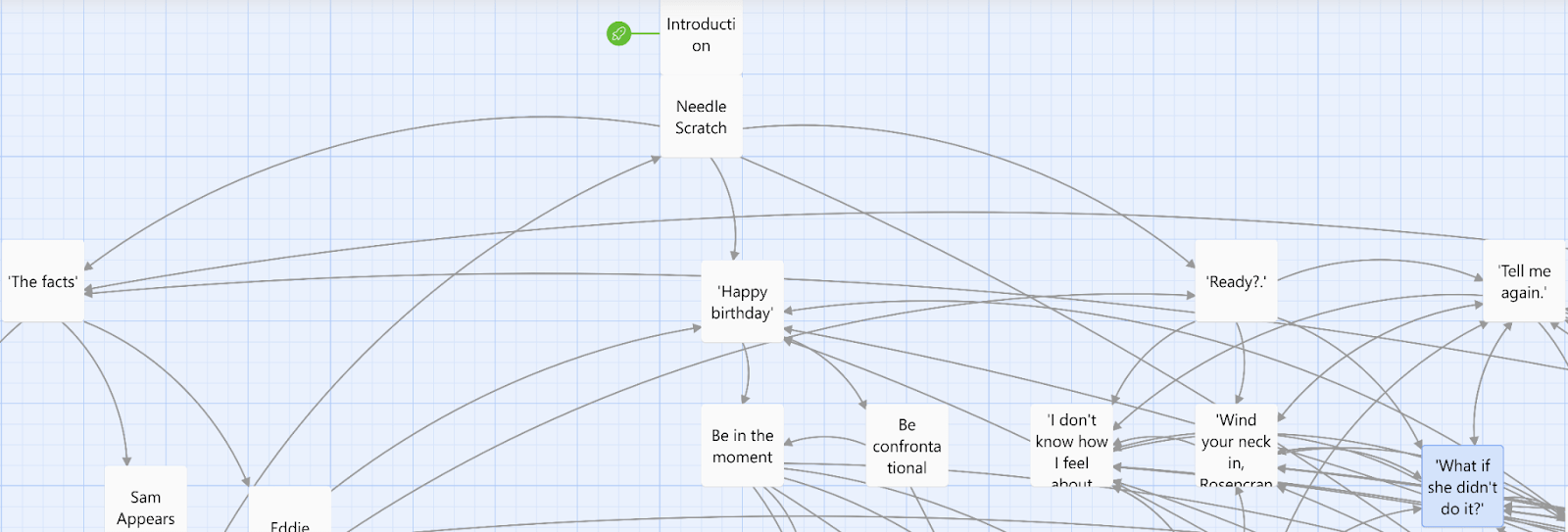
You can see how the boxes represent dialogue choices and those choices interact in different ways, meaning you can go back and forth between them and chart your own path within a set framework. That’s all on the designer and the player has agency but within very set parameters.
TTRPGs are different because a player can literally blow a hole in a wall and step through to a new area and you have to work out how to reflect that. The key to dealing with this is two-fold. Communication so everyone knows they’re on the same side, and planning for what happens when you get thrown a curveball anyway.
On the TTRPG ‘industry’
Which collaborations had the biggest impact on your TTRPG career, and how did you initiate them?
Jason Pitre changed my professional life. One of my other hats is podcasting and I’ve hosted PseudoPod, one of the first weekly horror podcasts for almost 18 (DEAR *GOD*) years. Jason was a fan, got talking, found out I was a gamer and we knocked around some ideas about working together.
The result was After the War. Set in a galaxy that narrowly avoided conquest by a piece of sentient alien music, it’s a game about building community after trauma, set on the last world left standing. It’s weird and sad and beautiful and hopeful and it took years to make. We’re so proud of it and it taught me so much about deep diving into world design, collaborating with big teams and crowdfunding.
Which system and setting have impressed you in the last few years?
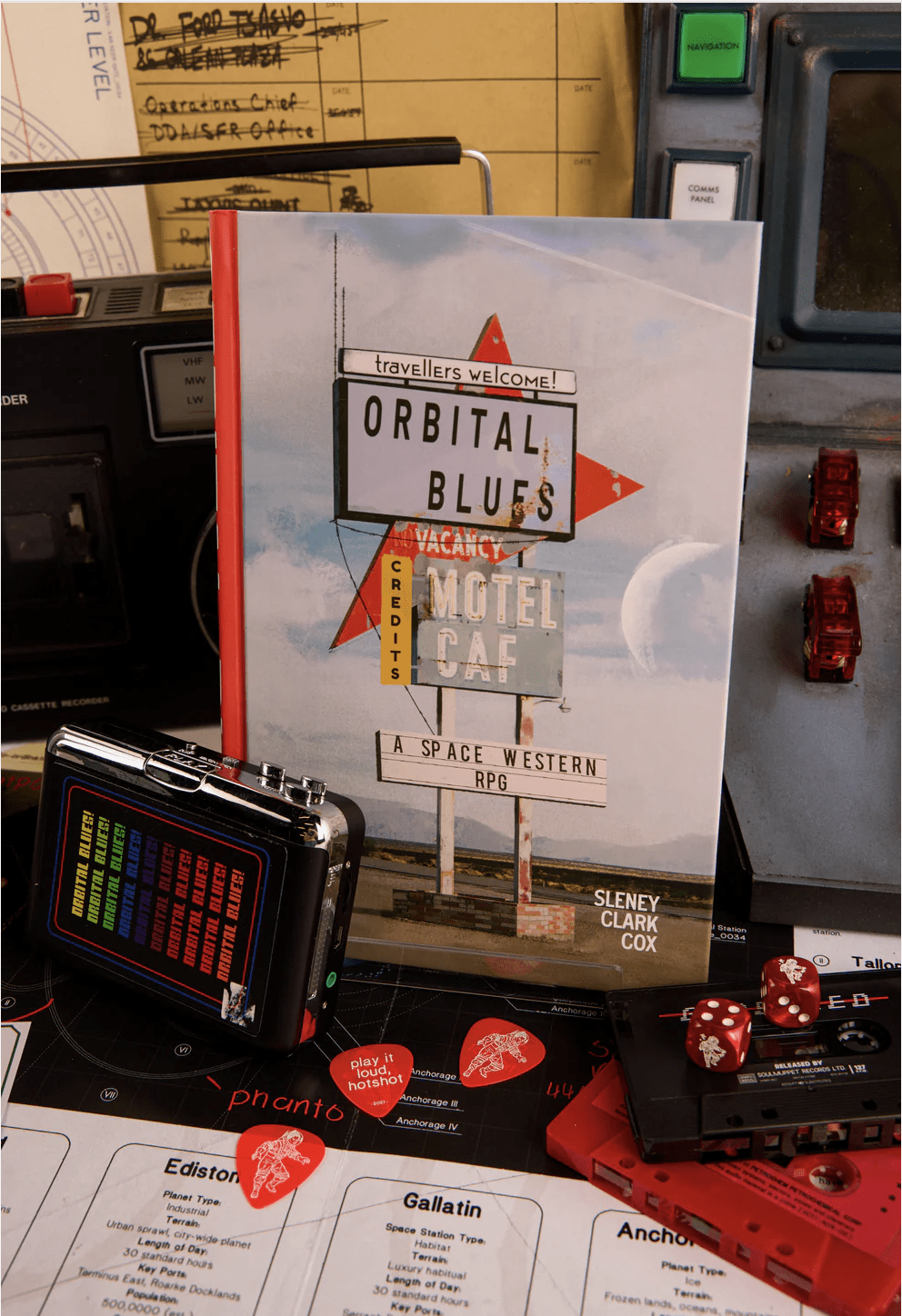
Everything GilaRPGs and Soul Muppet have put out. Gila do these fantastic, pamphlet RPGs that riff on video games like Destiny for SF and some excellent fantasy stuff too. I just bought their new one, Wyrm, that looks really fun. I had a lot of fun with Dusk too, and wrote a micro campaign for that last year called Beacon City 3.
Soulmuppet do jaw dropping work. Their Orbital Blues is a gorgeous design object and also an enormously fun game about sad cowboys in space dealing with trauma. One of the supplements is a series of small adventures in a VHS case. A VHS CASE. I’m stunned I haven’t already bought it.
Rowan, Rook and Decard are also incredible. Their one page RPGs are delirious sprints of invention and their long form stuff, especially Spire and Heart, are enormous fun. If you want to get a flavour of their work, check out this short, punchy, fun Actual Play produced by my friend Naomi Clarke.
Do the Ennie awards really matter?
Yeah absolutely! By which I mean they matter in the exact same way every award, and monetary system on Earth, matters; people believe they do. If you want to win one of those awards, it’s a great goal to work towards but not a long-term one. I’ve been a Hugo finalist, on and off, for almost a decade and the burning need to win one has very much been replaced with an awareness of how much being in that space costs emotionally and psychologically. Now I find joy in the work, and tremendous gratitude when I’m nominated. Changing ‘victory conditions’ like that means there’s always joy and catharsis in the exact way there isn’t in awards season.
From a business point of view, being a finalist or a winner is tremendous for your confidence and that’s something every creative on Earth needs more of. But I can’t say being a finalist or a winner is a concrete ‘prize’ it’s not. More an ambient seal of approval and long term reputation bonus, a +2 to Charisma rolls if you like:)
What’s your favourite convention for TTRPGs? And will you be at NecromoniCon in August?
Horrible confession time, I have not been to an RPG convention in years! I had a string of horrible convention (And everything else) professional experiences in 2019 that led to six months of burnout. I was very angry, very depressed, hated words and hated the thought of talking to other people about words. Then the lockdown hit and I just stopped going to anything for a very long time.
Escape Artists, the podcast company my partner and I are on the board of turns 20 this year so we’re doing a lot of conventions, after a soft return last year. It’s helped a lot, honestly, and while I still have both a measure of crowd anxiety (And some lovely masks now), and some gunshiness over interacting, I’ve had more positive experiences recently. Especially UKGE last year, that was great! And no, no plans for NecromoniCon right now I’m afraid.
On playing TTRPGs
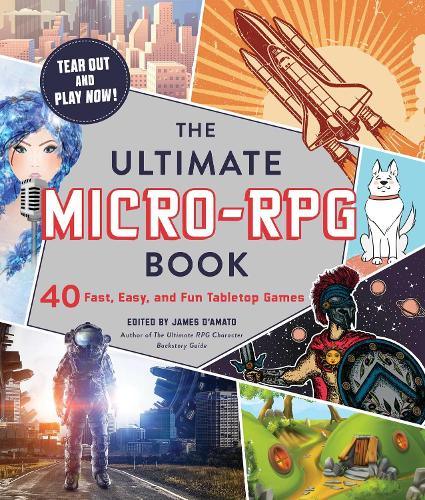
What TTRPGs would you recommend for someone who has only tried one or two?
Great question! The logical choice is D&D or Daggerheart, the new game from the folks behind Critical Role. But honestly, I’d recommend starting with something like the one-page RPGs from Rowan Rook & Decard or anything from this excellent compilation edited by James D’Amato. The rules are super easy and you’ll find something fun in there I’m sure.
Have you written any solo RPGs and if not would you like to?
…kind of? I wrote a couple of 58 word RPGs for a game jam a couple of years ago that were super fun. They’re not online anymore but I may look them out, it was fun to do.
I would like to write a solo RPG. It’s a really interesting format. Hmm…Got me thinking now. In the meantime, if you’re interested, check out The Wretched, that’s a very good place to start as is any of Chris Bissette’s stuff. Or Alfred Valley! Both SO cool.
What are the best TTRPGs for complete noobs/shy people/busy types who just want to get into a game very quickly and also for it not to linger on?
As I said elsewhere, the one-shot games book edited by James D’Aamato or any of the Rowan Rook & Decard one pagers are a great start. Alternately, the Daggerheart Quickstart (rules and adventure) is excellent and free.
On working with IP
Are you free to come up with your own ideas for IP work or are you limited a lot by the brief?
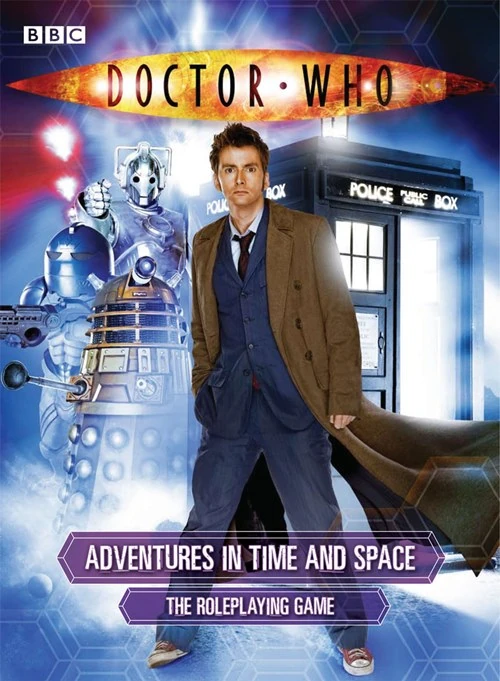
The answer to the first is honestly ‘both’. When I was writing on the Doctor Who RPG I hit the walls of what the BBC were comfortable with three or four times. Once it was because I’d inadvertently hit a beat the show was about to and the other times it was because I’d tried to add a little too much. Cases in point; I did the first run at the Autons for the first aliens sourcebook and built them out a lot. My boss loved it but they weren’t quite Autons anymore so the BBC said no. Similarly, I had a pitch in for a rescue TARDIS being left on Earth that we had to rewrite. But that did mean I got to write about a Dalek time machine trapped in a chip shop in Whitby which is pretty much the platonic ideal of a fun day at work:)
What are the best and worst parts of working in IP?
Best is you get to play with the toys that made you want to tell stories. I’ve written for Doctor Who! For Star Trek! For Primeval! My inner child is NOURISHED and has some really cool toys.
The worst is the money. Firstly, like every creative endeavour in history, TTRPG design does not pay well. Secondly, sometimes it just doesn’t pay. I was paid for my first book in a different decade to the one it came out in. have a book I contributed to three years ago where the funding ran out. It’s making its way through German litigation courts and I hope to see a hundred bucks for a week’s work in, maybe another year’s time. There’s another property where an adventure I wrote, got edits, and got paid for will never see print because it took too long to clear and the show in question has moved on. There’s another sourcebook where four of the six contracted writers dropped out. I wrote two thirds of the book, was ghosted and got told the book was ‘in review,’ Two years later, I noticed the book was on shelves and had been for some time. I got in touch, and got paid. As the only staff member on the book in the UK I may have been the only one. This was 2019 by the way and another reason I stopped doing a lot of things. You can only have the door slammed in your face so many times, you know?
Also, and this is something everyone has family members and friends that struggle to understand, this work is work for hire. You get no royalties. You get no further payments. Once it’s done and the check clears, that’s it. Which means when this stuff shows up in Humble Bundles, it’s great, but being told that by ten people a week who think the more they sell the more you earn is a little tiring.
If you can deal with all of that? The work’s great. But it asks a lot of you.
How much interference/influence do you have from the IP owners when working in other people’s worlds?
Interference isn’t really how it went for me. In my experience it was more ‘Nothing is true, everything is permitted, no not that.’ I’ve talked elsewhere about a couple of the things I tried to get over the wire with Doctor Who that got revision requests and that’s usually how it went. You’d know where a limit was once you bounced off it.
The fun thing about it is that it’s not that your ideas were bad. It’s just that they didn’t fit, and if they don’t fit here, that doesn’t mean they won’t fit there…
Also, sometimes stuff just happens. I did a module for a horror RPG where, for various reasons, the editors’ lives ensured they couldn’t get to initial signoff on pitches until we were already rolling. So I wrote a 10,000 word module about a rotating restaurant in a hotel in Seattle being converted via arcane rites into a hammer to break through into Hell so a private military company could hire the damned as reinforcements and…got quietly told they were looking for more of a small scale vibe with characters and less building sized Hell Hammers.
If I had a nickel for the amount of times I’ve been told that…
Anyway, in those situations you get offered what’s called a kill fee, which is basically ‘Thanks so much, through no one’s fault this isn’t working, have some money.’ Because I am, at times, an idiot, I pitched a second adventure. Smaller scale, same length, no Hell Hammers, lots of characters. That one landed but in those situations, sometimes the kill fee is best.
(Photo by Jean-Philippe Delberghe on Unsplash)
I haven’t played either the Dr. Who or the Star Trek RPGs. How hard is it to tailor the rules to stay true to the setting? Do you try to inject the theme and mood of the IP in the rules, or are the two parts (rules and settings) kept separate?
Excellent questions! The rules, from my perspective, are usually in place by the time I arrive. Not just in the book either but around the table. The self care philosophies so many groups live by now, such as running a session zero to set expectation, the X-Card, Lines and Veils and resources like the TTRPG Safety Toolkit and approaches mean the sort of casual psychological bullying that was part of so many games I played in as a teenager is largely relegated to groups who think Enoch Powell had some interesting ideas these days and honestly, that isn’t far enough from the light for my liking. But that foundation of self care brings with it a social contract, a benevolent conspiracy of fun, that really good gaming groups embody.
If you’re playing a licensed game, there’s another level of social contract on top of that because you’re playing in a world you love, and breaking that world stops it being fun. So you can play a borderline psychotic Starfleet crew consigned to the edge of known space because of how dangerous they are (I ran this game as a teenager) but it’s pretty limiting. Likewise, if you’re playing a Time Lord or version of the Doctor who shoots problems rather than solves them, that’s fun, once, maybe twice? And then you have to work out what game to play next. So for the most part the rules, and the setting, are designed to help everyone fit in and tell the best story they can together.
From a meta point of view, writing to an established IP helps immensely because it’s a song you know how to sing. A Plague of Arias, the Star Trek module I did takes an Admiral’s dark past, a Romulan military operation and my favourite two astronomical phenomena (The Hydrogen Frequency! Rogue planets!) and wraps them around a story about the last desperate attempt a civilization made to save itself and how that echoes with the Admiral’s attempts to save their reputation. It’s a story you could only really write in Star Trek and once you get comfortable with those guard rails, you’re off to the races.
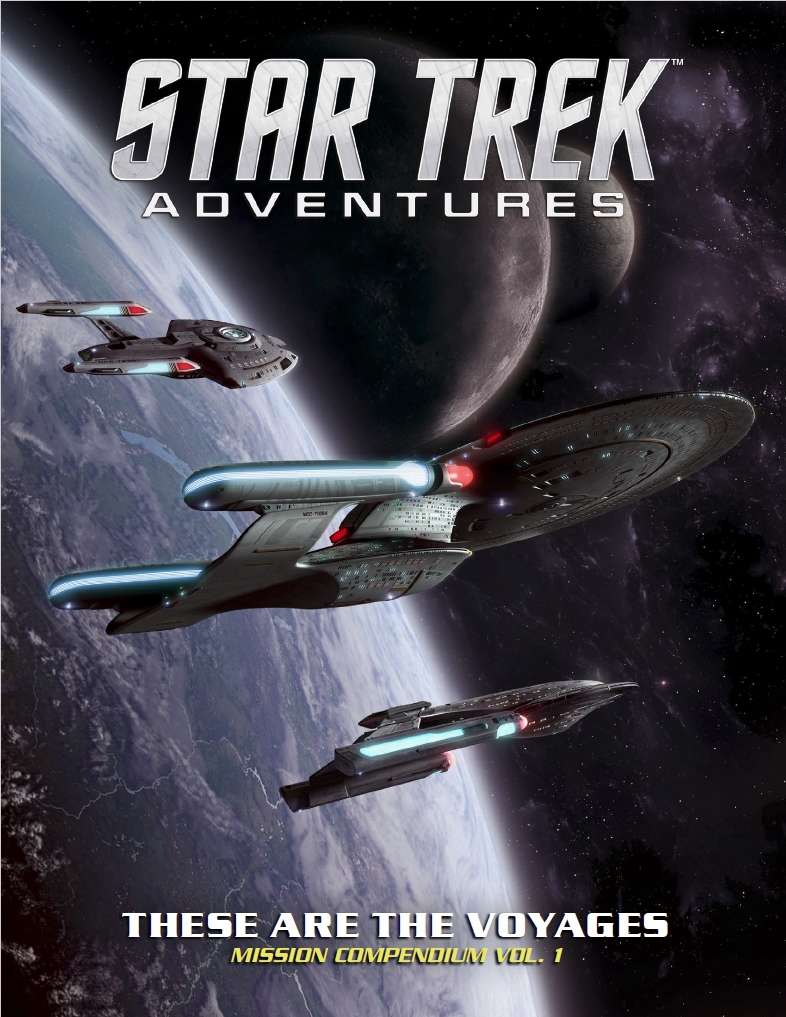
As an aside, in researching this piece I found both a stunningly insightful thousand word after action report about the changes someone made when running A Plague of Arias (All of them very cool) and a review describing the adventure, positively, as a ‘beautiful mess.’ That’s the ball game!
On SFF in general
How do you foresee the SFF writing landscape changing (or not changing) in the next year?
That is an absolutely enormous question! Right now (And I’m writing this as the Davos conference dominates the news cycle in the worst of ways) I couldn’t predict with accuracy where we’d be in a fortnight.
But I do have things I see evidence of, and things I’d like to see manifest across the next year.
From an industrial point of view, SFF has a commercial, moral and ethical duty to champion new and diverse voices. Commercial because everyone’s money spends the same and because when we see ourselves in stories we want to advocate for those stories and tell others about them. Look at the work Dave Moore and team have been doing at Solaris to see an example of how to do this as well as an example of what to do and how to do it. Also look at countless indie authors doing that exact thing, but labouring under the decades old-stigma of daring to do everything themselves instead of joining the rest of us being crushed to death against the gates of the Big Five. AK Faulkner, who is both a dear friend and basically the mayor of indie publishing, is a great place to start both for their excellent books and their knowledge.
Moral because kindness is always the right thing to do and this field is often anything but kind. Plus, the last few years have seen two massive names in our fieldshave their masks slip and the damage one of them in particular is doing, on a weekly basis, to the conversation culture has with itself is colossal. I won’t name names, you know who they are because you can’t move without being told what they think about people with a billionth of their reach or resources.

We’re better than that and them. As a genre, as an industry and damn sure as people. The fastest way to convince people of that is to stop platforming the bigots, stand up beside the people they’re trying to legislate to death and support them with everything we have.
Ethical because I learned to love SFF because it taught me that things could be better. Look at any given news cycle on any given day. Now’s our time.
The strides I’ve seen the last couple of incarnations of the BFS take are a big part of that. Likewise the work of publishers like FlameTree, Black Schuck and Wild Hunt. This work is being done. It’s not being done anywhere near enough by the big five but they’re getting there too. Our job is to dream bigger. Let’s do our job.
I think we’re also finally looking at the year the AI bubble bursts and when it does, it’s going to look like the opening seconds of Akira. The last three years have been like living through the stupidest version of Invasion of the Bodysnatchers as machines that steal artists’ work, don’t compensate or acknowledge them and suck at doing what they do are installed in every service and system we use. At long, long last the chickens are starting to come home to roost in the data centres and while my Schadenfreude loving self would love nothing more than Sam Altman and his ilk to get perp walked, I’ll take their tulip market collapsing so maybe, just maybe, we can build something that really does treat everyone fairly in its place. Utopias are SF too. And I’m so bored of living in a somewhat polite dystopia. So’s Cory Doctorow.
On a personal, sidebar note, I need to see the community take Covid seriously again. While the lockdown is behind us, Covid is still a very real issue and one that, from my perspective, I’ve seen very few organisations engage with. Convention venues have a moral obligation to upgrade filtration systems. We have a moral obligation to hold them to account for that with the only tool we have; their revenue streams. I know the issue is complex across a couple of different axes but across many others it’s very, very simple. We could do more to protect our friends and ourselves than we are and we could do it pretty easily. Acknowledging, and acting on that, isn’t impinging on any ‘freedom of choice’, it’s embracing the ideal of a community that keeps everyone safe and welcome and the idea of ‘community’ itself.
From a personal point of view, I think all of us as writers need to both read and write bravely. We’re all influenced by all the cultural artefacts we encounter, and we’re all made better writers by that influence. So let’s steer it. Read people we don’t normally read, listen to music we don’t normally listen to. Change your routines, change your preferences and see what comes as a result.
That ties back into community too, because when you find stuff you didn’t expect to love but do, you’ll find people who feel the same way. In a year, at the end of a decade, where social media has been used as a bullhorn for the laziest, stupidest, most bigoted humans on the planet to make us feel more alone, there’s nothing more powerful than being together. So let’s build a better future that way.
(Photo by Cash Macanaya on Unsplash)
Visit Alasdair Stuart’s website to find what he’s up to: alasdairstuart.com
Read previous columns
Ask an expert
- December 2026: Creative coaching, with Dr Rachel Knightley
- November 2025: Crowdfunding, with Fio Trethewey and Georgia Cook of The Holmwood Foundation
- October 2025: Creating darkness, with Daniel Willcocks
- September 2025: Working with book bloggers, with Kayleigh Dobbs of Happy Goat Horror
- August 2025: Websites for creatives, with E.M. Faulds
- July 2025: Anthologies, with Dan Coxon
- June 2025: Self-publishing, with AK Faulkner
- May 2025: Indie presses, with Black Shuck Books’ Steve J Shaw
- April 2025: Being a traditionally-published author with Adrian Tchaikovsky
- March 2025: SFFH artwork with Jenni Coutts
Ask an agent, with Laura Bennett: