The shortlisted works across all 13 categories of the British Fantasy Awards have been announced! Find out who’s in the mix over on our blog. Winners announced at Fantasycon in October.

For all things fantasy, horror, and speculative fiction
-
Announcement:
Ask an Expert: March 2026
In this monthly column, we pose your questions to an expert in a specific field of speculative fiction and the wider ‘industry’. For March, Richard Sparks takes questions on comedy—and, as the writer behind many an iconic comedy sketch, he has plenty of answers!
This month: Writing comedy & being funny, with Richard Sparks
Name: Richard Sparks
Website: www.richardsparks.com
Specialism: Writing comedy
Follow: Instagram | BlueSky
Born in England, Richard started out as a writer of plays, revues and TV, for such shows as Not the Nine o’clock News. Rowan Atkinson performed his Schoolmaster sketch in John Cleese’s The Secret Policeman’s Ball. To celebrate Rowan’s 70th birthday, the Schoolmaster sketch was nominated in The Guardian in January 2025 as Number One in a list of Rowan’s Top Ten film appearances.
His UK TV credits include The Famous Five, The Flying Kiwi, The Optimist, The Worst of Hollywood, and a lifetime of script editing.
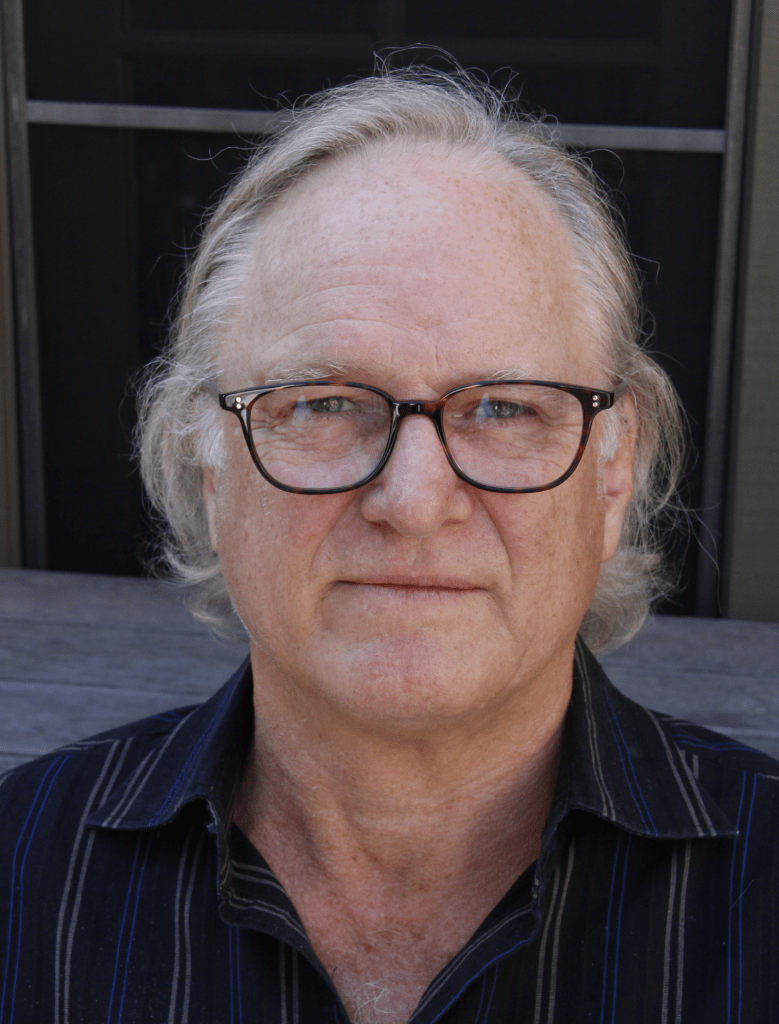
On being hired by Columbia Pictures TV, Richard moved with his family to Los Angeles in 1992 to work with Blake Hunter and Marty Cohan, creators of Who’s the Boss? His lyrics have been recorded by talents as diverse as Dom de Luise, Eric Idle, Vanessa Williams, Plácido Domingo and Hello Kitty. He directed Jack Black in Stravinsky’s The Soldier’s Tale (LACMA). Richard has written and/or directed onstage productions of libretti for several new operas produced by the LA Opera with composer Lee Holdridge (composer of movies such as Splash and Old Gringo, and TV shows Beauty and the Beast, Moonlighting, et al.). Richard has also written new English versions of German and Italian classic operas.
New Rock New Role (publisher, CAEZIK SF&F) was Richard’s fiction debut. New Rock New Realm, the second in the four-part New Rock fantasy adventure series, followed in November 2024. The third, New Rock New Rules, came out in 2025; and New Rock New Roads, the concluding book, is slated for publication at the end of 2026.
Full credits (also reviews and free samples, both downloadable and audiobook chapters) at www.richardsparks.com.
On Being Funny
How do you know something is funny?
Laughter is a reaction of surprise. A good laugh (or joke) hits you, and your reaction to the blow is physical—a bark of laughter, rocking backwards and forwards…
If I were to tell you the funniest joke you’ve ever heard, you would laugh. If I tell it to you again a minute later, you wouldn’t. The surprise element would be missing—and it is essential in comedy.
What jokes seem to be funny no matter who’s watching them in the world?
A lot of comedy doesn’t need words: Buster Keaton, Laurel and Hardy, Mr. Bean. Personally, I’m allergic to mimes, but I’d laugh along with the rest of you if someone shot them. Preferably with a custard-pie gun. Violence can be funny, but in general it doesn’t appeal to me, just as I’m not into horror, gore, etc—perfectly fine genres, but each to his own.
This could lead to a sub-section on “cheap laughs”. Comedians often talk about “the wrong kind of laugh”. They don’t want the nervous laugh, the unsure laugh, the snort of “does he really think that’s funny? Wow, poor guy, someone should tell him…”
To answer your question: Heroic failure.
Since people have different senses of humour, is it hard to write what most people would find funny, without it seeming scripted?
In general I don’t try to write “for” anyone—for other people / “most people”. It’s not a numbers game; it’s about does this work? I hope everyone will enjoy it, of course; but that comes later. Your eyes aren’t on the horizon when you’re writing, it’s the here-and-now that matters. Does this work? Ooh, yes, this is promising…
Sometimes funny lines and ideas pop up out of nowhere, and sometimes you get a nice flow going. At other times, it can peter out. You’ve made a decent start, but you’ve gone around a few twists and turns and… now where? What’s missing? What aren’t I seeing? At those times you need to put it away, take a break, let it ferment. And, of course, editing is vital.
Editing is where you get the gold. You’re got your first draft done, phew—now let’s get to work. Some of my best lines appeared in rehearsal. Some were contributed by other people. Wow, that’s great, love it, thank you, let’s use that. Take the good stuff, wherever it comes from. (See “On Inspiration”, below)
“Without it seeming scripted” is a great question. Here’s the thing: you don’t want the audience looking through the performer at the writer. You want them thinking that this is a real person coming up with all this stuff in real time. Later, you might wonder where it came from. Spike Mullins, anyone? You may never have heard of him. You will probably have seen his monologues for Ronnie Corbett. He wrote them all, every word. Ronnie C just said them. “Just said”? No. He brought them to life.
Chekhov said: “I write one thing, the actors write another, together we make a play.” Performing is a creative art, not simply an interpretative one.
Teamwork.
Or what about I’m Sorry I Haven’t a Clue? “Programme Consultant” = Iain Pattinson. This is code for He Wrote the Jokes. It would be distracting for the audience to think about that. They want Humphrey Lyttleton to have come up with his hilarious intros himself. Writers, especially comedy writers, belong in the background.
Since people have different senses of humour, how worried are you about offending people, and what (if anything) do you do to avoid it?
(Photo by Girl with red hat on Unsplash)
Not in the least worried about it! Some of the funniest lines I’ve heard, or come up with, are so devious and convoluted they could land all concerned in serious trouble. They are not for public consumption. AND, most importantly, they would not be funny with different people in the conversation / present / listening. There are shades of irony and nuance in private conversation that “outsiders” would not, in all senses of the word, appreciate.
I had a long correspondence over 40 years with a now-departed (and much missed) college friend in which we almost never “answered” the other’s previous letters, but bounced off on tangents into wild absurdities, as written by other people in other voices, often caricature types. Think Sir Herbert Gussett’s letters to the editor in Private Eye. His loopy, olde-worlde nonsense is delightful. He is mocked by his own words. Well, we’re all in on the joke, of course. But if we didn’t know it was a silly old fossil / caricature and thought he was being serious, offence could be taken. It’s a risk, but all comedy involves risk.
It’s a matter of being sensible. And sensitive. No one wants to offend. Unless someone deserves it, of course (political satire here we come). Bullies, tyrants and dic(khead-)taters MUST be mocked. We can’t let them get away with their lies and bullshit and greed and stupidity. Hats off to the Armando Iannuccis of this world.
The converse of this is “punching down”. That is rarely funny. Consider internet trolls being horrible about those they hate (often vulnerable people: women, immigrants, “others”). “Only joking, mate! Where’s your sense of humour?” No, you’re being vile.
It’s an important point. The Risk of Offending shouldn’t put you off, just be aware.
Are puns the devil’s work?
Well, he does have all the best lines, doesn’t he?
John Cleese’s three rules of comedy: “no puns, no puns and no puns.”
Personally, I’m an equal opportunities offender. There’s no point in generalising. Puns can work and they can fail. Sometimes, a good groan is more enjoyable than a belly laugh. Oh, God, that really is terrible…!
On Crafting Comedy
How hard do you have to rework writing to get it to funny level?
If it’s a funny idea, it should lead you, guide you. You and the idea work in step with each other. I think that if you’re not in sync with the idea, then making it funny would be quite hard. And perhaps not a good idea. Yes, you can make King Lear funny, and then it is something else. Parody.
If the idea has comic potential, then it usually has an optimum length. You risk flogging it to death if you try to over-exploit it.
Two thoughts:
1: “Where does it land?” That’s a different question from “How does it end?” A comic idea, bit, piece, sketch lands somewhere. Hits the mark. The old “grappling with the punchline” problem. Monty Python freed itself from that straitjacket by ignoring the tyranny of the punchline.
2: “Great pop.” My late friend Bill Link wrote Columbo, Murder She Wrote, and other shows (with his writing-partner Dick Levinson). At the end of each read-through, Peter Falk would say, for example:
“Great pop.”
“Needs a pop.”
“Pop misses, bit of a damp squib.”
“Pop” was his word for the twist, the surprise, the reveal, the landing, the clever bit of sleuthing his character had done to turn the tables, solve the mystery, etc.
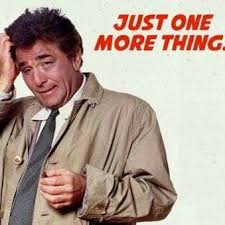
It was Bill and Dick’s job to get that “great pop” for him every episode.
And that often meant (a lot of) rewriting. Rethinking. Reworking.
How did they do that? All story structure is set-up and pay-off.
If it doesn’t pay off, you didn’t set it up right.
Go back to the set-up. That’s where the problem is. Or the roots of the problem.
“If I wanted to get to Tipperary, I wouldn’t start from here.”
What are the most common edits you use to make something funnier?
Scripts: Cut out all the Stage Directions. Write them first, so you know where they are, but don’t put them in the script / sketch unless they are vital (i.e. He produces a dead rat from his pocket). Let the actors discover for themselves. A lot of directors go through scripts with a blue pencil while reading it for the first time. They don’t want all the instructions. They’ll decide for themselves, thank you.
And if actor or director asks you what on earth is going on here, you have your answer ready.
I often encourage actors to consider that the most important parts of a script are what happens between the full stop at the end of one sentence and the capital letter at the beginning of the next one.
What is the journey?
What happens in the gap there, the pause?
What is the realisation? Is it sudden, or does it dawn slowly…
What doesn’t the character say, between that line and the next?
Does the character reverse himself in the next line?
Etc.
That is all rich stuff for the actor to explore and come up with solutions to the opportunities / problems presented.
It is death to a performance if an actor “gets on the train” and just goes full steam ahead with no swerving left or right.
Stories: Less is more. You want the joke to land at the optimum moment—which is usually half a beat before the reader sees it coming. We (audiences / readers) love being surprised. When a story twists to produce a magic, unexpected but oh-so-right ending: that’s when we really appreciate the journey we’ve been on.
Which is why story-structure is king.
And see “laughter is a reaction of surprise”, above.
“Common edits” that I use:
Cut out the stepping-stones. You don’t need to spoon-feed your reader / audience. Have them jump across with you. Over-explaining can bog things down.
Do you ever have to try and explain jokes to your editor? Are you often on the same page when it comes to humour—which is so subjective—and how crucial is this?
Not really. If an editor says “this isn’t funny,” then it isn’t really a joke any more, is it? It is an ex-joke. It has fallen off its perch and gone to meet its maker.
A story about that—which leads into the “why” and “what” of comedy writing:
Graham Chapman was a drunk. Lovely man; he and I shared an agent, Jill Foster, so I got to know him quite well. He would doze off on the couch with John Cleese, his writing partner, “doing all the work” at the desk behind him.
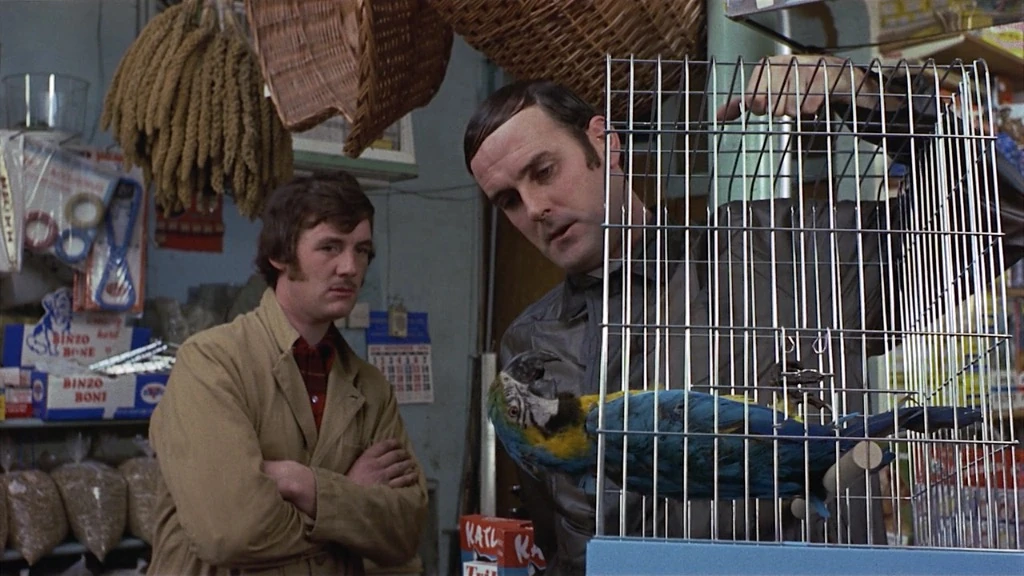
When Graham woke up one time John read him the sketch he’d been slaving away at while Graham snoozed. It was about a man returning a defunct toaster to a shop. Graham said, “Oh, make it a parrot.” Then turned over and went back to sleep. And John describes sitting there thinking but I’m the one who’s done all the bloody writing, and… and that’s brilliant.
You know when it’s funny. Your editor will too.
In the words of Tom Stoppard (Shakespeare in Love): It’s a mystery.
Also, some of the biggest laughs in life come with people who have no idea what the other is saying in whatever language we’re all using at each other.
“Explain”.
Great word.
I wonder how you explain comedy.
To a Martian.
Well, someone says something, or someone falls over something, and we Earthlings all make this arf arf arf noise and our faces break open and we double over…
And now I can’t resist telling the old story of the Famous Note from the Studio Executive. It was for an episode of the Sixties TV series My Favourite Martian. The script came back with a blue circle around a line of dialogue, and the immortal note: “A Martian wouldn’t say that.”
Do you try your material out on people? If so, how do you choose who to ask?
(Photo by Marcela Rogante on Unsplash)
Yes indeed! I have test readers. I know how lucky I am to have them, so I always buy them lunch. Nobody wants to read scripts. There is a reason for this. Scripts are blueprints of films / shows that haven’t been made yet. The manuscript of a book is much easier to read and appreciate. Scripts are hard to read.
I had four test readers on my New Rock series and got their feedback on each book before I sent them off. Their insights were very helpful, and guided my polishes.
Also, I give everything to my wife to read before anyone else. We have a convention. She has to say “It’s the best thing you’ve ever written.”
Then I want to hear what she really thinks.
Sometimes I don’t want to hear anything right away and need to decompress; so I’ll wait a day before giving her the piece to read, to give me a little down-time.
She groans whenever I say, “You only get one chance to make a first impression.” But it’s important. You want to give your book / script every chance to make a good impression. So, get it right / polished / as good as you can before it goes off to your agent, publisher, producer, cast.
How you choose someone to ask is not easy to answer because it’s different for everyone. First, have readers who are people you like who (might) like your work. They will be well-disposed and generally kind and encouraging. Then you need to expose your work to people outside your bubble / circle. And do listen. I’ve had great notes that I’ve almost missed, and then I thought, hold on a moment, that’s interesting…
Also, finally: if someone (including you) spots a flaw, or a misstep, never dismiss it or brush it off. You can’t pretend it isn’t there, because it is, and someone has spotted it. It may mean pulling at the tiniest of threads, and then a whole garment unravelling. That’s always a jolt. But it is far better to learn the awful truth sooner rather than later.
Can you learn to be funny? When I make people laugh it’s often unintentional or spur of the moment, so is being intentionally humorous a skill that one can develop? And if so what resources would you recommend?
There was this utter jerk at my secondary school who was vile, nasty, mean-spirited—and possessed of a needle-sharp wit. I’d always loved laughing as a kid. I even rolled around on the floor in the cinema once. But this guy*… ugh!
And I thought, I want to do that. Make people laugh. Not to taunt, but… yes. That’s the way to go.
And so I learned how.
When you’re 13 or 14 your brain is still forming, so you can train it. Point it in the right direction. Find out how. Learn. We all know how kids find it easy to learn when they really want to learn about something that fascinates them.
Unintentional laughter can indeed happen. It’s a reaction of surprise, remember.
But yes. Ooh, that worked. Wonder if I can do that again? That’s where it all begins.
And you learn throughout your life. Your skills improve. I’ve recently been writing comedy sketches again, and so far seven really good ones have come to completion, and I have two more on the boil. I can truly say that they are a lot better than stuff I wrote in my 20s and 30s.
As to recommending resources: there’s a lot out there these days, readily accessible on YouTube, etc. Which makes it far easier for kids these days to learn the guitar than it was for Hendrix and Page. Perhaps the same applies to comedy. See what your heroes do or did. And isn’t it great when you discover a new one?
Another story: I wrote a play that was on in a London fringe theatre and I got an important lesson from a critic. The play worked—all kudos to the magnificent Gavin Richards, who played the lead (and did five completely different characters within the part I’d written). Boy did I learn a lot from Gavin! Talk about getting lucky. The critic in Time Out gave it a rave review, in which this sentence jumped out and jabbed me in the eyeballs:
“Entirely lightweight, but often very funny…” (etc).
And I thought: “What does she mean, ‘entirely lightweight’??!??! It’s a searing insight into the human condition—” or some such bollocks. I was miffed. “Entirely lightweight”??? How dare she…
It took me some time to realise:
Lightweight is hard.
P.G. Wodehouse is lightweight. He made 300 pages of notes on each book before he wrote the story, then complete rewrites before each was finished.
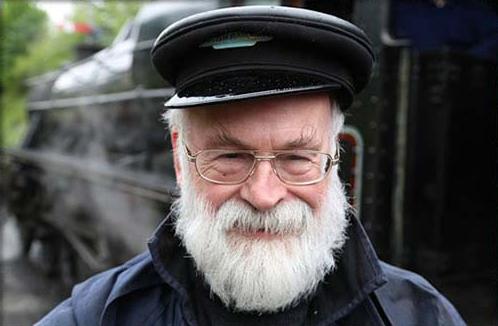
Dorothy Parker is lightweight. S.J. Perelman. Leo Rosten (author of the Hyman Kaplan stories). In our fields of SF&F: Douglas Adams, Terry Pratchett (pictured), Robert Sheckley.
Are those writers good or what?
Lightweight is a gift. If you can do lightweight, you’re in luck. Philip Pullman, a very fine writer, said “I don’t know how to make you laugh, but I do know how to make you turn the page.”
If you’ve got it, use it. We’ll be grateful, we all love a good laugh. And if you haven’t, yes, I firmly believe that you can learn. Why isn’t this funny? Well, it’s a toaster. Make it a parrot.
So: where does it come from? (See Inspiration, below) I’ve written these seven (going on nine) new sketches, and after each one I thought, well I can’t think of any other ideas for comedy sketches. How on earth did those appear anyway?
And then another one suggests itself, and… you see if you can make something of it. They sometimes fizzle out, as three or four other ones have done; but that’s just how it can go. Write it and see.
[*I re-met this guy a few years later in our university days and he couldn’t have been more delightful.]
On Funny Fiction
Are there any character types/traits that lend themselves to humour? And/or could any characters be humorous in the right situation?
A primary school teacher told us: “Urchin slips on banana skin isn’t funny. Bishop slips on banana skin is.”
= Pomposity deflated.
Grandiosity. Boasting. Persiflage. Blowhard preening pretentious cruel lying sacks of…
It is satisfying when they get their well-deserved comeuppance.
I don’t know if “people you feel sorry for” could be humorous in the right situation. I suppose it would depend on the situation.
The “little guy against the world” isn’t someone you feel sorry for. He is someone you root for. And you cheer him on through thick and thin. Or, in comedy, thick and thicker.
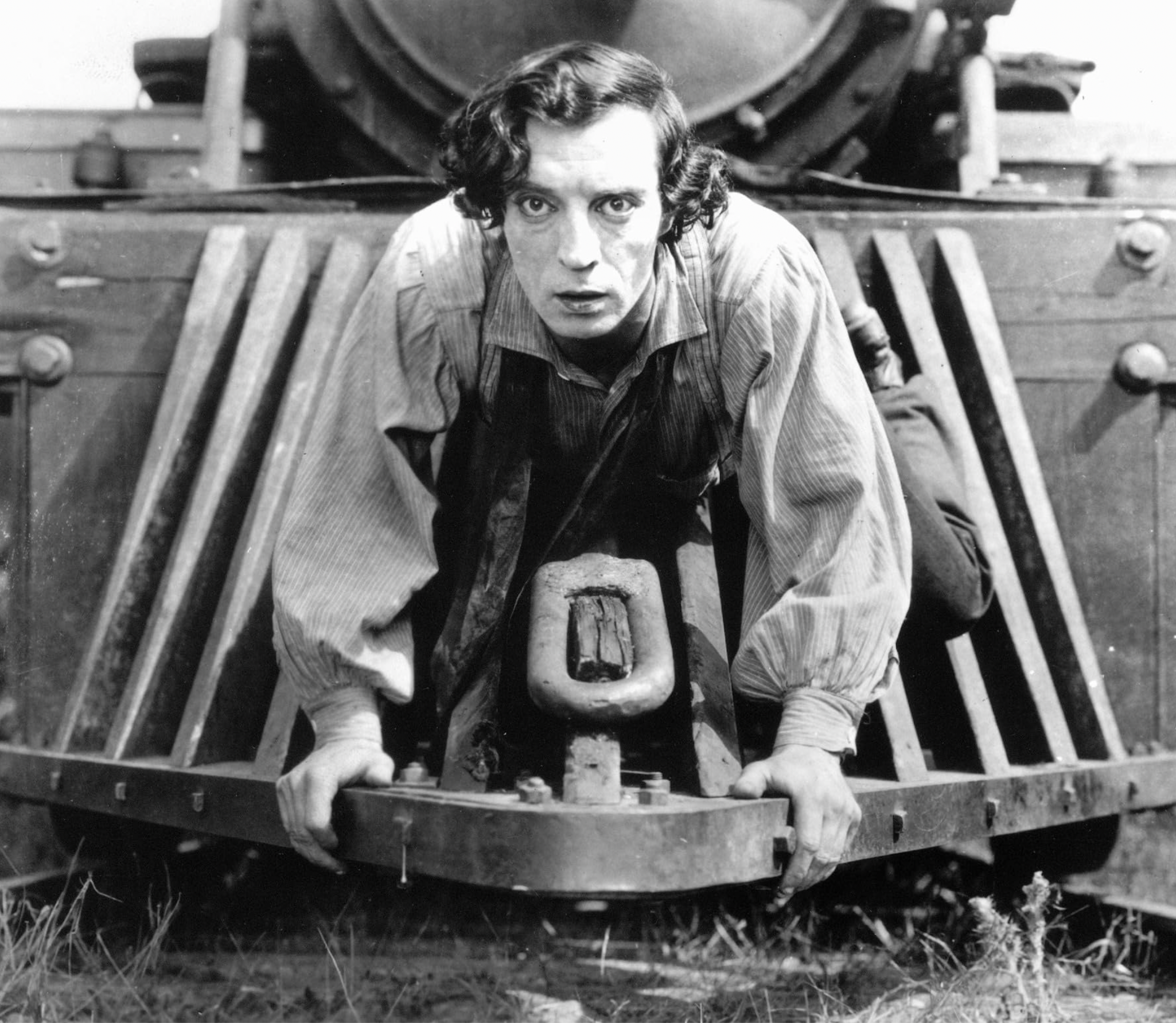
Time to see Buster Keaton (pictured) in The General again.
So yes: the more the odds are stacked against a character, the more promising his/her story is for comedy gold.
And don’t we love it when the worm turns.
Is a good character enough? Can/should you play the rest of the story straight?
Talking of The General: “All generalisations are suspect, including this one.”
It depends on the particulars of the story.
There is no difference in story structure between comedy and tragedy. They both have the same skeletons. The differences are in tone, and pacing, and character, and so on.
Some of the funniest things ever are played totally straight. Deadpan works brilliantly in comedy. Contrast this with “obvious” comedy, comedy that is over-egged and begs you to laugh—Look at me! Aren’t I funny!!
Er, no. Sorry, you’re a bore.
You have to earn it.
To address your question: good character is a fine place to start. Is it enough? Well, what else can you throw at them?
Romantic Comedy Rules (and I quote an eminent mentor of mine):
1: Falling in love takes two minutes, the rest is denial.
3: Put your lovers up a tree and throw rocks at them.
(There is no Rule 2. But in comedy there is the Rule of Three. Englishman, Irishman & Scotsman walk into a pub…)
Is there a difference between writing humour for a script vs in a story?
My editor gave me an excellent lesson when I told her it was a relief to be telling a story (in books) rather than showing one (in scripts).
She said, “What on earth do you mean?!”
She made me turn to (say) page 210. Pointed at it. Said, “That’s a great scene. Show me, don’t tell me.”
Brilliant note, brilliant insight. Okay, I get it. Don’t tell the readers what happened, like in a newspaper story. Bring it alive, show it happening so that they are right in the middle of it.
So that lesson was: always show rather than tell, if you possibly can.
In books and short stories you have the added weapon of narration, description, etc. But that’s secondary.
Usually humour / funny scenes happen in action, rather than in reportage or writing about them later. But again, see P.G. Wodehouse. His turn of phrase is just so wild and wonderful, breaking rules, taking risks. “I wouldn’t telephone him with a bargepole.” Genius. And this makes it hard to adapt him for TV / film. He wrote great dialogue, and many plays as well as books for Broadway musicals. But some of his finest Wodehouse-isms are in the telling of his narrators, and can’t be put into the mouths of characters.
So, yes, there is a difference. In a script or stage play, that’s all you have: the dialogue. The things they say.
Also… Some of the funniest moments in plays I have written were completely without dialogue. The actors found moments where words were impossible. I remember one actor just hopelessly staring out at the audience, who were roaring with laughter at his miserable predicament. Thirty seconds, forty-five. And me sitting in the audience thinking—how did this happen? I had no idea this was available. I wrote that? I didn’t write that…
And there it is. And it’s magic.
You build a trampoline, they bounce.
On Your Own Career
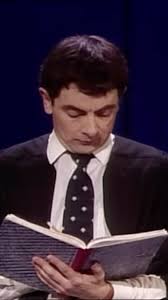
So much of your comedic writing is now considered iconic (such as the Rowan Atkinson Schoolmaster sketch, pictured)—does that add pressure to what you do now? Do you ever think about “living up to” or comparing to previous work?
Only in a backwards way. If something doesn’t feel as if it is going somewhere promising, I no longer insist on banging my head against it. In the old days I would persevere. I have an unfinished story in my script cupboard (where old scripts go to die) that I stopped writing halfway down page 285. I just thought, who the hell would want to read this? I certainly don’t.
Yes, you need stubbornness as a writer. Determination. You need the drive. But you also need to realise when your efforts are wasted. Lesson learned, don’t do that again, move on.
No, that’s not “wasted”, is it? It’s actually time well spent, now I think about it. Several months bashing out something that turned out to be nothing. “A sadder and a wiser man he rose the morrow morn.” The price of wisdom / months of toil.
One thing about getting your toehold in the business: when you get published or performed you get validated. You get a belief that yes, I can do this. Or rather, I always knew (=felt, in my bones) that I could do this, now I know for real—and these folks do as well. That feedback and encouragement is—well, everything.
I had the monkey on my back for a long time, long after some early hits. I felt I wasn’t getting anywhere. Suddenly it wasn’t there any longer. It wasn’t rational. It was just a miserable feeling. I’m glad it’s gone.
You’ve worked in such different types of creativity, from comedy to directing to lyrics and libretti, and now fantasy adventure fiction. Do you have any tips for those of us bouncing around genres and formats? How do you keep things fresh / not let the different projects and styles bleed into one another?
Everything you write is you.
I was actually scared of writing novels because I once read something someone said along the lines of: “Every line that a writer writes is a revelation of their character.” That put me off writing all sorts of ideas. Ooh, I wouldn’t want anyone to think I’m that sort of person.
So you’ll never see me write slasher porn. I wouldn’t be able to do it justice anyway, not knowing the subject. I wouldn’t even be able to write a half-decent spoof. That’s for other people, let them write about it. To me, it’s just nasty. I’d rather do something else.
Does this bring us to “write what you know”?
Well, you can do that in all sorts of forms. For example: translating and writing English libretti for operas. The original writers wrote ideas that we can all understand. I just take them and run with them. I try to be both true to the original and to take opportunities to fix any mistakes. For example, in the original libretto of Wette and Humperdinck’s Hansel and Gretel there is a moment where one character tells another character something she already knows (a real no-no). “Don’t you know there’s a witch in the wood?” Of course she does! She’s lived there all her life. An easy fix—“People were saying in town today that a witch has come to the wood.” Omigod! News! Witch! “And I sent the children out there into the forest, oh no, we must go and find them before she catches them…!”
In adaptations, you can also avoid traps that the source writers fell into.
Back in the Seventies I wrote about half the scripts for the Famous Five TV series. There are—or were then, in the editions I worked from—some pretty unacceptable sentiments. No thanks, Enid, our kids aren’t saying that.
Sometimes things do bleed into one another, as you suggest. For example, I had no idea, when I set out on the first book, New Rock New Role, that it would have funny moments / episodes. I set out to write an adventure. But sure enough, they popped up. And if you think about it, adventures are all about calamities and things going wrong and misunderstandings and confusions and disasters. As is comedy.
Comedy isn’t nice people telling jokes. That’s a dinner party. So the two can fit naturally together. This is different from a spoof, where the form is being lampooned. You’re at more of an arm’s length with spoof / satire.
In an adventure, you want to be enveloped in the story, wrapped up in it. So the funny things must be organic to the story, and happen naturally.
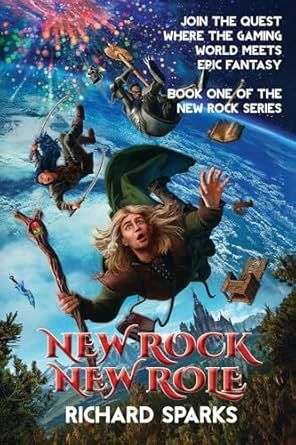
Even if—as comedy often does happen—bizarrely.
Summary: Every writer’s career is different. There’s no one way to go about it. If anything I’ve said has been useful, I’m glad. The rest is up to you.
On Inspiration:
My tutor at college and I discussed inspiration a lot. Where does it come from? How? You’re not meant to talk about it when discussing English Literature. Which always struck me as odd, as isn’t it the most fundamental thing of all?
Well, you’re not meant to discuss it because the academics don’t know anything about it. They focus on the result, the finished work, not the creation.
Here’s the answer. And it is contained in the word itself.
“Inspire” does not mean “breathe in” the way “expire” means “breathe out”. “Spiro” means “I breathe” in Latin, so you might think one is similar to the other, in-spire to ex-spire. But it isn’t. The IN in “inspire” doesn’t mean “breathe in.” It means breathe INTO.
IN-spiration is:
The muse breathing her message INTO your ear.
From outside.
So, where does inspiration come from?
It comes from… Out There.
Very Sci Fi.
Have you ever needed a break, and taken the dog for a walk, and your mind is empty, and suddenly you have to sit on a park bench and get out the notebook and scribble (or dictate into your phone)? That happens because something suddenly Comes From Out There.
Iron Clad Rule: ALWAYS have a notebook. Take it everywhere you go. Have one by your bed. We’ve all drifted off to sleep on the wings of a great idea, wow, yes, I’ll write that in the morning…
And in the morning, it’s gone.
And the muse is chuckling, saying “See? I told you it was a good one, didn’t I? And now it’s gone, hasn’t it? Tsk tsk, silly you…”
Haul yourself upright, turn the light on and write it down.
Or you’ll never see it again.
“Nothing great was ever achieved without enthusiasm”: Ralph Waldo Emerson.
You gotta love it. Even when it’s driving you nuts.
Woof, I need to lie down.
Thank you for all the great questions, and for giving me the chance to ramble around in my favourite subject.
Have fun out there.
Richard Sparks’ New Rock series is available now; more details at www.richardsparks.com

Read previous columns
Ask an expert
- February 2026: Writing romance with PS Livingstone
- January 2026: Writing TTRPGs and working with existing IP, with Alasdair Stuart
- December 2025: Creative coaching, with Dr Rachel Knightley
- November 2025: Crowdfunding, with Fio Trethewey and Georgia Cook of The Holmwood Foundation
- October 2025: Creating darkness, with Daniel Willcocks
- September 2025: Working with book bloggers, with Kayleigh Dobbs of Happy Goat Horror
- August 2025: Websites for creatives, with E.M. Faulds
- July 2025: Anthologies, with Dan Coxon
- June 2025: Self-publishing, with AK Faulkner
- May 2025: Indie presses, with Black Shuck Books’ Steve J Shaw
- April 2025: Being a traditionally-published author with Adrian Tchaikovsky
- March 2025: SFFH artwork with Jenni Coutts
Ask an agent, with Laura Bennett: