The shortlisted works across all 13 categories of the British Fantasy Awards have been announced! Find out who’s in the mix over on our blog. Winners announced at Fantasycon in October.

For all things fantasy, horror, and speculative fiction
-
Announcement:
The TV That Made Us: The Box of Delights (1984)
In his semi-regular column on the classic TV that made us SFFH fans, Gary Couzens revisits 1984’s The Box of Delights—the effects might be showing their age, but the original charm is preserved.
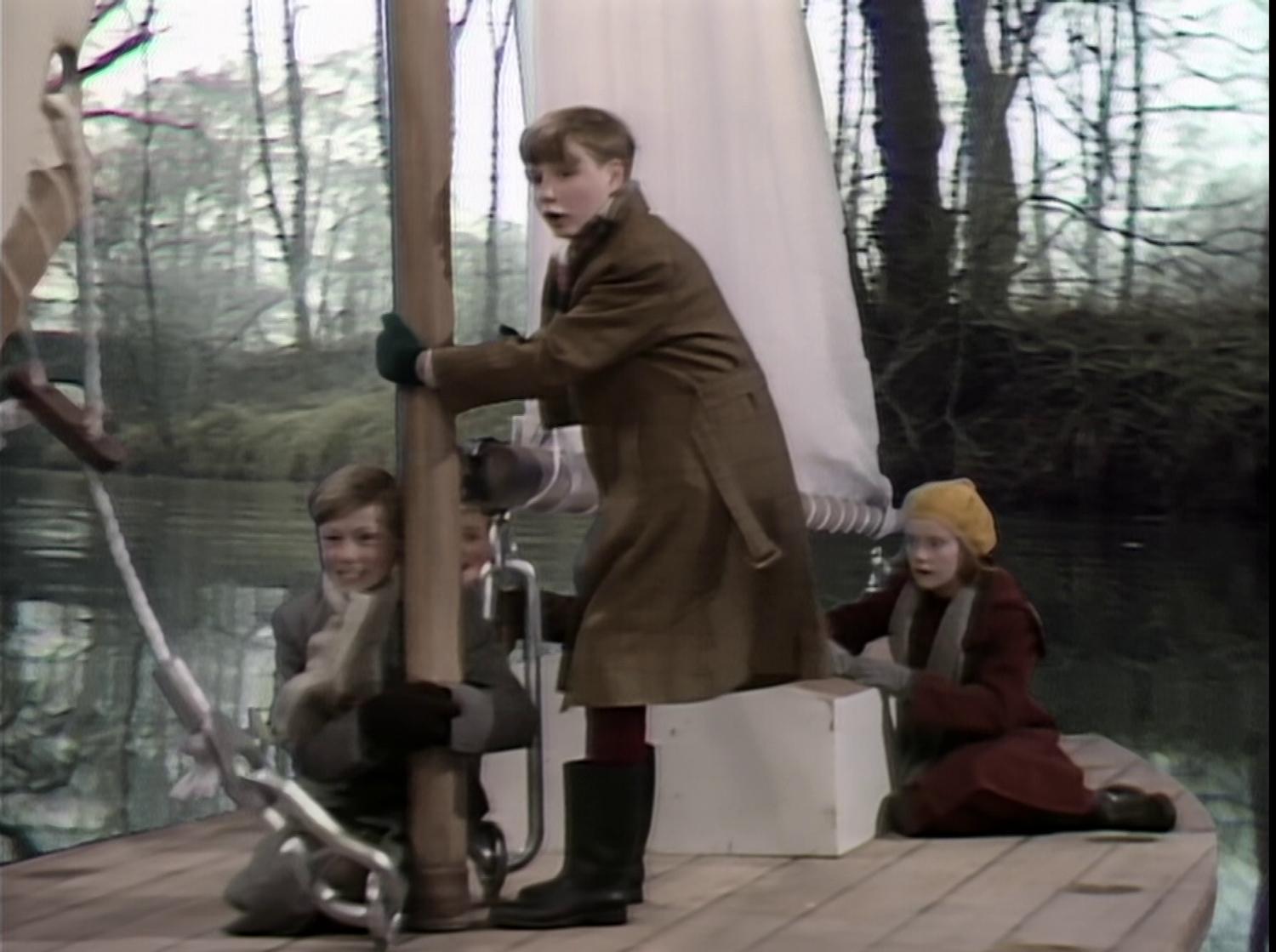
Christmas, 1934. Orphaned Kay Harker (Devin Stanfield) returns from boarding school to stay with his aunt and his four cousins, Peter (Crispin Mair), tomboyish youngest Maria (Joanna Dukes), and their “more sensible” sisters Jemima (Heidi Burton) and Susan (Flora Page). At the railway station, Kay meets an old Punch and Judy man called Cole Hawlings (Patrick Troughton). However, Cole is being pursued by Abner Brown (Robert Stephens) and his accomplice Sylvia Daisy Pouncer (Patricia Quinn) who are after a mysterious magical box in Cole’s possession, the Box of Delights…
Where It Came From: The Author
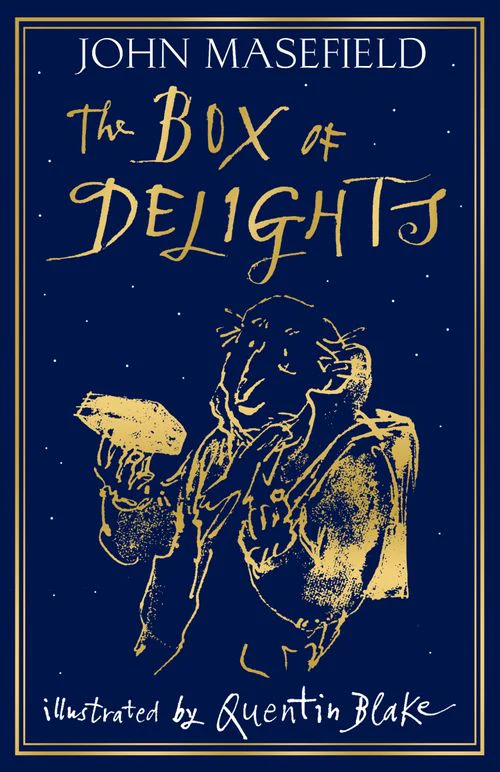
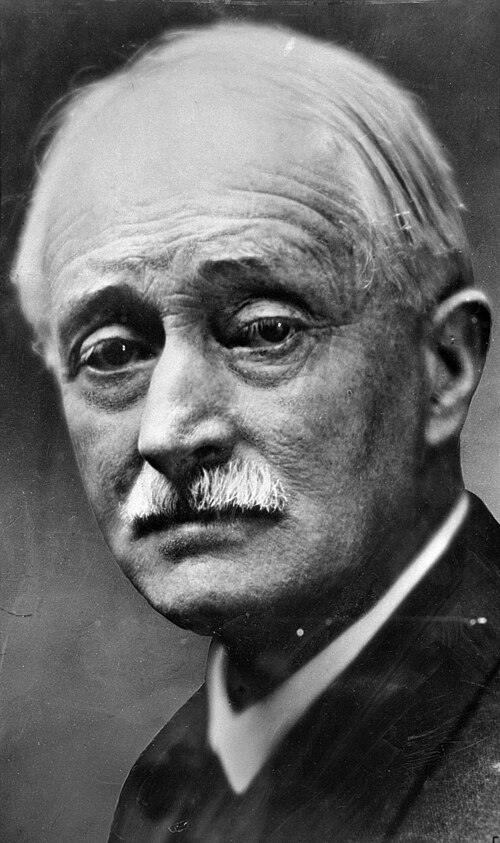
John Masefield (1878-1967) was best known as a poet, being Poet Laureate from 1930 until his death. His poems “Sea-Fever” and “Cargoes” are widely read in schools, or at least they were when I was that age. As a young man he was sent off to sea, in part due to an aunt thinking his extensive reading was not at all healthy. It didn’t cure him of it. However, towards the end of the nineteenth century, while working in New York, he started writing, and his poems began to be published in the early years of the twentieth. His prolific output included, as well as poems, novels, plays and non-fiction. Some of his background as a poet can be seen in The Box of Delights, with poems and songs in the text. In the contents list, each of the twelve chapters is described by a rhyming couplet.
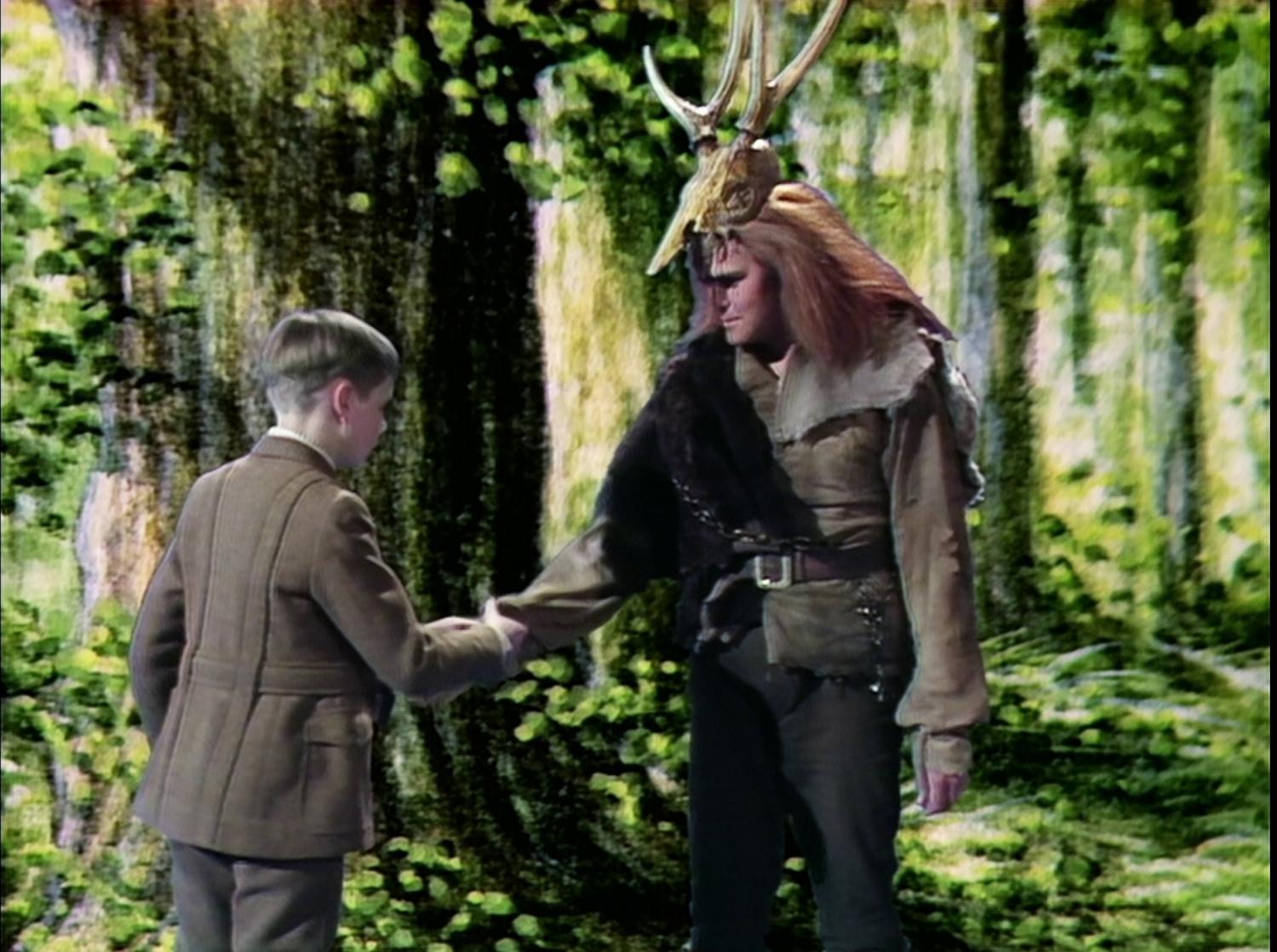
One of his novels for children was The Midnight Folk, published in 1927. This introduced the characters of Kay Harker, who sets out to find treasure stolen from his grandfather, with a coven of witches led by Sylvia Daisy Pouncer and Abner Brown also on the hunt.The Box of Delights, or When the Wolves Were Running followed in 1935, though it’s a sequel that can easily be read with no knowledge of the previous volume. Masefield throws in many figures from English folklore and mythology, with Kay meeting Herne the Hunter (pictured below; played by Glyn Baker, son of Stanley) and travelling back in time. Meanwhile, the buttons on the box enable Kay to “go small” (to miniature size) or “go swift” (hence several scenes of flying rapidly through the air).
The Adaptations
The success of the novel led to the several adaptations, at first on the radio. (There was no television service at the time, it having been shut down for the duration of World War II.) A six-part adaptation by Robert Holland and John Keir-Cross was broadcast on the BBC Home Service as part of Children’s Hour, on Friday afternoons at 5.20pm, beginning on 12 November 1943. There were two further productions, in 1948 and 1955. Among the cast was Charles Hawtrey, who played Mouse in all three versions.
A new adaptation, by Keir Cross solo as a ninety-minute single play, was broadcast on the Home Service on Christmas Eve 1966 at 8.30pm. Patricia Hayes, who had been Kay in the 1955 version, again played the role. This version was produced again in 1977, again on Christmas Eve at 8.30pm, on Radio 4, which the Home Service had become in 1967.
From Radio To TV
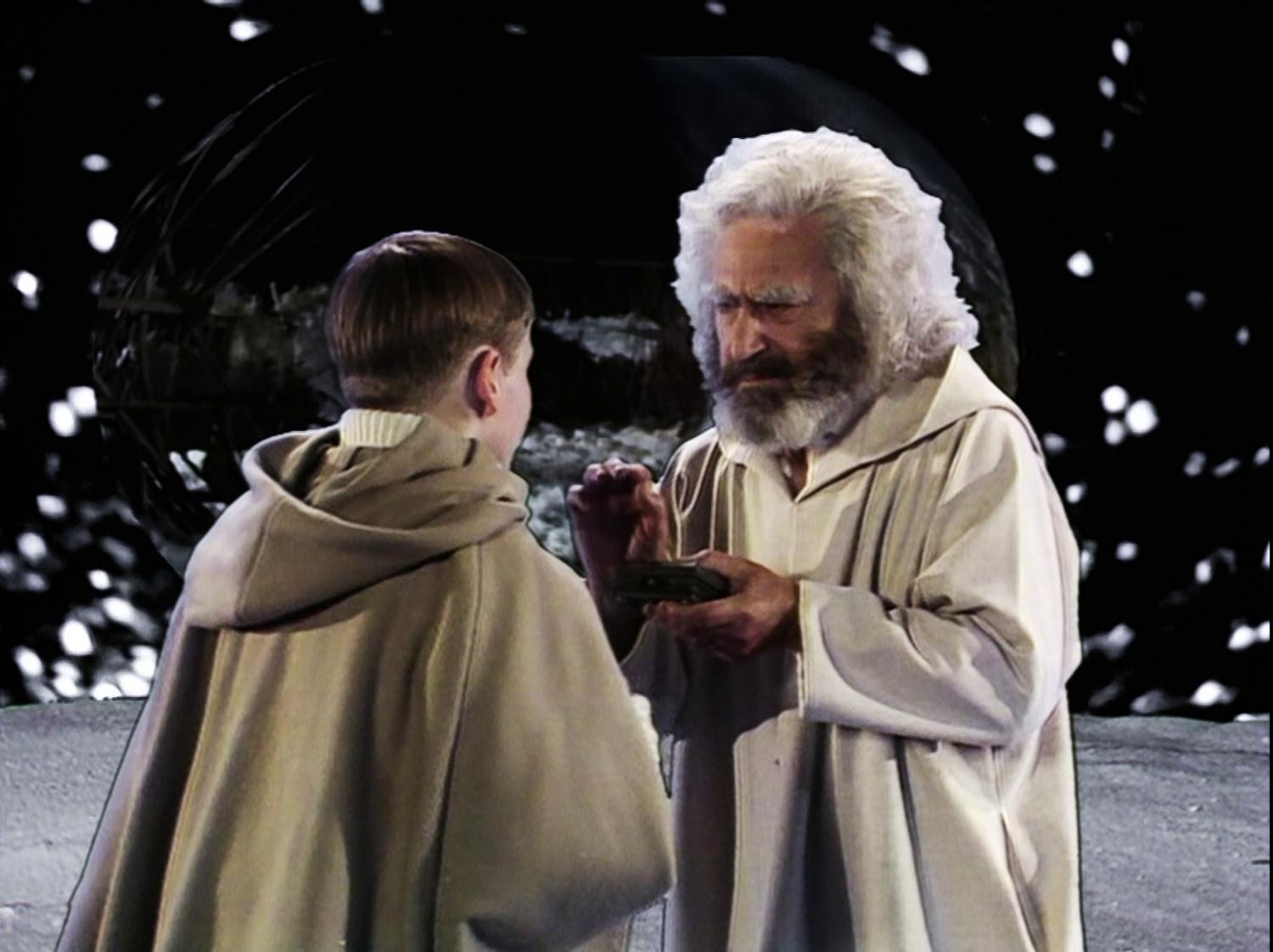
Several of the older members of the TV version’s cast had first heard the story in one or more of these radio versions. Edward Barnes had listened in 1943 as a boy of fifteen. He went on to a career at the BBC, as a producer of Blue Peter and creator of the children’s news programme Newsround, originally presented by John Craven. By 1984, he was Head of Children’s Drama, and The Box of Delights was a novel he very much wanted to bring to the screen.
It would clearly be expensive, not just due to the special effects involved but also the period settings and costumes, as Alan Seymour’s adaptation set the story in 1935, the year the novel was published. The American religious film company Lella Productions signed on to co-produce. The six-part serial ended up costing £1 million to make. This was a considerable amount of money when typically children’s programming, drama or otherwise, had far lower budgets than that intended for adults.
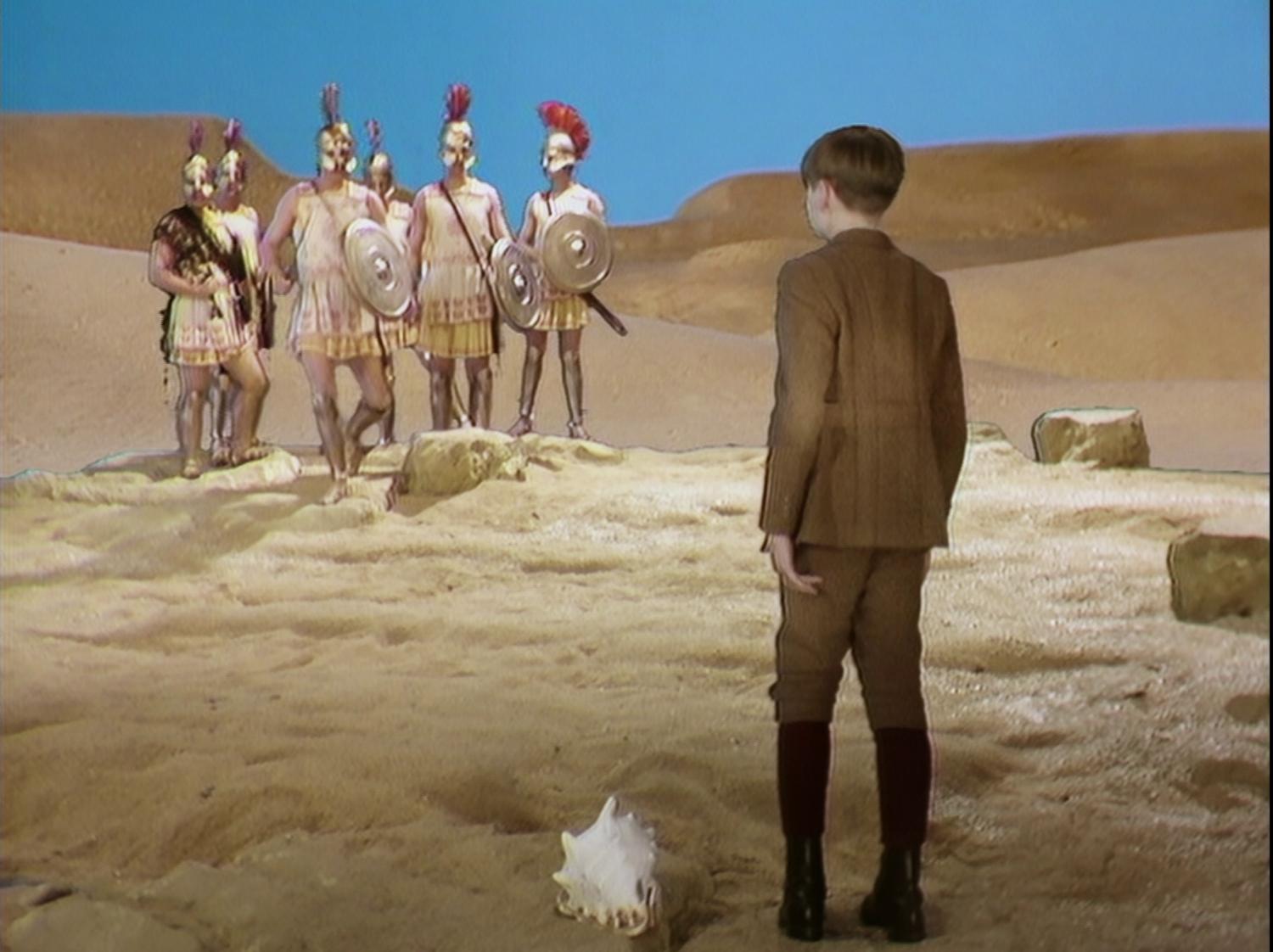
Renny Rye had worked as a director since 1977, beginning with two episodes of Rentaghost. At the time he was working as a producer on Blue Peter, when he was given the assignment of The Box of Delights. The serial, shot entirely on video, made extensive use of Quantel paintbox animation and Colour Separation Overlay (also known as Chroma-Key) for its special effects. Victor Hely-Hutchinson’s theme, from the third movement of his 1937 Carol Symphony, incorporating the carol “The First Nowell”, had been used for the 1943 radio version and was retained here. Roger Limb’s score made use of the main motif, which was played on a harp.
The Cast
Devin Stanfield was twelve years old when production started, and he had his thirteenth birthday on set. His grandfather and both parents were actors, both of whom discouraged him following in the same path. That said, he had been signed up to an agency for child actors and in the same year as The Box of Delights had acted in Thames Television’s adaptation of John Wyndham’s novel Chocky. At the time The Box of Delights was broadcast, he was playing Jim Hawkins on stage in Treasure Island, with his father as Ben Gunn.
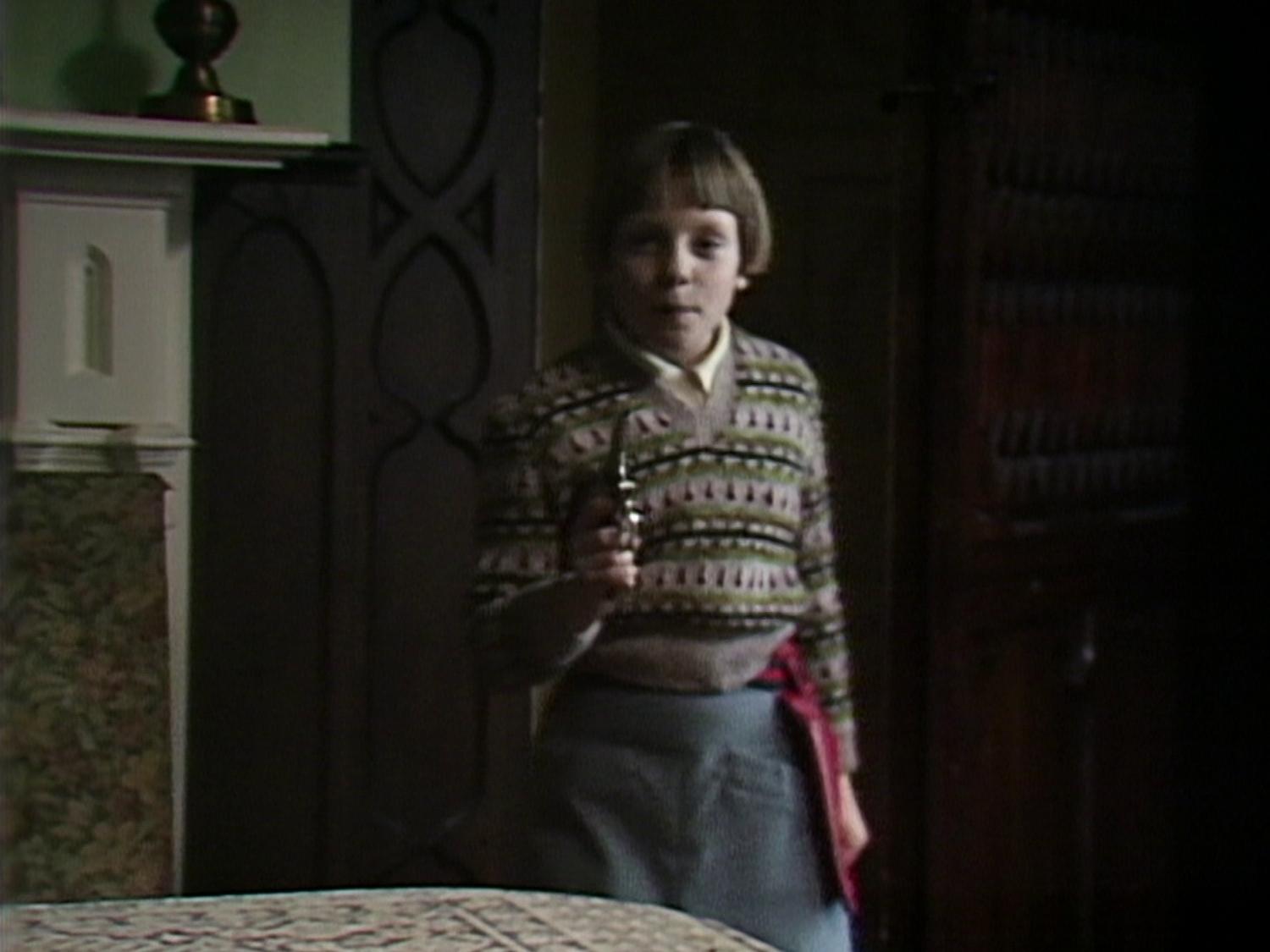
Later he did leave the acting profession and moved into technical direction and production management. He gives a strong, unaffected performance, with few of the stage-school line readings you can often find in children’s drama. That’s especially so here because he and the other cast have to negotiate the period dialogue, including some of Masefield’s presumably made-up slang such as “scrobbled”.
Crispin Mair auditioned for Kay but was cast as Peter, largely because he more resembled the three girls cast as his sisters. Of these, Joanna Dukes as Maria has the showiest role, but that’s how it was written in the script and the novel. It’s not the fault of Heidi Burton and Flora Page that their characters register less.
Patrick Troughton’s presence, in three of the six episodes, was a considerable coup for the production and he grounds his character well, underplaying opposite the two villains.
Robert Stephens was another who had listened to the radio version and said that he would have paid the BBC to play the role. When Patricia Quinn was offered her role, she surprised Renny Rye by saying that she had already read the script when it hadn’t been sent to her. What Rye didn’t know was that she had been Stephens’s partner for many years and had read his copy. They married in 1995. Stephens was knighted in that year’s New Year’s Honours List, passing away in November at the age of sixty-four.
The Reception
The BBC publicised this expensive and prestigious serial widely, giving it the front cover of Radio Times. It was broadcast on Wednesday afternoons from 21 November, at first at 5pm (following Newsround and followed by a pre-early-evening-news repeat of The Good Life), then at 4.55pm, with the sixth and final episode moved to a Monday, namely Christmas Eve. It was shown during children’s viewing hours, but by 1984 home video recorders were becoming widespread so many adults still at work at the time could also watch it, which wouldn’t have been the case a decade earlier.
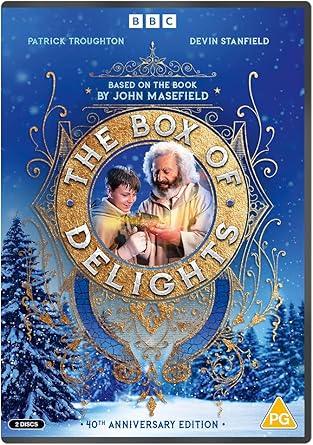
The Box of Delights was nominated for five BAFTA Awards, winning three, for John Mason’s video lighting and Stephen Newnham’s editing, and as Best Children’s Programme. The serial was repeated for Christmas in 1986, with its original six half-hour episodes combined into three fifty-minute ones. The Box of Delights was released on DVD in 2012 and its fortieth anniversary in 2024 was marked by a repeat showing on BBC4 and a Blu-Ray (pictured).
Technically, The Box of Delights shows its age, as inevitably what was cutting-edge has long been superseded. But that’s the same with anything, as any film or television production has to do its utmost with what was available at the time. The serial preserves the charm and imagination of Masefield’s original novel, and for many it’s a Christmas perennial.
Do you remember The Box of Delights? Let us know what you thought in the comments below ⬇️
All photos taken by the author as screen grabs
Meet the guest poster