The shortlisted works across all 13 categories of the British Fantasy Awards have been announced! Find out who’s in the mix over on our blog. Winners announced at Fantasycon in October.

For all things fantasy, horror, and speculative fiction
-
Announcement:
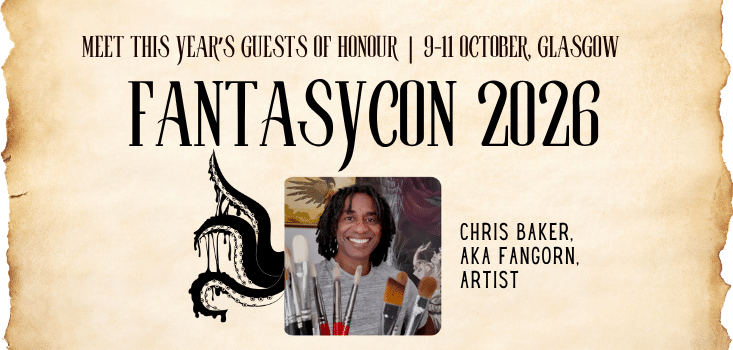
Meet Our Fantasycon 2026 Guests of Honour: Chris Baker, aka Fangorn
With Fantasycon getting ever-closer, our online content editor Lauren McMenemy caught up with this year’s Guests of Honour for a very different sort of interview. No spoilers for their chats at the con proper; hear more about their Fantasycon experiences, and, importantly, what they’d like to wear to mark them out as Fantasycon Royalty.
We’re excited that British SFF art royalty Chris Baker, otherwise known as Fangorn, joins us in Glasgow as one of our Guests of Honour. Watch the interview on our YouTube channel, here, or read the transcript below.
Who is Chris Baker?
Chris Baker RBSA (a.k.a Fangorn) is a graduate of Bournville School of Art and a member of the Royal Birmingham Society of Artists and has had quite a varied artistic career. He states that it was the support of all the crew at Andromeda Bookshop, in Birmingham, that encouraged him to start attending SF and Fantasy conventions to display and hopefully sell his art, Novacon in 1976 being his first SF convention.
After leaving art college he became a full time graphic designer, which then went on to segue into a freelance career, producing artworks for Games Workshop and book covers and picture books for a variety of publishers. Notable works include covers for the UK editions of Robert Aspirin’s Myth series, Brian Jacques Redwall books and providing the artwork for the graphic novel adaptations of David Gemmell’s Legend and Wolf in Shadow. His collection of oil paintings for an illustrated edition of Salems Lot by Stephen King, for PS Publishing is another highlight.
Beyond his printed work, Chris has been heavily involved in the film industry, for over 25 years, as a concept and storyboard artist, working closely with the likes of Stanley Kubrick, Steven Spielberg, Tim Burton and Sam Mendes. His credits include: A.I. Artificial Intelligence, War of the Worlds, The Golden Compass, Alice in Wonderland, Road to Perdition, Star Wars: The Force Awakens and several Bond movies. During this time, he has also received several Industry awards and nominations More recently he provided storyboards for A Quiet Place: Day One and Michael B Jordan’s forthcoming (new) remake of The Thomas Crown Affair.
He has been nominated several times for the BSFA Award and received the trophy twice for his book cover art. In 2024 he was also invited to be Artist Guest of Honour at the World Science Fiction Convention in Glasgow. More recently he has worked with musical artiste Pharrell Williams on his Voices of Fire project and also with the Louis Vuitton company.
Outside of his work for print and film, Chris enjoys oil painting, print making and figurative sculpture. Despite all this, he still has yet to decide what he wants to be when he grows up.
The BFS is delighted to welcome Chris as Guest of Honour to Fantasycon 2026. His artwork will be exhibited/available for sale as part of the art show.
Interview transcript
Lauren McMenemy: Hi everyone. I’m Lauren McMenemy from the British Fantasy Society, and I’m here chatting with Mr. Chris Baker, RBSA, also known as Fangorn, and he is of course one of our guests of honour at this year’s Fantasycon. He’s had quite a varied artistic career: a graduate of the Bourneville School of Art and a member of the Royal Birmingham Society of Artists, after leaving art college, Chris became a graphic designer, which then went on to segue into a freelance career producing artworks for Games Workshop and book covers and picture books. He’s also heavily been involved in the film industry for over 25 years as a concept and storyboard artist, working closely with the likes of Stanley Kubrick, Steven Spielberg, Tim Burton and Sam Mendes, with credits including War of the Worlds, The Golden Compass, Star Wars: The Force Awakens, and several Bond movies—things which I’m sure many of our community will have seen or come across at some point. Chris, thank you so much for having a chat with me today.
Chris Baker: You’re welcome. I’ve really done all that? Wow!
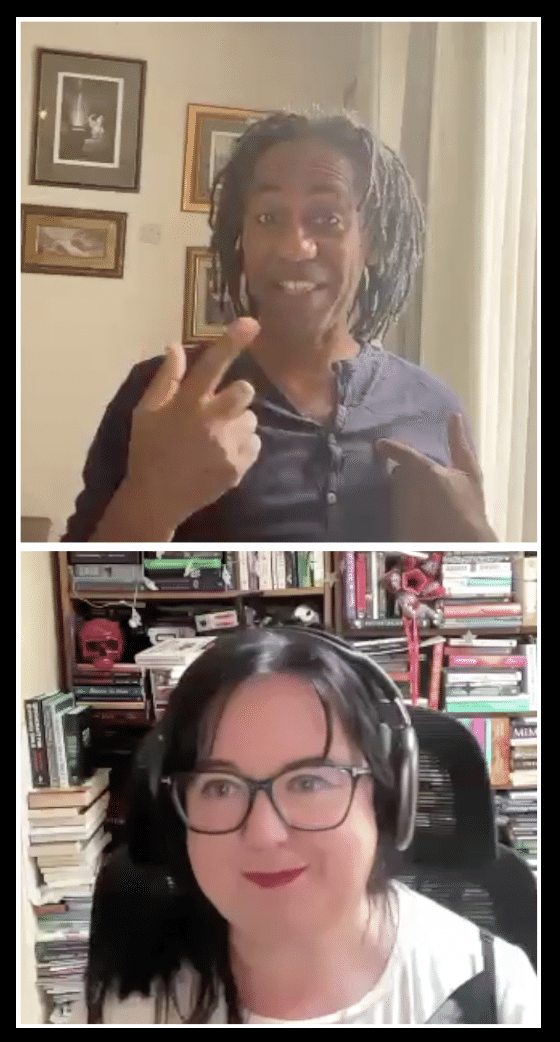
Lauren: I know. I was like, oh wow, this guy’s super impressive. No wonder he’s a guest of honour. So that is, of course, why we’re speaking: You’re a guest of honour at this year’s Fantasycon. So can I start by asking, how did you find out, and what does it mean to you to be a guest of honour?
Chris: Well, it was just an email from Shona just wondering if I would be happy to be a guest of honour at this year’s Fantasycon. Of course, I couldn’t say no. It’s always nice to be asked. Actually, I’ve been a guest at a number of conventions now, and at my advanced age, it’s still nice to be asked. I’m looking forward to it. I mean, most of the conventions that I’ve been a guest at have been science fiction, and so this is my first fantasy convention, which is kind of interesting because for the most part, my art has been fantasy more than science fiction. I shall make the most of this one.
Lauren: Absolutely, and that’s a really good way for us to say make sure you get to the art show at this year’s Fantasycon because Chris has some stuff there, some very special stuff for you to to have a look at, potentially purchase if you so wish.
Chris: There will be works for sale, and prints as well, and my engravings, and yeah, there’ll be quite a bit to see actually. As much as I can get into the car, that’s how much I’ll be bringing. That’s what will go on the walls and various bits of the room at the Crowne Plaza in Glasgow.
Lauren: So the guests of honour are like the prom kings and queens of the cons. If we were to bestow upon you some sort of token that would mark you up publicly, visibly as con royalty, what would you like us to give you?
Chris: The only thing I could think of—I could only think of it in a humorous way because I wouldn’t wear a sash; I’d look like the prom king or something—or a great big badge with a star or something like that, but I was thinking, you know, those great big hands that you you can buy? There’s something like foam, and they point like that. And I’m thinking, well, suppose you had one of them, but it was attached to a hat, so you just walk around all the time with this finger pointing at you, and maybe you’d have written on it ‘guest of honour’ or something like that. I know, but in reality, I wouldn’t want anything. I just want it on my own badge, you know? I’m too reserved to have anything, that kind of outward show of sort of celebrity.
Lauren: So we’ll just have to make sure that your picture is posted all over the place so that people know when you see this guy, yeah, this guy is a guest of honour. This guy, come and have a chat with him. Go and buy his stuff. But yeah, I like that idea of the big foam hand. I’ve seen memes where people say this is how they can spot their short colleagues in a shop, and it’s having a big red arrow pointing down on a hat. Okay, so you mentioned that you’ve been a guest at many conventions over the years. Do you remember your first Fantasycon?
Chris: Well, the very first one I went to would have been in the early 80s, but I think I just kind of popped in. It was when they were regularly in Birmingham, and I would just drift in and out. I didn’t really make a big thing of actually being at the convention. But my first one proper where I exhibited artwork would have been in 19—I’m trying to; I lose track of the years—it would have been ’89. And I think the one reason I remember that is that it was the same month that my son was born.
Lauren: Oh wow!
Chris: And then after that, I exhibited at the WorldCon that was at Docklands, but I can never remember what year that is. Must have been around ’95, something like that. And they they’re quite a bit different from SF conventions—well, they certainly were back then. You know, a different sort of group of people. They tended to be more serious. Not suggesting that science fiction conventions aren’t serious, but yeah. And so I never really made a regular thing at Fantasycons, and I think probably mostly because they kind of stopped doing the art show. Really, conventions for me has generally been about putting stuff in the art show. So it was really good when you know Jenni in particular, Jenni Coutts, wanted to for World Fantasycon last year really wanted to stress the art show and push the art show, and she’s doing it again this year. So if that becomes a regular thing, then I’ll probably continue to be at Fantasycons because I still do a fair amount of fantasy art for myself, not so much professionally these days. And it’s always nice to have somewhere to exhibit your artwork, and of course, it’s always nice to catch up with people.
Lauren: And next year it’s back in Birmingham, so, that’s handy. That’s that’s round the corner.
Chris: Great! I did wonder actually. I did wonder.
Lauren: It’s in the exact same hotel as Eastercon this year, we’re just swapping over. Eastercon’s in the same hotel in Glasgow next year, and Fantasycon is in the same hotel in Birmingham.
Chris: Yeah, Glasgow is becoming a home away from home because we had Worldcon in 2020, yeah, and then back to Glasgow twice in sort of like six months or so. I know it’s a bit of a journey, but it’s well worth it.
Lauren: It’s absolutely worth it, and it’s good for our Scottish members. I was going to say, we’ve got we’ve got quite a few of our members are up in Edinburgh and Glasgow these days, so it’s good for them to not have to come down south for a little bit. But it’s a bit of a trick for the rest of us, but we’ll do it for them.
So, if we talk about your career—because obviously as a guest of honour, you’ll be interviewed and you’ll be on plenty of panels talking about you know your experiences and things like that—but if we’re thinking about your first Fantasycon being the 80s, obviously there’s been a few years in between then and now. When you look back at your career over that time and the progression that you’ve had, what are you most proud of?
Chris: Well, God, there’s been a lot of things, really, as far as each new achievement, artistically, you’re proud of. I’m trying to think what happened since then that I can remember. I mean, I think probably mostly my work in the film industry, because it was such a huge change from what I’d been doing before. I’d been doing book covers and a lot of work for Games Workshop before that, and then I did a couple of graphic novels which were based on David Gemmell’s works, Wolf in Shadow and Legend, and I gotta admit, I was proud of those.
But yeah, I mean, when out of the blue you’re contacted by Stanley Kubrick and Steven Spielberg and Tim Burton and whatever, those are obviously quite proud moments. But at the same time, when I compare them to other things, because I look back to having my very first professional illustration printed, or my first illustration printed in a professional magazine—that was White Dwarf Number Two—when it was just these little black and white illustrations, you know, and that was just the business. And even going back to some of my very first fanzine work, I was getting stuff published when I was still at school and at college, and I used to do catalogue covers for Andromeda Bookshop in Birmingham, things like that.
Having my very first book cover was something else, and then after that, my very first hardback book cover was which was for Brian Jacques’ Martin the Warrior, and I saw it for the very first time in Waterstones, I won’t swear, but it was like was great, that’s me.
It’s all kind of relative, you know, because obviously, the film industry, it’s this big thing, but it doesn’t necessarily surpass kind of other achievements just because it’s the film industry. But at the same time, I was working with Stanley Kubrick for Eyes Wide Shut, you know. I suppose something like going to the the world premiere of Artificial Intelligence in New York, and there’s all these big wigs sort of like on the red carpet and whatever, and at the end of the film, when the credits come up and my name comes up in the credits, and it’s it’s a single line of text for me, you know? That’s that’s makes me kind of proud. But I think that those kind of feelings kind of disappear pretty quickly because it’s like on to the next thing, and also I think you’re only as good as your next thing, in a way.
But the next thing could be anything because, you know, I would still like to illustrate another children’s book. I’d love to do another graphic novel. If I could do another graphic novel, that would be great. But I guess there’s always a sense of pride when I get asked to do anything, because I tend to sort of just—I am a bit of a hermit, you know, but I get these phone calls and I get emails from people wanting to work with me, and there’s always a sense of pride that people still want to work with me. You know, I worked at Aardman for a while in Bristol after Christmas, and being asked to work at Aardman, that outfit, they’re all right, they’ve had a few things. And also, there’s I suppose there’s even a sense of pride when I produce a painting, a personal work that I’m really pleased with, because it’s not that easy. It’s not that easy producing something that works out the way you want it to.
But I don’t even know that what I feel is actually pride. I think it’s more—it’s difficult to put into words. You know, I think probably the one time where I’ve felt the most sort of sort of excitement was when I spoke to Steven Spielberg for the first time.
Lauren: Yeah, I can imagine. Well, I can’t really, but I can imagine.
Chris: I could say the same about Kubrick, but there was something about the, you know, getting that phone call from Steven Spielberg was probably the most excited I’ve been about that kind of thing at work in a way. I mean, I do get excited about other things. Like if I get asked to to illustrate a book or something like that, you know, there’s still that certain amount of excitement. But that initial sort of… Because I think about you know where I’ve come from, which all started with conventions. You know, my first convention, I was, what, 16? And I was selling artwork then. In fact, my first convention I sold everything. I think I was selling them for like 12 quid a piece or something like that, and that that was probably one of my proudest moments.
As I said, or can’t use the word pride. It’s not pride, but I feel it’s just achievement.
Lauren: Yeah, it’s like that little marker of oh, I’ve done something that—
Chris: The fact that people like your work because there are there are probably people who are really talented but don’t get the opportunities, and I don’t take it for granted. So when something comes along, someone personally asks to work with me, or I get asked to be a guest at a Fantasycon, yeah, it’s great. So, yeah, achievements. Achievements are always good thing. I mean, there’s still unfulfilled achievements. I haven’t directed my first feature film yet.
Lauren: Ok, we’ll get someone at FantasyCon. We’ll have the idea for you. You will get you a graphic novel, a kids’ book, and a feature film, all in Glasgow. I’ll let Shona and Dave know that they’ve got to sort that out for you.
Chris: Well, thing is, I already know—well, actually, it’s not even a feature film. If, you know, if I met the devil on the highway, and he said to me, ‘Chris, what is this thing you want to direct?’ and I’d tell him, and I know what it is, and it’s never going to happen now. But it’s one of them. But I would still like to direct at least one feature film, but I think time’s running out.
Lauren: Oh, you never know.
Chris: I think when I was younger, I had bigger ideas of what I’d like to do, because I was totally involved with science fiction and fantasy and whatever. Oh, I’d like to direct a big science fiction film with lots of visual effects and all this kind of stuff. Now I wouldn’t want to do anything like that. No, I would want to do something really, really small and sort of intimate, and that you can control. Because the thought of working with all those Hollywood bigwigs is not for me. It wouldn’t work. It really wouldn’t. Not for me anyway.
Lauren: A lot of achievements! Pride is such an awful word. Like I, know when I use it, it’s the wrong word, especially for creatives to ask because we always just go, oh, it’s all my babies, or oh, it’s all crap, or whatever it might be, but like I like that idea of thinking of achievements as things that gave you a little bit of a tingle when they happened.
Chris: Yeah, of course. I mean, for instance, there are some paintings that I would never sell, and they’re hanging on my wall, either here, and I’ve got a house in Spain, or hanging on the wall there, and I would never sell them. So I’m assuming there must be a sense of pride with those. I don’t know what it is. I do ask myself, well, why do you want to keep those? What’s so special about those? And I do think that I should probably let them go and move on.
Lauren: You’ll know—they will tell you when it’s time to let them go. For now, they want to stay where they are.
Chris: Well, I’ll let them go when someone gives me an offer I can’t refuse. Something really, really disgusting. Yeah, you can have it.
Lauren: We’ll get Spielberg back on the phone.
Chris: Well, yeah, Stephen. He did actually give me a mention recently. I think it was the 25th anniversary of AI this year, and they were presenting it on the—Oh, what’s the channel? The Cable channel. Yeah, Sky Movies. They were presenting it on there, and they were chatting with Spielberg, and he gave me a mention. I thought, oh, you haven’t forgotten me then, Stephen. I didn’t know. Actually, two guys sent me a message on Facebook that it’d come up, and they sent me that little bit of the interview.
Lauren: That’s so cool.
Chris: So actually, I’ve probably felt a sense of pride when that happened.
Lauren: It’s like the sort of thing where you just, you know, polish your shoulder and go, yeah. OK Chris, I’ve got one more question for you, and then we can let you get on with your creating the next great achievement that is coming up.
Chris: But this painting is ridiculous. I’ve been working on this painting upstairs for over two months. It’s ridiculous.
Lauren: And you’ve got a deadline, so you want to take this one to Glasgow, don’t you?
Chris: Yeah, so another reason to go and see the art show is to see this ridiculous—it’s taking its time, this blooming thing. I swear to God. Anyway, sorry.
Lauren: So as a seasoned con goer, be it a sci-fi one or a fantasy one or whatever, do you have any tips for surviving one of these longer conventions, especially for newbies who might be there for their first time?
Chris: Pace yourself. Have a hearty breakfast. Don’t drink as much as you’d really like to. Well, not until later in the day, anyway. I suppose if you’re a newbie, you probably want to go to as many of the programme items as you can. But I’d also say that chatting with people is important. Chat to as many people as you can, you know, without annoying them. If you see me, come and have a chat! And yeah, that’s that’s about it, really, because you know, as a newbie, like I say, I was 16, and fortunately I knew a number of people already at the convention. They were the guys who sort of said you should come along, and I don’t think I paced myself at all.
Lauren: Well, you were 16. I think you can be forgiven for it.
Chris: Yeah, those early days, I used to get drunk all the time! But I would say chatting with people probably is one of the most important things because to go to a convention and maybe just go to programme items, you’re still kind of isolating yourself, so get chatty and get to know people. And that’s not so much survival, but it might be the thing that makes you want to do it again. If you can start building relationships with people—and actually buying artwork from artists is a really good way to ingratiate yourself. So yeah, I recommend that.
Lauren: Yeah, absolutely. Get to the art show with your wallet. Give them all the cash, and you will have a friend for life.
Chris: Yeah, some of it spread it around the artists, you know, to make multiple friends. I think it’s be relaxed, like I say, about programme items, spend a lot of time in the bar chatting, and I suppose to survive it, don’t get to bed too late.
Lauren: At least not till the last day.
Chris: Yeah. But again, that’s terrible advice from me because I always used to get to bed sometimes till three or four in the morning, but that that was in the days when I could do that kind of thing when I was much younger. Yes. And on my clubbing days when some days I didn’t go to bed at all. Ridiculous!
Lauren: Chill, have a good time. Don’t take it too seriously, but take it seriously enough that you make the most of it.
Chris: Yeah, because I think when that’s the thing, once you get the bug for it, that’s it.
Lauren: Your life will be dictated by con dates once you’ve got the bug.
Chris: Yeah, I mean, I did actually go through a phase. It was when I was working overseas, like when I I missed a lot of conventions, and a couple of years I don’t think I went to any at all. But I like to do at least two. I do sometimes think I should do more, but that takes a lot of organisation on my part, and I have no organisational skills whatsoever. But yeah, I mean that’s probably the best thing about conventions: the people. You can have all the programme items, whatever, but spending time with people of like mind or at least similar mind is great. And actually, I would say, particularly for someone like myself as well, because like I say, I am a bit of a hermit, and I quite enjoy being a hermit, but I enjoy getting out and meeting people at conventions. You might only see them a couple of times a year, and that’s great. It’s good for the soul, I think.
Lauren: Absolutely. What a nice note to end on, Chris Baker. Thank you so much for your time today.
Chris: Thank you Shona—no, mixed up, you’re Lauren. Shona is the other.
Lauren: It happens all the time. We both have black hair and Scottish names. But yeah, everybody go see see Chris—see Fangorn at the art show. Go and say hi, and we will see you in Glasgow very shortly.
Chris: Yeah, two weeks from today.
Lauren: Oh God, crazy.
Chris: That’s for sure. Yeah, and I’ll see you there, and bye to you all.
Leave a Reply