More than just another trend, folk horror continues to gain momentum. But with plenty of creators jumping on the folk horror bandwagon, dark fiction author Stephanie Ellis interrogates what exactly makes something “folk horror”—as opposed to a dark story based in folklore.
Folk horror is having a moment—or so they say. To hear this announced a couple of years back, and to hear it continually repeated, has warmed my fiendish little heart. With joy, my eyes have lit up on blurbs for books declaiming they are ‘folk horror’, excitedly I dive in and then … and then the old sinking feeling returns. The book I am reading, whilst I might be enjoying it, has been sold to me under false pretences. It is not, as I conceive it, folk horror.
A witchy woman in a village does not a folk horror make, nor does a strange murder in an isolated rural spot, or a cult plonked on a mountainside, or a retelling of folklore or myth. I am not saying there is a tight definition of folk horror—it does have blurry edges and shifts to grow and evolve, again which I am fine with—but there are basic elements which underpin a folk horror which fans of the genre expect. And, even then, it is how these tropes are blended that give it the right to carry this genre label.
Whether you disagree or not with what I discuss here, I hope it makes people more wary of laying claim to be ‘folk horror’—it can be seen as jumping on the bandwagon of ‘folk horror rising’.
The Academic Definition
The definition of folk horror has gradually become agreed as meeting the requirements of film scholar Adam Scovell’s now oft-quoted folk horror chain, which he created having analysed the classic folk horror films Witchfinder General, The Blood on Satan’s Claw, and The Wicker Man. Four key elements were found to be common to the three, now seen as the “holy trinity of folk horror”:
- Landscape: “The landscape … augments and defines … character as well as actually being a character itself.”
- Isolation: Landscape in turn isolates characters “whether it be just a handful of individuals or a small-scale community”. Note this is not restricted to the rural; an urban landscape can still be part of the chain if it creates this sense of isolation.
- Skewed belief systems and morality: This is a conflict between what is regarded as the norm and the beliefs of the isolated community. Poor Sgt. Howie epitomises this on his arrival in Summerisle: His rigid kirk doctrine clashes with the inhabitants’ paganism in The Wicker Man.
- Happening/Summoning: The combined impact of the above three elements ultimately lead to an event. For Scovell, “folk horror is often about death in the slowest, most ritualistic of ways…” and I agree with him there.
(Photo by Alessio Zaccaria on Unsplash)
Pulling down another book from my shelf, Folk Horror Revival: Field Studies has an introduction written by Andy Paciorek. His commentary discusses the folk horror chain and touches upon my own personal view mentioned earlier. For a book to be properly considered folk horror, it does depend on how these elements are blended. Paciorek says it better: “There appears to be a ‘Folk’ ambiance and aesthetic that more often can be felt intuitively rather than defined logically.”
Folkloric vs Folk vs The Supernatural
There was an article in The Guardian quite recently and its headline referenced Celtic Folk Horror, listing books to look out for. I took a screenshot so I could add the books to my TBR pile (delighted to see Lucie McKnight Hardy’s got a new one coming out in April, Night Babies), and included amongst them was the beautiful Honeysuckle by Bar Fridman-Tell, which I reviewed for Horror Tree. Now this is what I mean:Honeysuckle is not folk horror. It is a mythological retelling of the Welsh legend of Blodeuwedd. There are elements of folk horror, especially the isolationism, but no more. The landscape is not a character; although it features strongly, it can be controlled by charms and is not the ‘character’ as expected. There is a summoning of a sort but it occurs via magic and with a nod to Frankenstein, although Daye has to undergo continual rebirth.
I feel in this instance the headline was lazy marketing, as the article then talks more about folklore than folk horror. In my opinion, Honeysuckle is folkloric horror and fantasy. I am hoping that those other books which were described as horror are truly folk horror. These days, I am taking nothing for granted!
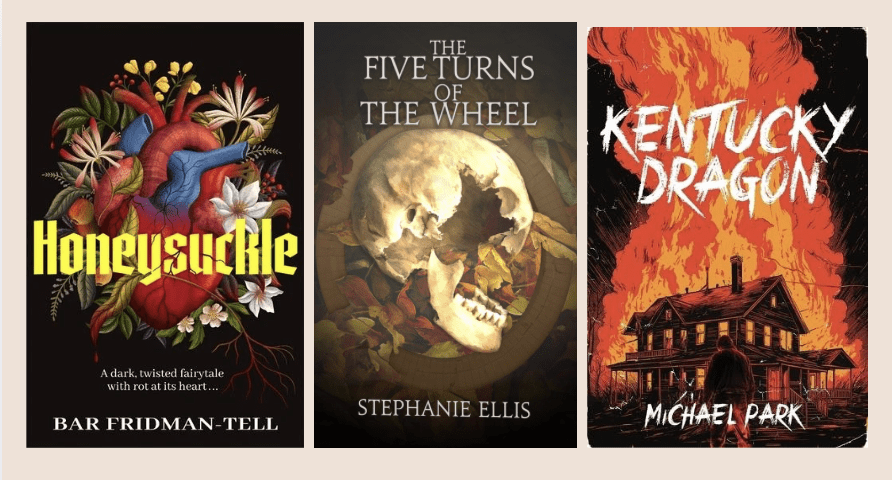
The supernatural can, and does, often feature in folk horror. I certainly include it in my Five Turns of the Wheel folk horror series where I summon deities: the Mother (Mother Nature); Hweol, her son; Cernnunos, the Horned God; and their other human-looking, but demonic, offspring. It might not be a story of a cult but it is told from within a skewed belief system—that is, no Sgt Howie types arrive to show the conflict. I keep the clash here as one between the sexes in their isolated community.
I also read Kentucky Dragon by Michael Park recently and reviewed it for Horror Tree. The first in a trilogy, I loved it. It is very much an occult story, with hints to an old myth and supernatural beings, and was great fun. I’d regarded it as simply a horror novel—then I saw a graphic promoting it with the label ‘folk horror’. Again, it is not. Ultimately, apart from the marketing labelling (which is not the author’s fault), I have a strong feeling that folkloric horror is being conflated with folk horror.
Let’s Not Dilute Folk Horror’s Impact
And yes, there are always going to be grey areas around books as we seek to define them, and the folk horror chain may well be expanded and refined at some point, but let’s not let it get too loose and become just another casual label. No other genre seems to be called upon to define itself as often as this one. It’s as if everyone wants to claim it—and that’s a backhanded compliment when this can lead to the destruction of the very thing they seek to own.
Folk horror is unique, it is liminal, and it addresses us as readers at an almost primal level. Whether you read or watch folk horror, there is always that sense of dread, the feeling that something isn’t quite right, even when on the surface all looks well. It is a subversion of the norm.
So a plea to all you publishers and book marketers, if I may: Handle this label with care. There are many who love and treasure what it stands for. To dilute its definition is to undermine its existence.
(Photo by Todd Trapani on Unsplash)
References:
- Folk Horror: Hours Dreadful and Things Strange, Adam Scovell, Liverpool University Press, p. 15-24
- Folk Horror Revival: Field Studies, Wyrd Harvest Press