With a Kickstarter currently running to fund an audiobook, indie creator Tristan Gray shares how everything he does is not a solo project—it’s always a team effort, from supplementary support to building a network.
Books don’t appear out of nowhere, and they definitely don’t spring into being from the mind of a single great auteur—leaping from their mind directly into the pages of a fully edited and printed book they put together with their bare hands. Books are a collective endeavour and this is, if anything, even more important in the world of self-publishing than it is in indie and traditional publishing.
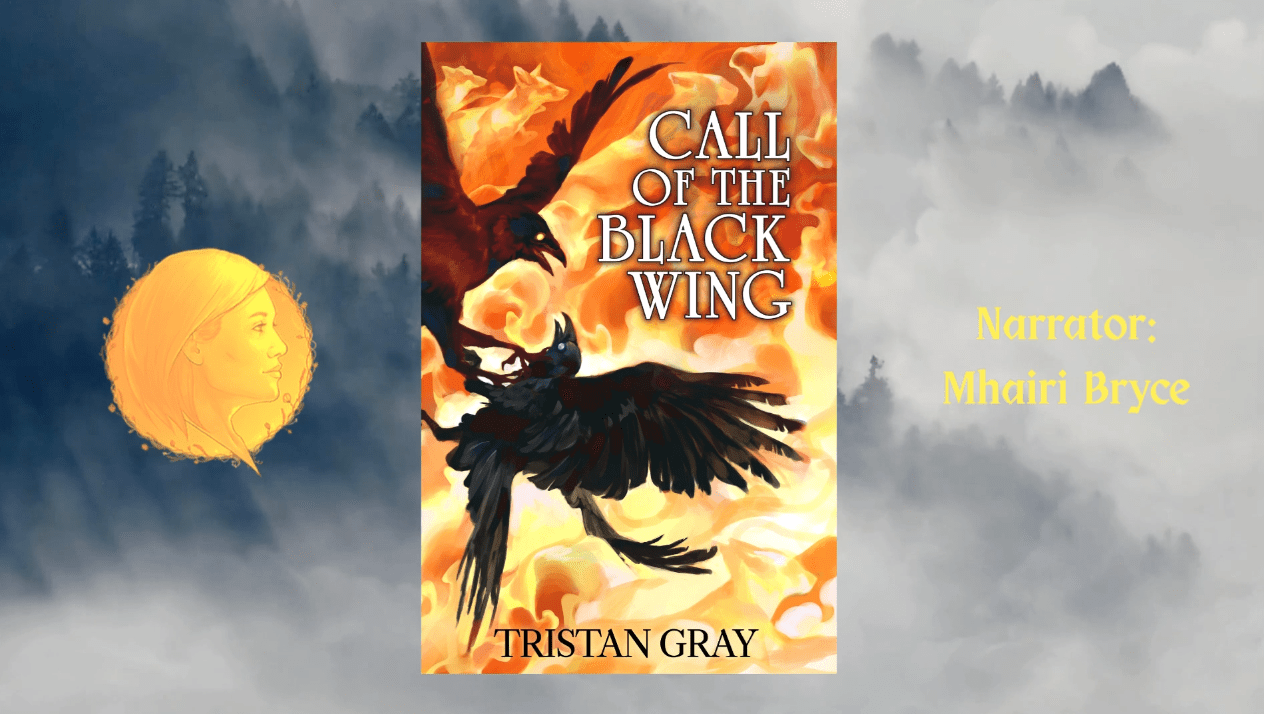
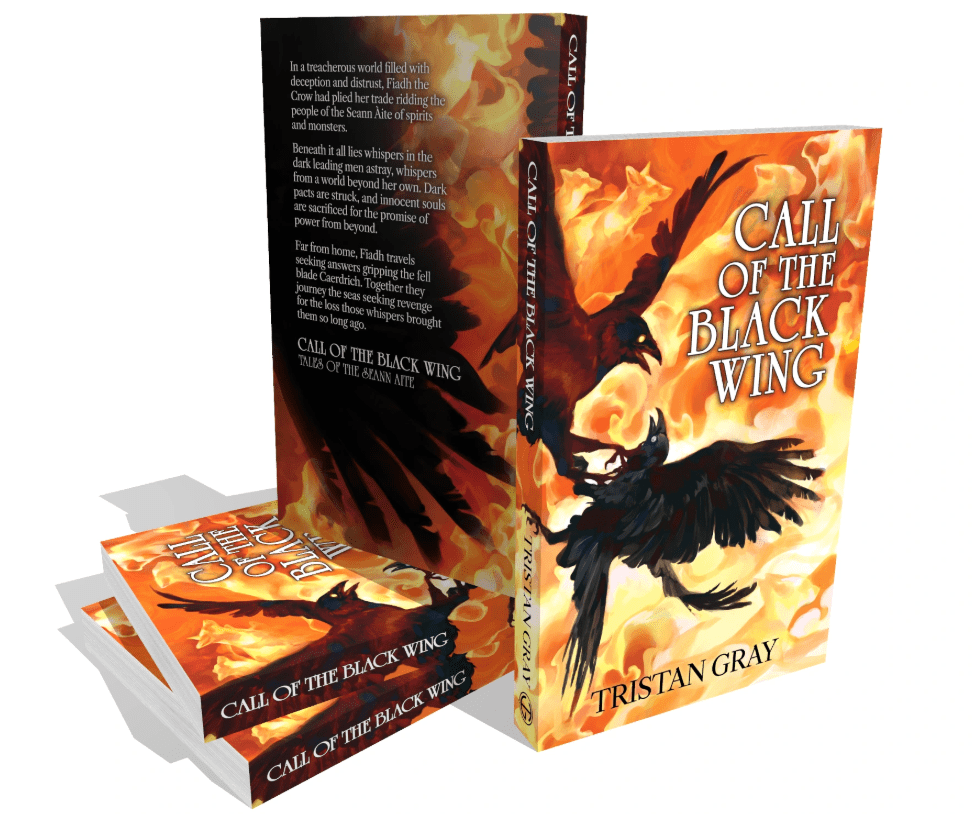
This has become especially apparent to me as I run a Kickstarter to develop an audiobook adaptation of my debut novel ‘Call of the Black Wing’. It’s been a long time coming—I published the first short story of what would eventually become this book five years ago. Even back then, this was far from a solo project.
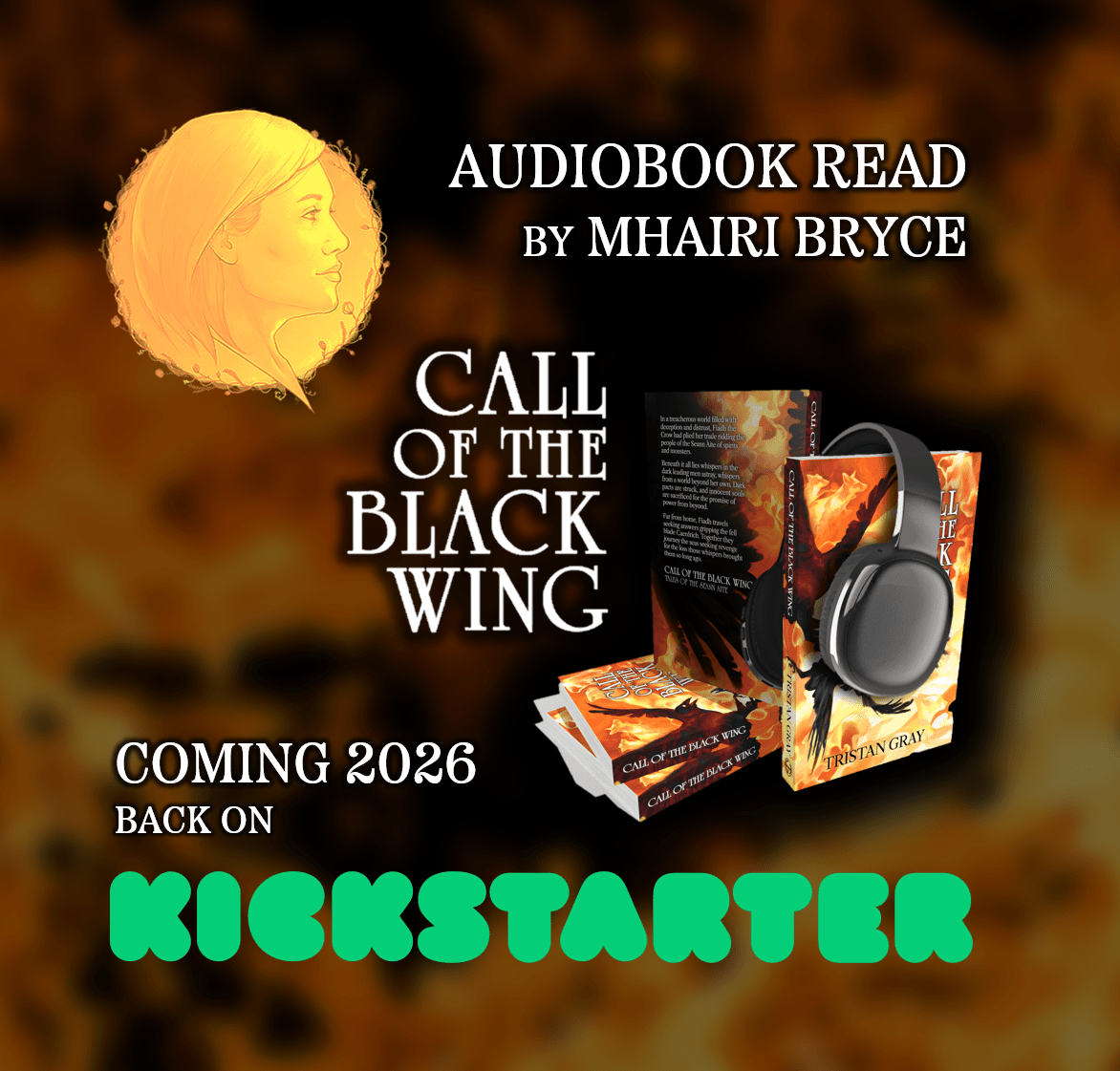
I recently put together a Creative Scotland application for the audiobook—that meant budgeting everything to do with the production of the project. That meant estimating my own hours and how much I cost for doing it so I could list that as an “in kind” contribution (a strange experience as someone who is used to just… writing) but it also meant uploading the CVs of people I was working with and making clear what they were bringing themselves.
That’s a lot. Mhairi Bryce and Michael Ireland have been fantastic to work with over the past few months. Fellow author Morag (one half of gothic fantasy duo MK Hardy) helped me out with some of the image and font choices. Mara Livingstone-Mcphail will be supporting Gaelic pronounciation. Xina (of Peggy’s Pages) and Cristiana Leone both provided art.
It Takes A Village…
When I promote the Kickstarter I often say “my” audiobook, the next step of “my” book. But that is a team. That’s seven people working together to bring a project to life.
Mo and Mara both returned from supporting producing the book in the first place, as cover designer and Gaelic editor respectively. They were joined by cover artist Syd Mills, development editors Margaret Kingsbury and April Jones, Scots editor and proofreader Gillian Hamnett, and beta reader Matthew King.
Eight of us. For a self-published piece of work.
What is most important? The only two people who went unpaid crafting the book were myself (self-publication is a choice that involves taking on the financial risk of hoping for returns from sales yourself) and Matt, who has been beta reading my work and tearing it to pieces gleefully (and mostly respectfully) since we lived together at university 15 years ago. Thanks, Matt!
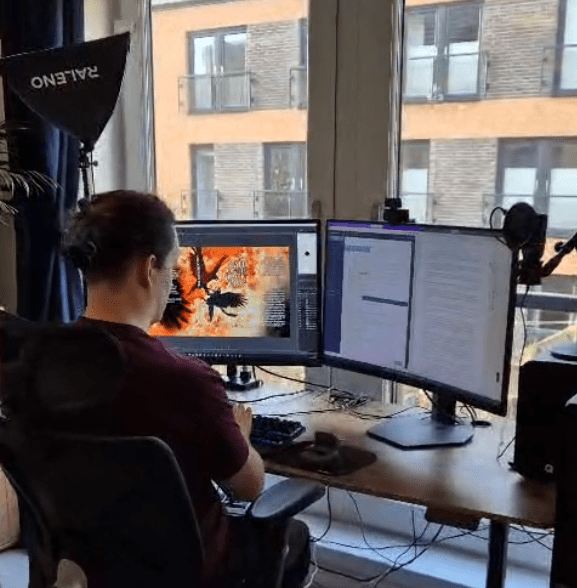
(Pictured: Tristan hard at work)
I found my contributors in all kinds of ways. Syd I found on Artstation; Mo through our shared writing group in Edinburgh; Gillian and Mara were both recommendations via the Scots and Gaelic communities on Twitter (RIP); Margaret and April both worked at Salt & Sage books, who I found through searching for sensitivity readers out of unrelated curiosity; Cristiana was recommended via a different indie writing group; Mhairi approached me after encountering me on a gaming livestream I was supporting; Michael bumped into my stall at Fantasy WorldCon; and Xina I met whilst we were both selling at stalls at Cymera Festival.
When I hear about self-published books in which no one is involved except the author I can’t believe it because I can’t imagine being able to create something so expansive as a novel that I could put in people’s hands without all of these people. I put down words and I put together a map. Alone that could never have been enough.
Crowdfunding To Help Profit Sharing
The Kickstarter hit its initial goal in just 12 hours and raced to 150% in a week. That wasn’t coincidence, or luck. It was the result of building community, connections, and investing in talented people who could create something worth people backing it.
It should go without saying—paying for good work is more likely than not to result in good work. Pay your artists! Taking shortcuts (especially when shortcuts are based on the theft of the work of genuine creators) is something people will notice, and they will start asking questions about where else in your work you’ve cut corners. Is the cover genuine art? No? In which case why shouldn’t they be concerned whether writing inside might not be genuine, either?
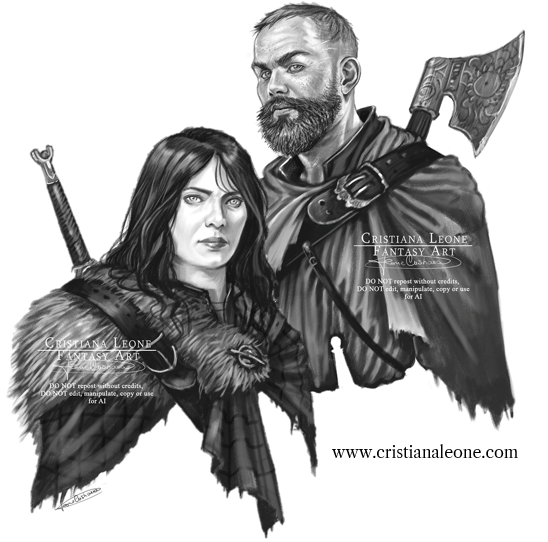
(Pictured: Some of Cristiana’s artwork)
When work is well done or someone goes above and beyond? Tipping might differ from culture to culture but a little extra to a freelancer goes a long way. My second stretch goal for the Kickstarter is “profit share”, where my narrator and director get a boost in their payments. Because I wasn’t alone making this happen, and I wasn’t alone reaching these goals.
Some people do get lucky. Some do hit a viral moment or are just such social media whizzes that their projects blast off from that alone. Some people had the right connections all along to give them a leg up along the way. Most of us aren’t like that, and never will be. For us it’s important to remember that art isn’t often a solo project—and putting a book out into the world absolutely isn’t. All of us, in big ways or small ones, lean on others to help us along the way. Respecting one another as creators, and as professionals in our craft worthy of being paid and acknowledged, should be the fundamentals of remembering that.
Especially in a world where so many billionaires are rallied against us, claiming that everything we do could be replaced by the regurgitated lowest-common-denominator digested remnants of the mass theft of our work. It can’t, it never could be, and working alongside so many talented people has made that incredibly clear.
If you’re interested in supporting an independent audiobook production; a dark fantasy tale of Scottish mythology and folklore; of talking cats, haunted swords, and old gods; the Kickstarter is running now and gathering stretch goals.