
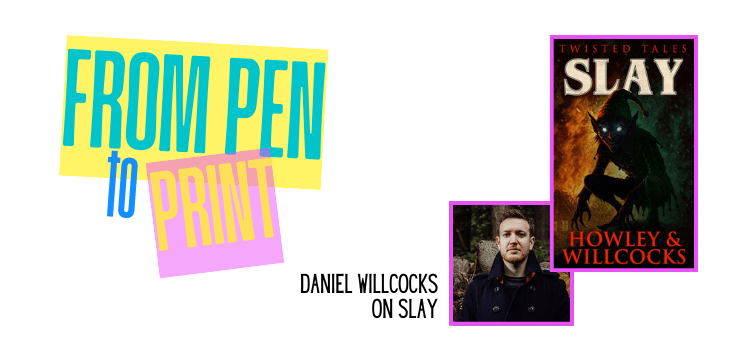
With the latest entry in the Twisted Tales series about to be unleashed, Daniel Willcocks returns to tell us more about the creepy Christmas novella Slay.
Name: Daniel Willcocks (he/him)
Based in: I’m a UK horror author currently based in Cambridgeshire, in the East of England.
What genres/subgenres are you drawn to?
Horror
Is writing your full-time focus, or do you have a day job as well? What do you do?
Writing, publishing and podcasting take up a big chunk of my life, but I also work in digital marketing for a further and higher education group. Day to day that means running campaigns, building funnels and trying to herd students towards the right courses, then coming home and herding monsters onto the page instead.

The Book: From Pen to Print
What was the genesis of this book? Where did you get the idea from?
Slay started on a sunny day in July, when my co-author R.P. Howley and I decided to do the most sensible thing possible: think about Christmas. We’d already tackled Halloween pumpkin mayhem in Jack and gothic terror in Heir, so the brief this time was, “Let’s make something fun and horrific for Christmas.”
Rob ran with that, created the mountain town of Dregmouth, the Vinterblot Tithe folklore, and our protagonist Eli Halverson, then populated it with vicious little elves. When I came in on the second draft, I had one key note: “The elves are going to explode into glitter.” From there we leaned hard into gore, chaos and festive glitter, layered over a story about grief, guilt, and complicated family ties.
How many drafts did you go through before you felt it was ready to query? How long did that take you?
Rob wrote the initial draft over roughly two months. I then took a full structural and line-edit pass to shape the second draft—that’s where a lot of the glitter, gore and emotional through-lines were refined—and after that we did a final clean-up/proof pass before it went to our early readers. In practical terms, that was three main drafts over about three to four months before we were happy to move it into production.
Did you work with beta and/or sensitivity readers? How did you find them? How did you incorporate their feedback?
Yes. We have a small “Twisted ARC” reader team who get early access to each Twisted Tales book. They’re a mix of long-time readers, reviewers, and fellow writers who’ve come up through Devil’s Rock Publishing, my podcast community, and the wider horror scene.
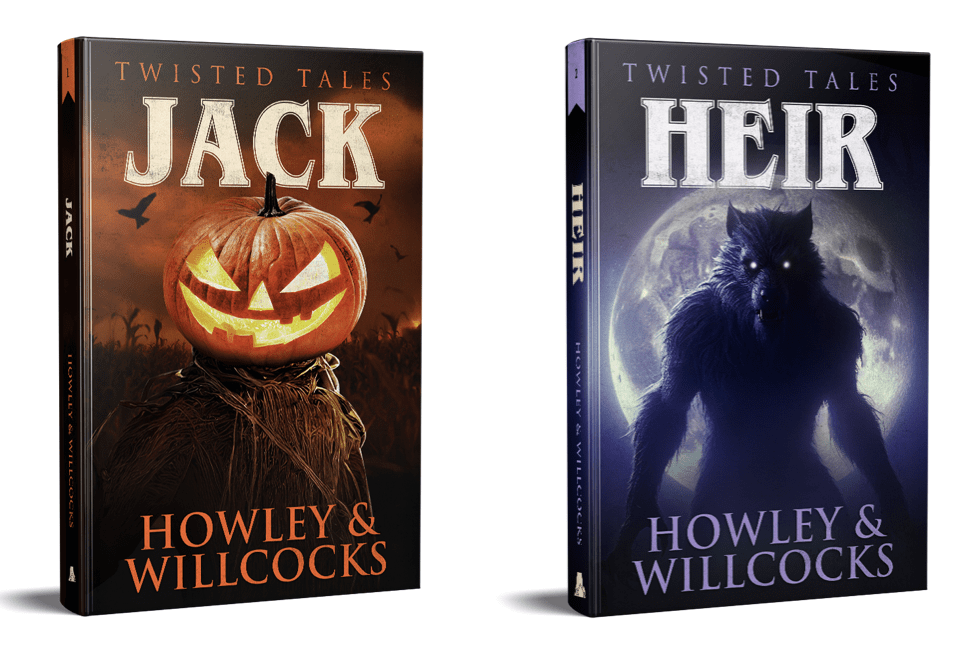
(Pictured: previous entries in the Twisted Tales series)
With Slay they helped us pressure-test the folklore, the pacing, and the emotional beats around grief, queerness, and family. We look for where they stumble or where they light up—the comments usually agree on a handful of scenes that need tightening or clarifying—then Rob and I go back in to sharpen the tension, clarify the rules of the Vinterblot Tithe, and make sure the heart of the story lands as hard as the carnage.
What was your querying process like? How long did it take?
“Slay” was independently published through Devil’s Rock Publishing.
Once it was in the hands of your publisher, what was the process to get it ready for release?
Devil’s Rock Publishing is my own imprint, so “putting it in the hands of the publisher” basically meant dropping it into our in-house pipeline.
First we locked the story with a developmental/line edit, then sent it to proof. In parallel we worked on the cover and series branding—Twisted Tales leans into bold, punchy, slightly retro horror vibes—and handled interior layout for print and ebook. From there it was all the unsexy but vital bits: metadata, retailer pages, advance copies for reviewers and our Twisted ARC team, and making sure it slotted into the wider Twisted Tales release plan.
And now your book is about to be unleashed on the world! How are you feeling?
Honestly? Pretty thrilled.
I’ve had it in my plans to create specific holiday horrors for a long time. We achieved the first of those books with the Halloween deliciousness of “Jack” in October, and now “Slay” is a perfect title to slot into the Christmas canon.
It’s also probably the most fun we’ve had writing a Twisted Tale, and the early reviews are reflecting that. We focused on leaning into the “fun” on this one, suspending disbelief just enough to throw in as many festive tropes as we could, while keeping the book original and in line with our other Twisted Tales. We never want to copy another story, and I think we’ve delivered our own unique sauce on this winter tale.
Now, it’s on to the next one…
What would you like us to know about this book?
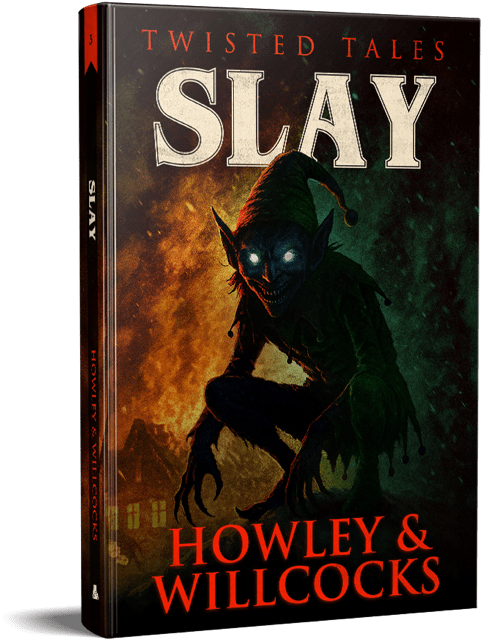
On the surface, “Slay” is a fast-paced festive horror novella about a cursed mountain town, a winter tithe gone wrong, and a swarm of vicious elves who are more lamprey than Lapland.
Underneath, it’s about a man coming home to the place that made him, trying to reconcile his grief for his dad, the expectations of his family, and the weight of a terrible choice.
If you like folklore that feels half cosy, half absolutely cursed, this one’s for you.
Who’s the ideal reader for this one? What sort of things do they like to read about?
We wrote Twisted Tales for readers who grew up on Goosebumps and now want the grown-up version: shorter, punchy books with bigger stakes, more blood, and more emotional heft. “Slay” is ideal for anyone who loves festive horror, small-town folk horror, messy families, queer leads, and monster stories that don’t take themselves too seriously even while they’re punching you in the feelings. If you’ve ever thought, “What if Christmas elves were actually tiny murder-goblins?” you’re very much our people. (Join the #TwistedTribe)
Your writing process
Are you a plotter or pantser or somewhere in between? How do you do your first draft?
I’m very much somewhere in between. I like to know the big tentpole moments—the emotional core, the ending, a few key set pieces—then I discovery-write my way between them.
With the Twisted Tales books, Rob and I usually brainstorm the concept and shape the story together, then one of us takes point on the first draft. With “Slay,” Rob drafted from our shared brief while I played “gremlin editor” later on, adding new scenes, twists and, yes, more glitter.
How do you approach writing? Are you the type or writer who needs to treat it like a job? Is there a particular time of day you find best for you to write?
With a kid, a day job, and a publishing business, I have to treat writing as part of the job or it just doesn’t happen. I’m a big fan of small, consistent sessions. Mornings are my best time for new words—if I can get even half an hour of drafting in before the rest of the day starts shouting at me, I’m happy. Evenings and weekends tend to be for edits, admin, and all the bits that orbit the actual writing.

Geek out about stationery: do you use a notebook? A specific type of pen? Or are you computer all the way?
Drafting is mostly on the laptop in Scrivener—it’s the only way I can move fast enough—but I’m never far from a battered notebook. Rob and I also use Notion as our preferred software for world building and keeping all the pieces together.
Is any of that different for editing?
When I’m ready to set to edits, I roll with Microsoft Word. I’ve been using this for reviewing changes and tracking tweaks for years, so why reinvent the wheel?
Where do you work? Do you have a comfy, creative space at home or are you someone who has to grab the moment wherever it comes?
90% of my writing takes places in cafes around the UK. I’m fortunate enough to work remotely, but I find staying indoors makes my brain go stale. Mornings are usually in a café, laptop next to a flat white. I’m between houses at the minute, so I don’t have a particular home space to use, though I’m very excited to set one up when I get the chance. I’ve had my ideal office planned out for years.
What’s your writing soundtrack?
“The Horror Writers’ Mix—Music for Writing Horror” is a playlist I created back in 2017 and have been adding to it ever since. It features moody, atmospheric songs and soundtracks from horror flicks (all music, no speak), to help me get in the right mood for a good writing session. It’s public and available on Spotify, so you can share the tunes, too.
Do you have a writing ritual?
Nothing elaborate, but I do have a pattern. Coffee first. Then I’ll skim the last page or two of what I wrote previously, tweak a sentence or two to get my brain back in the right voice, set a timer and go. If I can hit my small daily target, I call it a win and move on with the rest of the day.
Small things that help: Big headphones (blocks out the world), glasses (tells my brain I’m in focus mode), and my horror soundtrack.
Where can we follow you / find out more about your work?
- Website: www.danielwillcocks.com
- Instagram: @willcocksauthor
- Facebook: facebook.com/willcocksauthor
- Bluesky: bsky.app/profile/danielwillcocks.bsky.social
- Twisted Tales: www.twistedtalesbooks.com
- Publisher site & horror hub: www.devilsrockbooks.com