The winners of the British Fantasy Awards 2026 were announced at Fantasycon. Find out all the details on our blog.

For all things fantasy, horror, and speculative fiction
-
Announcement:
The TV That Made Us: Moondial (1988)
In his semi-regular column on the classic TV that made us SFFH fans, Gary Couzens revisits Helen Cresswell’s adaptation of her classic children’s novel, Moondial, featuring genre TV legend Jacqueline Pearce.
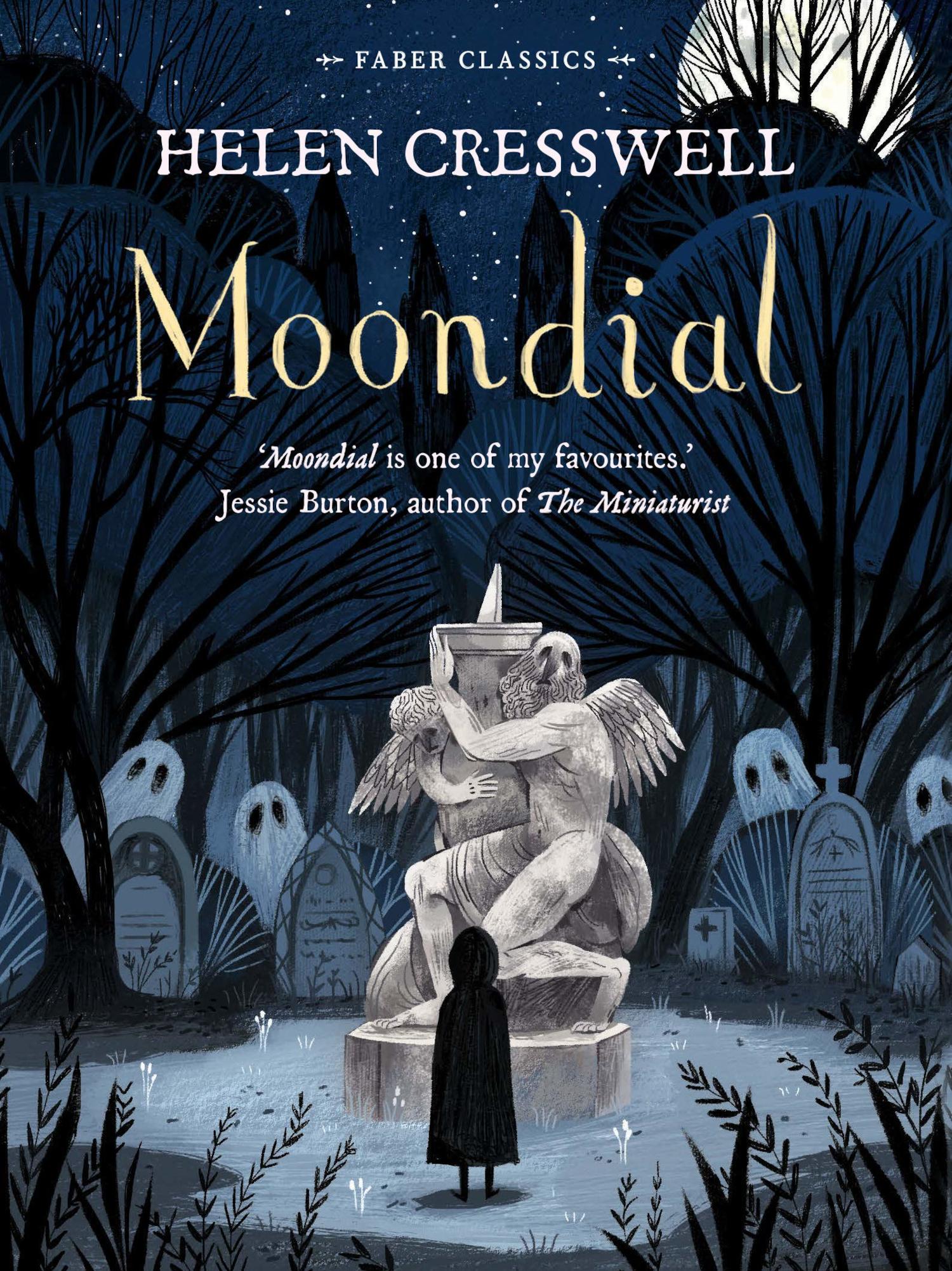
It is midnight in that most dark and secret place. If you should chance – and why should you? – to be walking there, you would be blindfolded by the night. You would hear the hooting of a lone owl from the church tower, the scuff of your own steps on the gravel. You would smell the ancient, musty scent of the yews that line the path, and the curious cold green odour of dew on grass. You put out a hand. It gropes to find the ungiving touch of stone. The shock of it brings an uprush of fear so strong that you can almost taste it.
Helen Cresswell, Moondial
After that second-person address to the reader in the prologue, with its appeal to four of the five senses and a dash of synaesthaesia (“cold green odour”), Helen Cresswell’s Moondial switches to standard third person, omniscient viewpoint but anchored to its central character, and it stays there for the rest of the novel. We are introduced to Araminta Cane, known as Minty, an ordinary mid-Eighties girl, but one who seems to have something of a sixth sense.
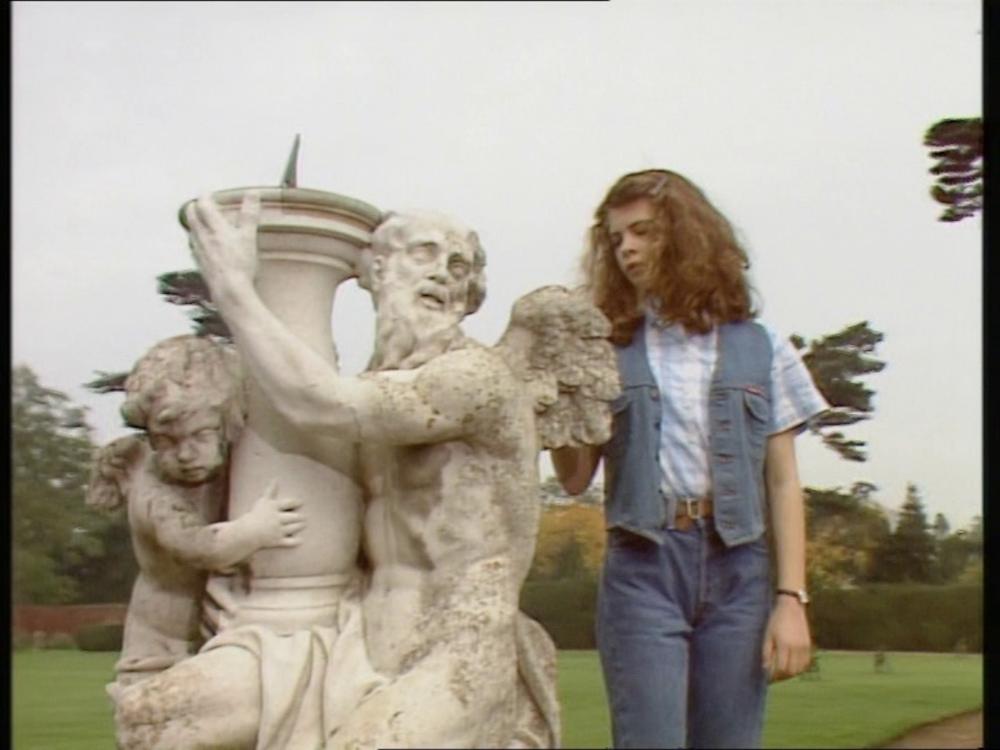
The BBC serialisation of the novel replaces that second-person invocation with a dream sequence but the spirit of the story is the same. Cresswell wrote the script and it’s notable that she’s not beholden to her original novel and felt free to change aspects of it as she needs to. That does speak of her experience as a screenwriter, a decade and a half at this point. Minty (Siri Neal) is living with her mother Kate (Joanna Dunham), her father having passed away a while back. It’s the summer holidays, and Minty is to stay with her aunt Mary (Valerie Lush). While she is there, Minty is fascinated by the old mansion nearby, which has extensive grounds and what is not a sundial at the centre of it…a moondial?
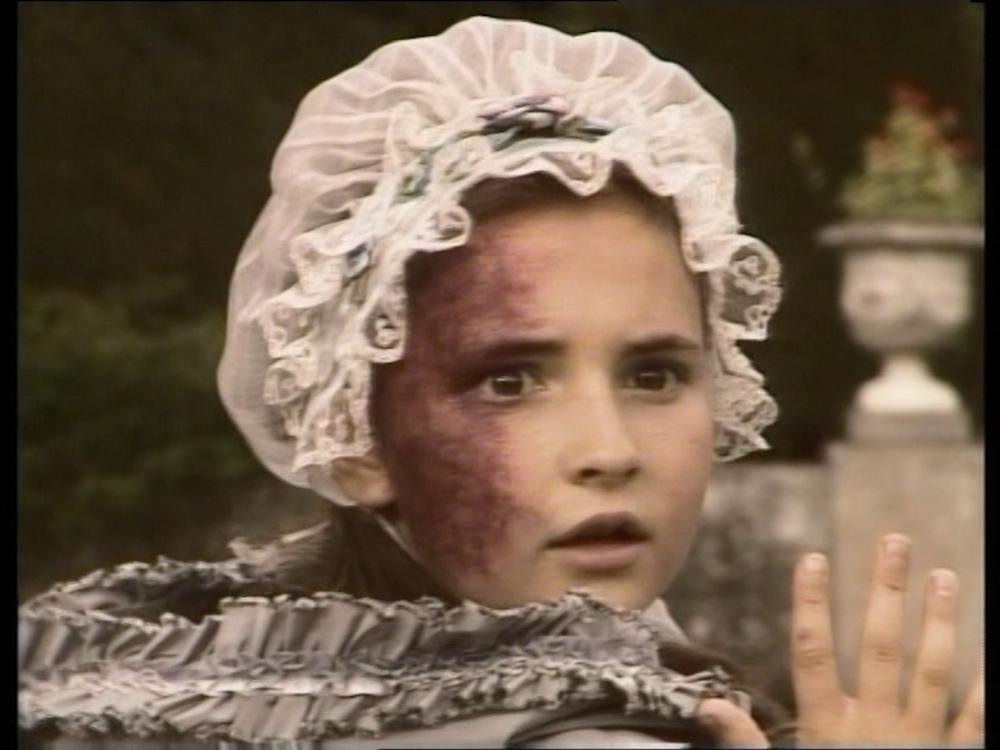
However, Kate has a car accident on her way home from dropping Minty off, and is in a coma in hospital. While visiting her, Minty starts seeing some strange things in the grounds of the house, particularly a young boy, Tom (Tony Sands), who appears to be a kitchen boy from the Victorian era. However, to him, Minty is the ghost. And there’s another girl, Sarah (Helena Avellano), who appears to be from a century earlier, and who is picked on by other children for being a “devil’s child”. Is Minty travelling in time? And what does professional ghost hunter Miss Raven (Jacqueline Pearce) have to do with it
The Author
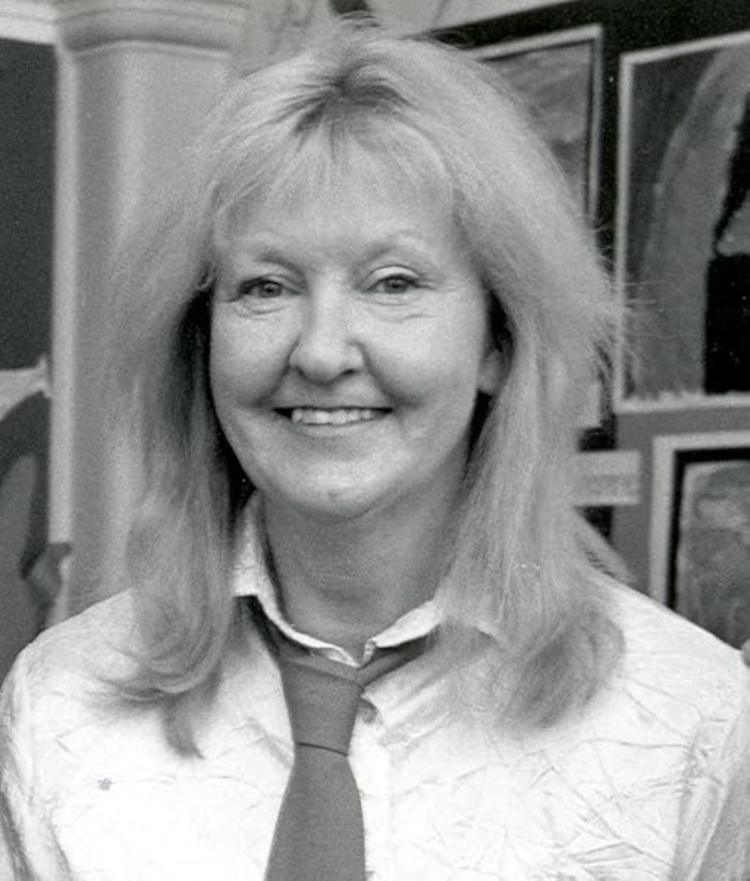
Helen Cresswell (1934-2005) was a prolific author, with over one hundred books for children young and older. Born in Nottinghamshire, her mother arranged Greek-language tuition for her. At the age of twelve, she was hospitalised for a year due to spinal problems, and you’d imagine all that reading time being a stimulus for many an imaginative child and writer to be. Originally a poet, she concentrated on children’s fiction when her first novel, Sonya-by-the-Shore was published in 1960. The Piemakers (1967) was commended for the Carnegie Medal, losing to Alan Garner’s The Owl Service. She was commended or shortlisted three more times (The Night Watchman (1969), Up the Pier (1971) and The Bongleweed (1973)) but never won. However, in 1989 the Children’s Literature Association gave her its Phoenix Award for the best children’s novel of twenty years earlier which hadn’t won an award, for The Night Watchman. On the plotter-to-pantser scale, Cresswell was very much the latter, once saying, “I write a title, then set out to find where that particular road will take me.”
However, Cresswell had a second string to her bow, as a screenwriter. This began in 1973 with Lizzie Dripping, which saw a second series in 1975. In this case the original novel (which saw four sequels) developed in parallel, as Cresswell was commissioned to write an original for Jackanory Playhouse, a series usually devoted to dramatising existing stories. Cresswell wrote Lizzie Dripping and the Orphans, which was broadcast in December 1972. A series followed, as Cresswell wrote the further novels. Penelope (future Blue Peter presenter Tina Heath) is the imaginative girl of the title, “Lizzie Dripping” being a slang term for someone with her head in the clouds, and she is the only one to be able to see a witch (Sonia Dresdel).
After that, Cresswell adapted her own novels for the small screen: Jumbo Spencer (1976), The Bagthorpe Saga (1981) and The Secret World of Polly Flint (1987). She also adapted other people’s work for television: E. Nesbit in Five Children and It (1991) – to which she wrote a television sequel, The Return of the Psammead (1993) – and The Phoenix and the Carpet (1997), Enid Blyton in The Famous Five (ten episodes from 1995 to 1997) and Gillian Cross in The Demon Headmaster (1996-1998).
Cresswell certainly aimed to keep up to date in her work: Moondial is very much a contemporary novel, set in the mid-1980s. However, by the late 1990s it could be said that she was falling out of fashion to some extent, and on television at least, was being supplanted by younger and somewhat edgier writers like Jacqueline Wilson, whose novel The Story of Tracy Beaker, with its care-home heroine, became a successful TV series beginning in 2002. Cresswell’s last work for television was Little Grey Rabbit (2000), an animation based on Alison Utley’s novel. However, Cresswell continued publishing into the new century, with her final book being a retelling of Rumplestiltskin n in 2004, a year before her death from ovarian cancer at the age of seventy-one.
The Serial
Moondial is a timeslip fantasy, a form with a long tradition both in fiction and on screen. Previous BBC examples included Tom’s Midnight Garden, from Philippa Pearce’s novel (dramatised three times by the BBC, and the subject of an earlier piece in this series) and A Traveller in Time, from the novel by Alison Utley, which the BBC dramatised in 1978 with a young Sophie Thompson in the lead. There may be nods to both in Moondial, as when she first meets Tom she gives her name as “Minty, short for Penelope”. (Tom says he is “Tom, short for Edward” and we get an explanation for that towards the end.) While Utley’s Penelope goes back to the Elizabethan era, Minty, like Pearce’s Tom, only travels back a hundred or so years to Tom’s time.
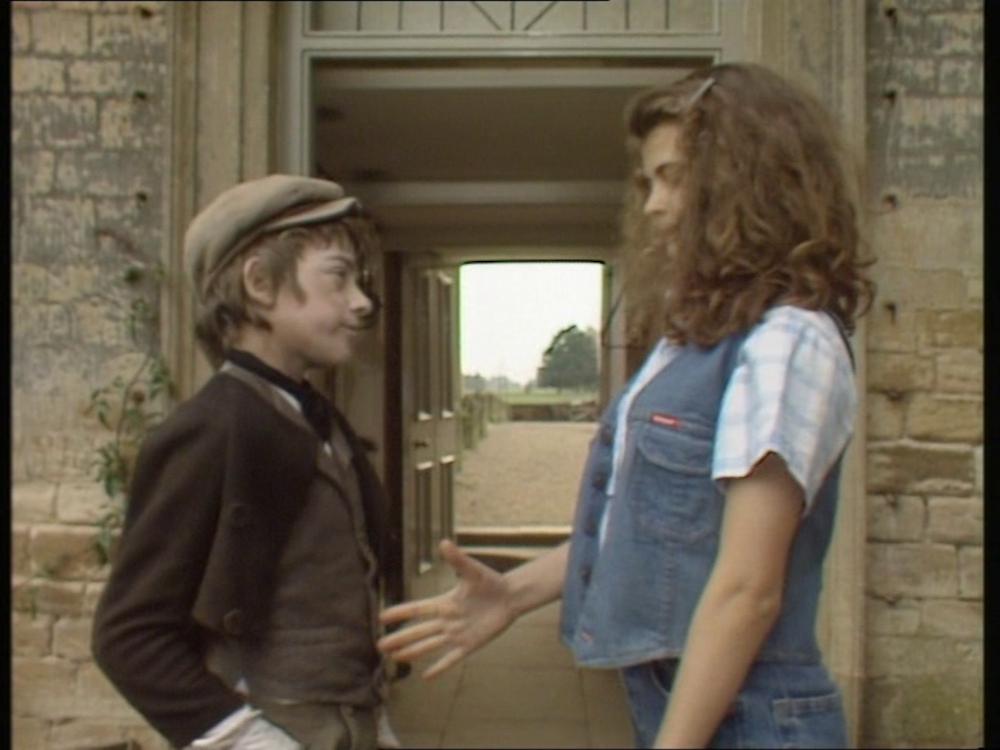
The story has some fun with social changes. Tom wonders how Minty could be a girl when she’s not dressed like one, being in jeans. (She does adopt an old full-length nightdress and cloak for when he meets Sarah, though. Tom even says, “Ladies with legs!” to two elderly visitors to the house with skirts just below their knees.) While she keeps her adventures secret, there are a few adults in the know, particularly the old man known as World (Arthur Hewlett) who may be able to see the “ghosts” in the grounds of the big house. Minty’s other confidante is Kate, as she talks about the happenings to a tape recorder and secretly plays it to her while at her hospital bedside. As for Miss Raven, she may see things herself. She has a counterpart in Tom’s time with the tyrannical kitchen head, Miss Vole (also played by Jacqueline Pearce).
The house in the novel was inspired by the real-life Belton House in Lincolnshire, and it provided the location for the TV serial, shot entirely on video in 1987. As usual, the children’s roles were filled by those from stage schools. One of these was the Corona Theatre School in Hammersmith, West London. Director Colin Cant was wise to the fact that schools often didn’t put forward every one of their pupils who fitted the age and description of the character, sometimes holding back some because they had misbehaved. So Cant asked to see others from the school. One was Siri Neal, who was fourteen years old. She got the part and went on to an adult career which lasted until 2002, by which time she was using the name Siri O’Neal. She ably holds the story together, given that she is onscreen in almost every scene.
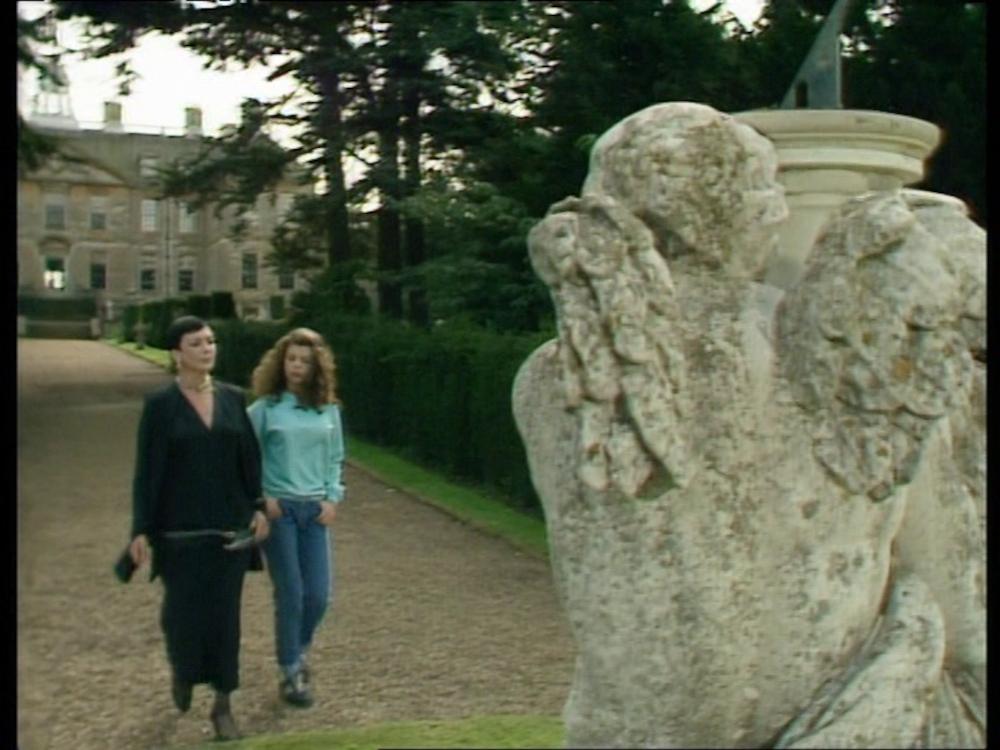
Neal befriended Jacqueline Pearce, though not without the latter putting her in her place by referring to herself as the serial’s leading lady. Of course Neal wasn’t – she was the “juve lead”. Neal and Pearce remained in touch for the rest of the latter’s life. Moondial was also the debut for Tony Sands, who came from Anna Scher’s Children’s Theatre. He has continued to act, as well as write, produce and direct, and has worked in Special Needs Education. He cofounded STEP, a football charity for adults with learning disabilities. This is, however, the only credit for Helena Avellano. They are supported by well-established adult actors, with Jacqueline Pearce’s dual role the showiest. She would be best-known to the intended audience’s older siblings or parents as Servalan in Blake’s 7 (1978-1981) and to an older generation as the lead in the Hammer film The Plague of the Zombies (1966). Here she plays the villain to the hilt, with surprisingly sexually-ambiguous overtones which may well have gone over the heads of the children watching.
TV Broadcast
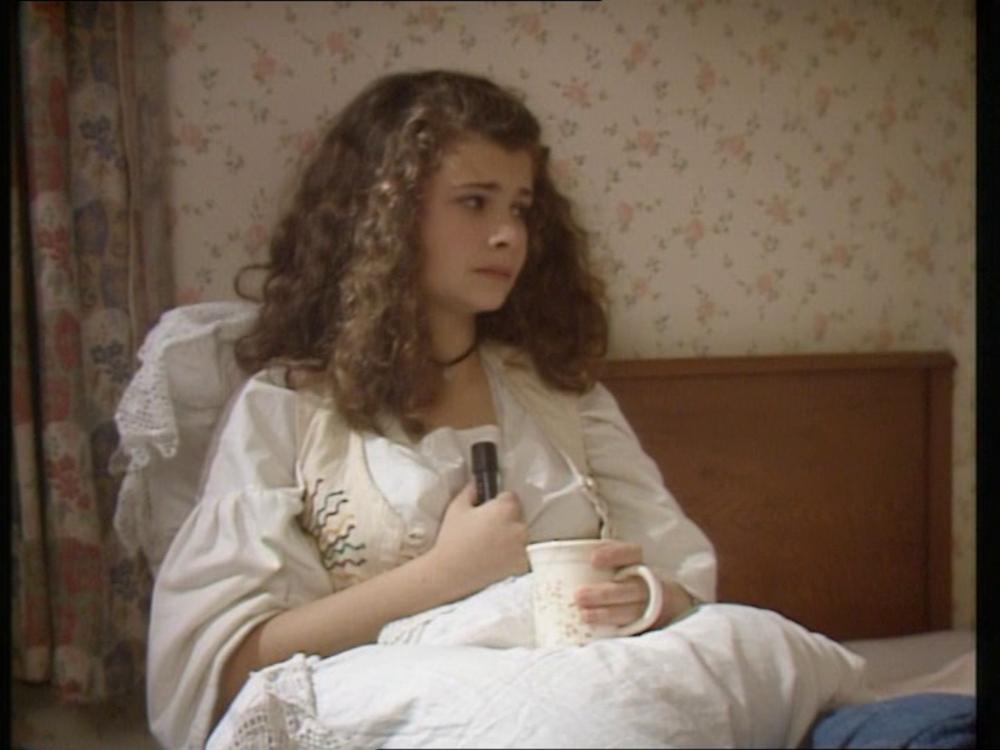
Moondial was first broadcast in 1988, the opening episode of six showing on Wednesday 10 February. It was on at 5pm, in between Newsround and before a Hospital Watch and then Neighbours before the early-evening news. It had a repeat showing beginning on Wednesday 9 May 1990, at 5.05pm, again in between Newsround and Neighbours. It has not had a further TV showing, but Cresswell adapted her novel as a ninety-minute radio play, broadcast on Radio 4 on 7 May 2001 and again on 21 April 2003. The serial was released on VHS in 1990, as a shortened “movie edit” cut down to 112 minutes. This version was also released on DVD in 2000, but it wasn’t until 2009 that the serial was available in its full-length episodic form. It was most recently released on disc in 2019, a DVD including interviews with Colin Cant and Siri Neal, and commentaries on the first and last episodes.
When so much television of its era doesn’t see the light of day after original showings and repeats, still less appear on disc, other than bootleg copies on YouTube and the like, this availability has meant that Moondial is still current for many people. It has a place in the memory of those who saw it at the time or since.
Do you remember reading or watching Moondial? Let us know what you thought in the comments below ⬇️
Title photos taken by the author as screen grabs; other images from IMDb.
Meet the guest poster
Leave a Reply