The shortlisted works across all 13 categories of the British Fantasy Awards have been announced! Find out who’s in the mix over on our blog. Winners announced at Fantasycon in October.
For all things fantasy, horror, and speculative fiction
-
Announcement:
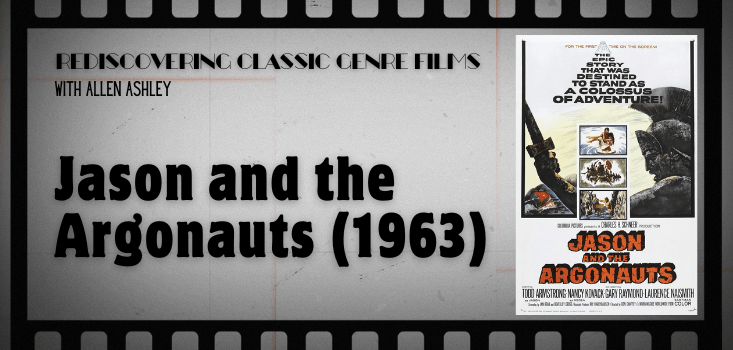
Classic Genre Films:Jason and the Argonauts (1963)
Allen Ashley is training his eye on classic genre films for us, looking at not just the film but the context in which they were released. Here’s the latest instalment in his blog series.
Jason and the Argonauts (1963)
Director: Don Chaffey
Colour
98 minutes approx running time (on DVD)
(All images taken from imdb.com)
(Note: Time stamps are of author’s own noting)

What Are You Offering?

Ancient Greek mythology has got the lot. Heroism, monsters, deities, adventure, locations, prophecies, quests, and morality – sometimes questionable. After a flurry of films mostly involving Ray Harryhausen in some capacity during the 1950s and 1960s, this sub-genre’s Hollywood star has faded somewhat. The co-opting of Norse mythology into elements of the Marvel Universe suggests there has been a change of focus. The film Troy (2004) took something of a critical pounding and seemed to put a lid on adaptations for a while. But this very July, flavour of the month director Christopher Nolan (Oppenheimer, 2023) is bringing us The Odyssey based on Homer’s epic narrative poem, so maybe the tide is turning.
Pick a Side

In the meantime, let’s look back at the much-loved Jason and the Argonauts (1963). It has every quality that I listed in my second sentence. It’s a lush Eastman Color spectacle – some scenes are shot in over-exposed sunset orange coupled with shining azure.
The key mythical characters we know about from the works of Ovid, the aforementioned Homer and in this case Apollonius of Rhodes are often complex individuals who fluctuate between performing heroic feats but later indulging in barbaric arts. Theseus is one example (he’s the unnamed villain in my poem “Ariadne on Naxos PG”, which was in a Fantasy Con souvenir programme). In this film, though, the team line-ups are pretty straightforward. On the good side, we have rightful heir to the kingdom and appealing mix of brain and brawn Jason (played by Todd Armstrong), along with boatbuilder Argus (Laurence Naismith), most of the ship’s hunky crew, and also later love interest, the beguiling priestess Medea (played by Nancy Kovack).
In the evil camp, we have throne-stealing child murderer King Pelias (Douglas Wilmer), and his son Acastus (Gary Raymond) – who somehow finds his way into Jason’s inner circle and betrays our hero in Judas Iscariot fashion. As audience, we are also meant to see King Aeetes of Colchis (played by Jack Gwillim) as a thoroughly bad guy – luring Jason and his men into the court with promises of food, drink and exotic dancing entertainment, but then imprisoning the heroic crew with a view to executing them in the morning.

Certainly, Aeetes’ gleeful order to the skeleton soldiers born from the teeth of the Hydra – “Rise up you dead… Rise and avenge us!” and “Destroy them! … Kill them all!” across minutes 91 to 93 is very much in the spirit of the Wicked Witch of the West sending her “pretties” off to fight (The Wizard of Oz, 1939) or any standard Bond villain enacting their snarling, maleficent attack plan. But one might caution that the Golden Fleece belongs to King Aeetes and the territory of Colchis even if Jason claims divine right to acquire it, having been personally instructed by king of the gods Zeus.
The Quest Begins
This is a quest story and the plot is therefore episodic. The first eight minutes serve as a prologue / origin story as baby Prince Jason is orphaned by the conquering armies of evil Pelias. We even get a prophecy of later doom for the usurper. The watching deities tickle the water and twenty years have passed. Jason unknowingly meets and helps his nemesis Pelias. Jason is a man on a mission – to restore himself as rightful ruler of Thessaly – and in order to do this must travel to the ‘end of the world’ and bring back the magical, healing golden ram’s fleece.

The goddess Hera (played by Honor Blackman, soon to be Pussy Galore in Goldfinger, 1964) will assist Jason, although her husband Zeus (Niall MacGinnis) limits those interventions to five questions only. Along the way, Jason inadvertently invents the Olympic Games and if you like sweaty bronzed blokes clothed only in white loincloths there is plenty of that for you here!
Scary Monsters

Once the sea voyage gets underway, aboard the “Argo” with its figurehead a representation of Hera curiously placed in the ship’s stern section, there is danger aplenty. Fighting, capsizing, shipwrecks, drowning, and encounters with antipathetic mythical creatures – harpies, Titans, the Hydra. Like many quest or journey tales, Jason and the Argonauts is largely a series of connected set pieces. But what set pieces!
The creative special effects genius at work here is once again the revered master of stop-motion animation, Ray Harryhausen. The harpies are winged creatures with jerky, bat-like movements that add to the sense of difference and unnatural provenance.
The Hydra – a massive, snake-like creature with multiple spitting heads – is classic Harryhausen, the venomous mouths moving and attacking unpredictably as the supernatural monster protects the Golden Fleece from thieves and intruders.

My favourite foe on this rewatch is Talos, the huge animate alloy statue who comes to life on the Isle of Bronze. The moment when he lumbers into view from behind a cliff, sending the comparatively tiny human Argonauts scurrying for safety (c34m) has echoes of the so-called “creature feature” movies of the 1950s and their progenitor King Kong (1933).
The film’s music is once again composed by Bernard Herrmann. It may be heretical of me to say so but I found the score occasionally brash and intrusive. The very best soundtrack moment occurs at about minute 33 and it’s the deep metallic clanking sound as the statue Talos comes to life and steps down from his pedestal. Close your eyes and listen and you will know exactly what is happening with the gear movement of one bronze plate or joint against another.

Skeletons out of the Cupboard
Then there’s the famous battle featuring Jason alongside his two companions Phalerus (Andrew Faulds) and Castor (Ferdinando Poggi) against the blade-wielding skeletons that spring up from the ground when Aeetes scatters the teeth of the deceased Hydra.
What follows is one of the best sustained swordfights in cinematic history as our three brave young men take on the seemingly indestructible killing machines in what many consider to be Harryhausen’s finest ever stop-motion sequence. Accompanying DVD extras or You Tube videos attest to just how tightly rehearsed and syncopated the choreography had to be to get this sequence to work and excite (c93-97m). It makes for a thrilling and fitting climax to a good, old-fashioned heroic adventure.

Chess Moves
There is one other defining characteristic of the film and it is the linking scenes featuring the gods and goddesses on Mount Olympus meddling in human affairs, with even our greatest monarchs and heroes the mere pawns or playthings of the Olympians. We first encounter Zeus and Hera swirling the water of their magic viewing pool at about minute seven. Soon afterwards (c.11m), Jason is transported by Hermes to Mount Olympus where he appears to be about six inches tall compared to the clustering deities. If you’ve ever seen Captain Kirk in the original “Star Trek” series boldly standing up for himself and humankind in general against superior / stronger / more intelligent / vaster beings, this scene is the precursor. The influence on “Star Trek” doesn’t end there, either. There’s a subtext in this film, expressed by Zeus himself on occasion, that one day homo sapiens will stop believing in gods living in palaces in the sky. This notion was essentially extrapolated in the classic Star Trek episode “Who Mourns For Adonias?” (1967) in which the crew of the Enterprise encounter Apollo, the last surviving Olympian, who demands their obedience.
Yes, the pantheon of gods is more Caucasian than Grecian. That’s a reflection of the casting decisions common at the time of the film’s production. From a jaded, modern day perspective, one might feel that these switches to and from Mount Olympus make the whole story veer towards the cosy. Cosy? You need to add up the death count, pal. Besides, I would say that these intermissions are essential to the movie’s charm. This filmic adaptation of a Greek myth is a classic take on the Classical.
– Allen
What did you think of Jason and the Argonauts? Let us know in the comments below ⬇️

Meet the guest poster