The shortlisted works across all 13 categories of the British Fantasy Awards have been announced! Find out who’s in the mix over on our blog. Winners announced at Fantasycon in October.

For all things fantasy, horror, and speculative fiction
-
Announcement:
Review Details
Review type: Book
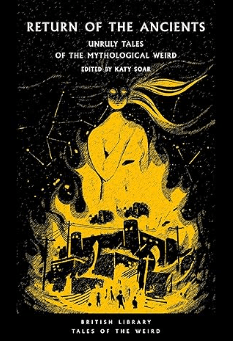
Title: Return of the Ancients
Editor: Katy Soar
Publisher: British Library Publishing
Release date: 22nd May 2025
Reviewed by: Pauline Morgan
Other details: Paperback RRP £10.99
Return of the Ancients by Katy Soar
Book Review
Pauline Morgan
Whatever your religious beliefs, myths and legends tend to hold a fascination. Although in some cultures tales of these elder Gods and Goddesses are taken seriously, for most, they are exciting fantasy tales, often filled with heroic deeds. Most of the stories of the higher members of the Greek and Roman pantheons are well known, but there are many more stories of the lesser gods. Writers through the ages have drawn on all kinds of mythology, and in these stories, they have supposed that their influences are still extant. In the majority of these stories, the encounter with the ancient god or goddess in set approximately at the time the author was writing.
‘Dionea’ by Vernon Lee (1890) relates, in epistolary form, the story of a child found washed up on a beach and brought up in a convent. She is called Dionea, as this is the name on a parchment pinned to her clothes. As she grows up, she seems to leave havoc in her wake. The suggestion is that she is a reincarnation of Dione, one of the Greek Titans. Also drawing on Greek mythology is ‘More Spinned Against…’ by John Wyndham (1953). Lydia’s husband is a collector of spiders. When he has identified them, he usually preserves them, though he does keep some alive to study. His latest acquisition is beautiful, and she tells Lydia that she is the mythical Arachne. She persuades Lydia to change places with her for a day, but Arachne as a human has the same mating habits as many spiders. Harpies, too, are of Greek origin. In ‘The Face in the Wind’ by Carl Jacobi (1936) the wall at the edge of the marsh has always been said to have been built to keep the frogs out of the garden. When the narrator decides to have part of the wall repaired, he disturbs the charms that keep the Harpies in the marsh.
There are many stories that centre around taking something from its proper place and invoking a curse. In ‘The Ring’ by Thomas Graham Jackson (1919) archaeologists open up an untouched Etruscan tomb. Bryant takes a ring from the tomb, and this angers the thunder god, Tinia. Once he realised his mistake, he tries to get rid of it. He dies before he is able to return it to the tomb.
Different groups of people emigrating to other countries take their beliefs with them. In ‘The Great Mother’ by R. Ellis Roberts (1923) it appears that there are traces of the worship of Cybele, a Phrygian goddess from central Turkey. Here, a young man ventures into a wood in Oxfordshire in search of her and is never seen again. The Roman legions brought their worship of Mithras with them from the Middle East. In ‘Family History’ by Stephen Baxter (1998), Valler is trying to persuade his elderly father to give up his obsession with Mithras and move into a care home. It is when he stops on the way to his home at the church on Hadrian’s Wall, which his mother used to take him to, that he discovers the underground crypt where the soldiers were inducted into the cult. Now it is his turn.
Britain also has its own mythology pre-dating the Roman invasion. In ‘The Wind in the Portico’ by John Buchan (1926) an eccentric man finds an altar stone dedicated to the pre-Roman god Vaunus in a wood. He has it moved and builds a portico in the grounds of his house to accommodate it and has plans to rededicate the altar to the god.
Owls turn up in many mythologies, often as omens of death. ‘The Owl’ by F.A.M. Webster (1931) has its origins in South America. Alison is scared of birds, but she is induced to accept the marriage proposal of a man who will pay off her father’s gambling debts. The potential groom is a member of an Aztec owl cult and has a reputation for cruelty. Alison is saved by falling in love with another man who is determined to protect her.
Cats, too, appear in different mythologies, but the best known ones are probably Egyptian. In ‘Pussy’ by Flavia Richardson (1931) the green statuette of a cat changes into a much larger beast and kills its purchaser. The implication is that this is a manifestation of the Egyptian goddess Pasht. Also coming from North Africa is a box in ‘The Veil of Tanit’ by Eugene De Rezske (1932). Inside is the Zaimph, a veil that when worn protects the wearer. The box is opened by a professor of antiquities, but it is also being sought by followers of Tanit. He gets the adventure he had always craved before making decisions about his own life.
Opening tombs and sealed temples is always a risky business. In ‘Serpent Princess’ by Edmond Hamilton (1948) the opening of the temple of the Babylonian goddess Tiamat awakens her from sleep. Realising they have unleashed evil on the world, she has to be put back to sleep.
Closer to home, ‘Above Ker-Is’ by Evangeline Walton (1978) is set in Brittany. It is the confession of a man who gave up his calling as a priest when he killed a woman he came to believe was the incarnation of a goddess responsible for drowning a city. ‘The House of Fenris’ by John Cooling (2008) takes on Norse myth. In the cellars of an old house, the legend of the binding of the wolf Fenris is played out in the shadows.
‘Justice Tresilian in the Tower’ by Ken Alden (1980) is the only story here that has an historical setting. Justice Tresilian was a real historical figure from the 14th century who was incarcerated in the Tower of London. In some ways, he is an incidental character, as the god that manifests is Bran, a Celtic deity who was buried under the White Tower to protect Britain.
At the end of this volume is information about the deities that each story has embraced.
This book barely touches the volumes of fiction that have taken the ancient pantheons as their subject, but it does give an idea of the popularity this theme has had. With a greater understanding of world cultures, this is only going to grow.
Meet the guest poster
All reviews
Latest Reviews:
- The Henchperson’s Guide to Unionizing by Marshall J. Moore
- Ballad of the Bone Road by A.C. Wise
- Bodies of Magic by Freya Marske
- The Big Bad Book of Kaiju ed by Jonathan Maberry and Henry Herz
- Wolf Worm by T. Kingfisher
- Tales From The Territory by Travis Baldree
- God’s Vengeance by Theresa Derwin
- An Empire in the Clouds by Ai Jang
- Warhammer: the Old World Roleplaying Game Player’s Guide
- Warhammer: the Old World Roleplaying Game, Gamemaster’s Guide
Review tags:
Action (51) Adventure (74) Contemporary Fantasy (20) Fantasy (134) Harper Voyager (17) Historical Fantasy (21) Horror (94) Mystery (15) Orbit Books (34) Romance (31) Romantasy (16) Science Fiction (41) Short story collection (17) Titan Books (51) Tor (18)
Leave a Reply