The shortlisted works across all 13 categories of the British Fantasy Awards have been announced! Find out who’s in the mix over on our blog. Winners announced at Fantasycon in October.

For all things fantasy, horror, and speculative fiction
-
Announcement:
Review Details
Review type: Book
Title: The Henchperson’s Guide to Unionizing
Author: Marshall J. Moore
Publisher: Bantam
Release date: 22nd September 2026
Reviewed by: Luna Gray
Other details: Paperback RRP £15.91
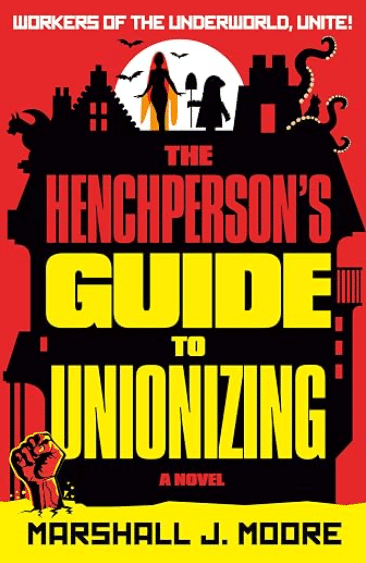
The Henchperson’s Guide to Unionizing by Marshall J. Moore
Game Review
Luna Gray
Gothic horror has always run on terrible jobs. Somebody has to rob the graves. Somebody has to stand beside the vampire for a few centuries, looking decorative. Somebody has to be the witch’s cat. The masters get their names on the spines, and the help gets a single line of dialogue, usually screamed.
Marshall J. Moore’s The Henchperson’s Guide to Unionizing (Bantam, 384 pages) is built out of those single lines, and I loved it. Igor is lab assistant to a doctor who is brilliant, demanding, and far too fond of electricity. When the latest torch and pitchfork mob drives them out of town (again), they land at Ravenwald Manor. The house already has tenants: a vampire Count and his bride, Cornelia, plus a witch and her familiar, Grimalkin. Three servants, three masters, one very large and drafty house. You can probably guess what starts happening once the help gets talking.
Igor is where the labor satire hits hardest. The Doctor gets to be the genius. Igor gets the graves, the stitching, the inventory and the moving house every time the villagers light up. He also gets the ongoing job of making sure his employer doesn’t electrocute himself too badly. Moore has compared the split to hardware and software, and the book makes you feel how lopsided that deal is. Igor is exploitable precisely because he’s good at his job. Every problem he quietly solves becomes one more thing the Doctor assumes will always get solved.
There’s a horror history joke buried in here that I enjoyed enormously. Mary Shelley never wrote an Igor. Frankenstein’s assistant grew out of stage and screen adaptations until the hunchbacked henchman became so familiar that popular culture gave him a name the original novel never did. His entire reason for existing was fetching things for a more important man. Horror has spent a century asking what the mad scientist owes to his creature. Moore wants to know what he owes the guy who dug it up.
Moore keeps the familiar hunch and the difficult gait. But the book’s attention goes to Igor’s competence and his craft. The body stays. The old shorthand that treated his body as evidence of stupidity or rot does not.
If the novel were only about Igor, “unionizing” would fit neatly. Cornelia and Grim complicate it, and I think that’s the smartest move Moore makes. Cornelia is not an employee with a lousy boss. She’s a vampire’s bride, supernaturally compelled to obey the one who made her, which turns control into something literal and intimate. What do you owe somebody who believes your loyalty belongs to him because he made you what you are?
Grimalkin’s problem is different again. A familiar is defined by service, so kind treatment is only half the question for Grim. The other half is whether anyone else gets to decide what Grim is.
Those three situations rhyme without matching. The real turning point isn’t a contract or a vote. It’s comparing notes. Each of them walks in assuming they simply got unlucky with their particular master. Then they start talking, and a private misery turns out to have a shape.
Which brings me to my one real reservation, and it’s about the title as much as the book. This is less a story about organizing than a story about recognizing abuse and getting out of it. That works for the characters. It also means “unionizing” ends up stretched across a lot of territory: leaving a coercive bond, claiming your own identity, finding your people. Moore connects those things warmly, but they aren’t the same fight. Anyone hoping for the mechanics of collective bargaining in a haunted manor will find the book far more interested in the moment before that, when you realize you’re allowed to want out.
The cozy elements work in both directions for me. The warmth, the found family, and the queer romance show you what a decent alternative looks like, and that makes the Doctor and the Count look worse by comparison. Kindness makes a damning backdrop for coercion. Every so often, though, the coziness sands down an edge I’d have liked left sharp, and the exploitation starts to feel safer than the premise first threatens.
I minded that trade less than I expected to. Moore has said he wanted to write something hopeful and fun after a difficult stretch, and hope is the engine here. The book just occasionally lets hope do a job that dread could have done.
Then there’s Spare, a creature who puts Igor in charge of someone more vulnerable than himself. I’ll say only that Spare keeps Igor from being a spotless victim. Liberation in this book includes refusing to become the Doctor the moment you get a little power over someone. That’s the Frankenstein question turned around and handed to the assistant, and it’s the thread I haven’t stopped thinking about.
Moore makes the premise work. The title oversells the paperwork. What the book actually delivers is three servants discovering that being needed was never the same as being owned. That turns out to be funnier, stranger, and more generous than a book about a union vote would have been. I’d follow Igor to the next manor. I’d just like him to get paid this time.
Tags: FantasyFound FamilyHumourVampires
Category: Game Review
Meet the guest poster

All reviews
Latest Reviews:
- The Henchperson’s Guide to Unionizing by Marshall J. Moore
- Ballad of the Bone Road by A.C. Wise
- Bodies of Magic by Freya Marske
- The Big Bad Book of Kaiju ed by Jonathan Maberry and Henry Herz
- Wolf Worm by T. Kingfisher
- Tales From The Territory by Travis Baldree
- God’s Vengeance by Theresa Derwin
- An Empire in the Clouds by Ai Jang
- Warhammer: the Old World Roleplaying Game Player’s Guide
- Warhammer: the Old World Roleplaying Game, Gamemaster’s Guide
Review tags:
Action (51) Adventure (74) Contemporary Fantasy (20) Fantasy (134) Harper Voyager (17) Historical Fantasy (21) Horror (94) Mystery (15) Orbit Books (34) Romance (31) Romantasy (16) Science Fiction (41) Short story collection (17) Titan Books (51) Tor (18)
Leave a Reply