The shortlisted works across all 13 categories of the British Fantasy Awards have been announced! Find out who’s in the mix over on our blog. Winners announced at Fantasycon in October.

For all things fantasy, horror, and speculative fiction
-
Announcement:
Review Details
Review type: Book
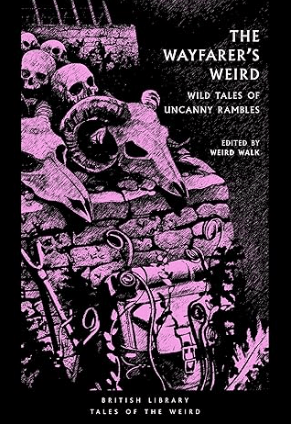
Title: The Wayfarer’s Weird: Wild Tales of Uncanny Rambles
Editor: Weird Walk
Publisher: British Library Publications
Release date: 21st August 2025
Reviewed by: Pauline Morgan
Other details: Paperback RRP £10.99
The Wayfarer’s Weird: Wild Tales of Uncanny Rambles by Weird Walk
Book Review
Pauline Morgan
Even in a country that is becoming more and more congested, there are still places where modern society does not intrude, where solitude can still be found. Whatever most people expect, there are places that do not have universal mobile phone signals, where it is possible to get lost in lonely places. In the past, getting lost, or encountering the unusual or scary, help was not a phone call away. Venturing into the wilderness was, and still is, an enjoyable pastime. The hikers in the stories if this volume, though, did not always come home refreshed. All these fourteen stories, written over more than a hundred years, are set within the British Isles.
Sometimes the consequences of the original walk don’t appear until afterwards. In ‘The Wraith of Barnjum’ by F. Anstey (1879) the narrator is walking on Cader Idris in Wales with an acquaintance who he doesn’t much like. On the walk, he pushes Barnjum over a cliff. On returning home, he discovers he is being followed by a wraith. The wraith of Barnjum is as irritating as the man had been, being able to change his clothes and be visible to others. The story has elements of farce.
‘The Wood of the Dead’ by Algernon Blackwood (1906) is very different. Set in Somerset, the narrator arrives at an inn where he is told the story of the Wood of the Dead. If someone is seen walking into it, it is a premonition of their death. At night, he follows the innkeeper’s daughter into the wood, where he meets an old man who shows him a vision of the girl working in the fields with her betrothed. This is a very atmospheric story.
Prophecies come in different forms. Hester, in ‘The Face’ by E. F. Benson (1924) has a recurring dream which turns into a nightmare. On a visit to the Suffolk coast, she sees a portrait of the man that appears in the dream. then on a walk on the cliffs, she sees the church she recognises from the dream.
‘All Hallows’ by Walter De La Mare (1926) is a very descriptive piece with the walker arriving at a cathedral on a beach. The verger gives him a tour, hinting at ungodly things that have happened there. Nothing much happens, and for the modern reader, it could seem a touch tedious.
‘The Cairn’ by H.R. Wakefield (1929) is an example of a young man doing what the locals advise him against. In the Lake District, Seebright decides that the warning not to climb up to the cairn on the top of the hill when there is snow on the ground is just a superstition. As is common in such stories, he should have listened to those who knew what they were talking about.
‘The White Sack’ by A. N. L. Munby (1945) takes place on Skye and introduces a common means of getting lost in the hills. It is also a story within a story, as Marchand relates to his friend how he was chased across boggy terrain by a mist that seemed sentient.
‘Cwm Garon’ by L. T. C. Rolt (1948) takes the reader back to Wales, this time to the Black Mountains. A brooding menace in the valley kills one man and lures back another to witness the visitation of the threat.
Mist plays a role in ‘The House of Balfother’ by William Croft Dickinson (1963). Lost in the mist and dark, the narrator finds an old tower house and demands shelter for the night. There he encounters a strange man. Later, back home, he discovers a tale about a man who cannot die being kept in the tower, though when he returns, all he can find of the place is a few stones.
Not all the stories are encounters on wilderness walks. In ‘The Derelict Track’ by Dorothy K. Haynes (1971) Teddy regularly walks along a disused railway track to an abandoned station from where he collects items. He has a complicated home life but eventually persuades his mother the come with him to see the ghost of a train that stops at the station.
In ‘Above the World’ (1979), Ramsey Campbell takes us to the Lake District. Getting lost on the fells, in what should be familiar territory, a seasoned rambler realises that he is tracing the last walk his ex-wife and her new husband took before they died.
Lisa Tuttle takes local Scottish folklore as the basis for her story ‘Redcap’ (1984). After a walk to an isolated castle, Carter is told a grisly tale by the caretaker. As in any good horror story, not everyone is who they seem.
‘The Pharisees’ Glass’ by R. B. Russell (1992) is another example of a tale within a tale. Set in Sussex after the great storm of 1987. The Pharisees of the title are the local name for fairies, and the fragment of glass, when looked through, revealed the truth about what was being observed.
‘Dragon Path’ by Jacqueline Simpson (2002) is a revenge story that has unexpected consequences. Mike, who has absorbed a lot of local history, is mocked by his companions when he talks about ley lines. Unfortunately, he hasn’t thought through the consequences of his actions. ‘On Ilkley Moor’ by Alison Littlewood (2014) is another revenge story, this time set in Yorkshire. The narrator goes back home to meet up with an old school friend, not realising that the reason for the meeting goes back to events that happened when they were much younger.
Many of the ramblers in these stories are walking alone, and often the atmosphere can work on the spirit of the walker. The imagination can work overtime, but these stories suggest that there really are scary things out there. What is interesting in this volume is how the approach has changed over the years.
Tags: British Library PublishingClassicFantasyHorror
Category: Book Review
Meet the guest poster
All reviews
Latest Reviews:
- Tales From The Territory by Travis Baldree
- God’s Vengeance by Theresa Derwin
- An Empire in the Clouds by Ai Jang
- Warhammer: the Old World Roleplaying Game Player’s Guide
- Warhammer: the Old World Roleplaying Game, Gamemaster’s Guide
- The Harpy Knight by Sara Omer
- What Stalks the Deep by T. Kingfisher
- This is Where the Future Bleeds by Mike Brooks
- The Wayfarer’s Weird: Wild Tales of Uncanny Rambles ed by Weird Walk
- The Witch Without Memory by Maithree Wijesekara
Review tags:
Action (51) Adventure (74) Contemporary Fantasy (20) Fantasy (131) Harper Voyager (17) Historical Fantasy (20) Horror (92) Mystery (15) Orbit Books (34) Romance (31) Romantasy (16) Science Fiction (41) Short story collection (16) Titan Books (49) Tor (16)
Leave a Reply