The shortlisted works across all 13 categories of the British Fantasy Awards have been announced! Find out who’s in the mix over on our blog. Winners announced at Fantasycon in October.

For all things fantasy, horror, and speculative fiction
-
Announcement:
Review Details
Review type: Book
Title: PHANTOMS OF KERNOW: Classic Tales of Haunted Cornwall
Editor: Joan Passey
Publisher: British Library Publications
Release date: 19th June 2025
Reviewed by: Pauline Morgan
Other details: Paperback RRP £10.99
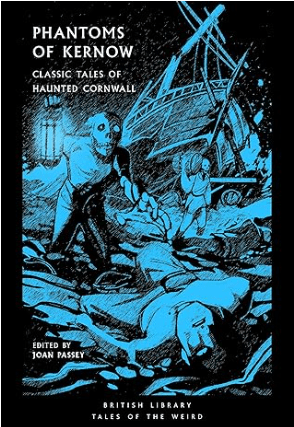
PHANTOMS OF KERNOW: Classic Tales of Haunted Cornwall by Joan Passey
Book Review
Pauline Morgan
To most people, the term phantom relates to a ghost or a ghostly apparition. In this collection of stories from past masters of the genre, it often means weird. Not all these stories have a definite ghostly presence, but all have some supernatural element and all have a strong connection to Cornwall.
As Cornwall is a county with sea on three sides, it is not surprising that it would feature in several tales. ‘The Spectre Ship of Porthcurno’ by Robert Hunt (1865) is a recounting of a local story in which a phantom ship sails inland on the mist. Anyone who sees it can expect bad luck. ‘The Wrecker and The Death Ship’ by William Bottrell (1873) is another retelling of a local myth. This time the ghostly ship comes to claim the spirit of a man who gained his wealth as a wrecker.
‘The Ghost of the Treasure Chamber’ by Emily Arnold (1886) provides a story of a benevolent ghost. The narrator follows the ghost of an ancestor and is able to find why he hid the famed treasure trove no-one in the centuries since had been able to find. She saves the family from penury. Equally benevolent is the ghost in ‘A Pair of Hands’ by Arthur Quiller-Couch. The narrator rents a cottage in Cornwall and wonders how the housekeeper is able to do all the work, and anticipate her wishes. She discovers that the ghost of a child, of which only her hands are ever visible, is responsible. Another thoughtful ghost is in Sabine Baring-Gould’s story ‘Aunt Joanna’ (1904). Here, an old woman makes sure her wealth goes to the right people from beyond the grave. This is a haunting of the more traditional kind.
‘The Ghost of Carnaquilla’ by Elliott O’Donnell (1910) is one of those stories in which the narrator becomes lost in the mist and encounters ghosts from Cornwall’s Celtic past. He is never sure if this is a real ghostly visitation or a dream. The narrator of ‘Mrs. Lunt’ by Hugh Walpole (1926) has a similar concern. Visiting an acquaintance in Cornwall, he wonders if he truly saw the ghost of his host’s dead wife or if he imagined it since he had taken an instant dislike to the house.
The other stories cannot be strictly ghost stories but definitely fall into the category of weird. ‘The Toll of Charon’ by Richard Dowling (1878) takes the idea that the county doesn’t willingly let its people leave. Maud is a schoolmistress with ambitions of being a singer/songwriter. She saves enough to get to London but finds life there much harder than expected. The supernatural element is very low-key, as it is in ‘Dr. Wygram’s Son’ by G. M. McCrie (1887). The narrator is told by Dr Wygram that his son was given an elixir to save his life but has made him immortal at fourteen, and Wygram wants help in reversing the process. As it turns out, there is a much more mundane explanation for the situation, and it is Wygram who is in need of help. ‘The Iron Pineapple’ by Eden Phillpotts (1926) can also be regarded as a tale of mental illness. In this case, the narrator has spells of obsessiveness. He develops a hatred for a painter who sketches on the beach and an obsessive love for the iron pineapple which was a decoration on the wall of a newly built house. The idea of getting the two together is all that he can think about.
Cornwall has been a place where mining of tin was common. ‘The Man Who Coined His Blood into Gold’ by J. H. Pearce (1893) uses a mine as a setting. The miner breaks through into a cavity, freeing a demon. The demon offers a reward, but the miner doesn’t phrase his request properly and as a result loses his life and his soul.
‘Father Brent’s Tale’ by R. H. Benson (1906) is an unsolved mystery. The large wave experienced on the River Fal by the narrator could be as simple as a tidal bore, or it could be a supernatural phenomenon caused by an adolescent boy. ‘The Living Stone’ by E. R. Punshon (1939) also involves a mystery, this time of disappearing people. Cornwall is a county littered with prehistoric monuments, including standing stones. In this case, the stone appears to have been the focus of human sacrifice. It absorbed the blood of the victims and is now hungry and beginning to hunt.
‘The Misanthrope’ by J. D. Beresford (1914) relates the unfortunate predicament of a hermit. Living alone on an island, he has the peculiar ability to see the ugly side of a personality by viewing them over his shoulder. The monster in ‘Negotium Perambulans…’ by E. F. Benson (1922) is a kind of vampire. Slug-like in appearance, it sucks out the blood from any inhabitant of a particular house who doesn’t keep the lights burning throughout the night.
‘The Old Man’ by Daphne Du Maurier (1952) is a gentle story of a family growing up beside a lake. It is only when the children have all gone that the narrator sees the truth about them as the parents leave in the form of swans.
Like all the anthologies in this there are stories that show the origins of some of the themes that are current in more recent writing, and show the imagination and skill of authors who have been forgotten.
Tags: British Library PublishingClassicGhost storyHorror
Category: Book Review
Meet the guest poster
All reviews
Latest Reviews:
- Tales From The Territory by Travis Baldree
- God’s Vengeance by Theresa Derwin
- An Empire in the Clouds by Ai Jang
- Warhammer: the Old World Roleplaying Game Player’s Guide
- Warhammer: the Old World Roleplaying Game, Gamemaster’s Guide
- The Harpy Knight by Sara Omer
- What Stalks the Deep by T. Kingfisher
- This is Where the Future Bleeds by Mike Brooks
- The Wayfarer’s Weird: Wild Tales of Uncanny Rambles ed by Weird Walk
- The Witch Without Memory by Maithree Wijesekara
Review tags:
Action (51) Adventure (74) Contemporary Fantasy (20) Fantasy (131) Harper Voyager (17) Historical Fantasy (20) Horror (92) Mystery (15) Orbit Books (34) Romance (31) Romantasy (16) Science Fiction (41) Short story collection (16) Titan Books (49) Tor (16)
Leave a Reply