The winners of the British Fantasy Awards 2026 were announced at Fantasycon. Find out all the details on our blog.

For all things fantasy, horror, and speculative fiction
-
Announcement:
Review Details
Review type: Book
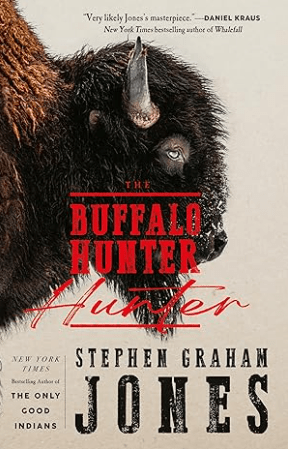
Title: The Buffalo Hunter Hunter
Author: Stephen Graham Jones
Publisher: Titan Books
Release date: 29th April 2025
Reviewed by: Pauline Morgan
Other details: Paperback RRP £10.99
The Buffalo Hunter Hunter by Stephen Graham Jones
Book Review
Pauline Morgan
There is a long tradition of novels based around a ‘found’ manuscript. Often it is framed within an explanation of how the document was found along with some scepticism about its authenticity, as it often contains an account of some hard to believe supernatural event. The Buffalo Hunter Hunter uses this technique but then takes it a step further by considering the consequences of the discovery.
The framing device has a setting of 2012, when a worker renovating a parsonage discovers a journal concealed within the wall. Because of the unusual name of the author, a Lutheran pastor called Arthur Beaucarne, the academic Etsy Beaucarne is contacted as the rightful owner of the journal, as the writer of it was her great-great-grandfather. She hopes that she can use it to produce the publication she needs to make tenure. The journal itself is very fragile, but she is able to transcribe the scans of the pages she is sent by the conservator who is trying to preserve it as a historical document.
The journal itself makes up the bulk of the novel and was written in 1912. At that time, Arthur Beaucarne was the pastor of a church in Miles City, a town in Montana. When an Indian starts turning up to his Sunday service, he is curious. Then the Indian, a Pikuni – part of the Blackfoot tribe – tells him that he wants to make a confession. Over the next few Sundays, the Indian, whose adult name is Good Stab, relates his life, and Beaucarne writes them down in his journal. Many years ago, Good Stab was with a party who came across burning wagons. All the men accompanying it were dead,, but it had been made to look as if
Indians were the killers. This prompted the group to get rid of the evidence, as the signs indicated that it was a troop of American soldiers who had committed the atrocity. In the wagon left standing, they found a cage with a strange man inside. Good Stab called him Cat Man as he had long teeth and nails and was pale-skinned. The Indians decided that he could be the Great White God. Tradition said that if they could get him up the Chief Mountain, it would crumble and open a way for all the tribes to pass, leaving all the napikwan (white men) behind.
The weather at the time blew up a blizzard, and the Pikuni were caught in it. The soldiers caught them and killed and burned all the bodies. During the skirmish, Cat Man was literally blown apart, and as he died, some of his blood was ingested by Good Stab. It was that which enabled Good Stab to survive. He discovered that now he could sustain himself by drinking blood and that he couldn’t die.
The novel is complex. Between the sessions he has with Good Stab, Beaucarne also recounts what is happening in Miles City. A body is found outside the town. The skin has been flensed and the tongue cut out. The face is painted yellow and black. A dog dies. After another body turns up in a similar condition, a Pinkerton man appears looking for a man and his two sons who have been kidnapped. The body is likely to be that of one of the missing people, and the Pinkerton man dies too.
As Good Stab’s story unfolds, it becomes clear that he is the buffalo hunter hunter of the title. The napikwans are indiscriminately killing the buffalo and just taking the skins and tongues. This is an affront to the Pikuni way of life, as not only do they leave good meat to rot, they also sprinkle it with a poison that kills any scavengers. Good Stab sets out to kill these men, and rescues any orphaned calves, rearing them to make a new herd lad by a white buffalo that he calls Weasel Plume – his name when he was a child.
Along with the confessions of Good Stab and the mystery of the local deaths, there is also a strong element of the actual history at the time. While it is important to remember that this is written and marketed as a horror novel, many of the events described were real. The buffalo hunters caused the near extinction of the species by massacring the herds and taking only the skins, leaving the flesh to rot. They and the soldiers destroyed way of life, spread disease and callously killed innocent Native Americans (a term not actually used in the book). Good Stab is not only outraged by the wanton slaughter of the buffalo, he also gives an account of the Marias River Massacre in 1870. This is a period of history that all Americans should be deeply ashamed of.
The framing portion of this novel doesn’t stop with the transcription of the journal. Etsy Beaucarne finds that the discovery of the document is the start of a new chapter in her life, and not the one she has been anticipating. She has to deal with the consequences of her ancestors’ actions.
Although the word is not used, the horror reader will quickly realise that Cat Man is a vampire and thus Good Stab has become one, too. He still has some humanity and is seeking redress for his people. That does not mean that he will not kill those who have wronged them, he will, and does. Jones uses some of the traditional vampire tropes, but adds a few quirks of his own.
This may be horror novel, but it is brilliantly conceived at many levels and showcases a side of history that most Americans want to forget. It is hard-hitting and sensitively written despite the material. Highly recommended, and not just for horror readers.
Tags: Historical FantasyHorrorMysteryTitan Books
Category: Book Review
All reviews
Latest Reviews:
- Fitcher’s Bird by A.G. Slatter
- The Henchperson’s Guide to Unionizing by Marshall J. Moore
- Ballad of the Bone Road by A.C. Wise
- Bodies of Magic by Freya Marske
- The Big Bad Book of Kaiju ed by Jonathan Maberry and Henry Herz
- Wolf Worm by T. Kingfisher
- Tales From The Territory by Travis Baldree
- God’s Vengeance by Theresa Derwin
- An Empire in the Clouds by Ai Jang
- Warhammer: the Old World Roleplaying Game Player’s Guide
Review tags:
Action (51) Adventure (74) Contemporary Fantasy (20) Fantasy (134) Harper Voyager (17) Historical Fantasy (21) Horror (95) Mystery (15) Orbit Books (34) Romance (31) Romantasy (16) Science Fiction (41) Short story collection (17) Titan Books (52) Tor (18)
Leave a Reply