
For all things fantasy, horror, and speculative fiction
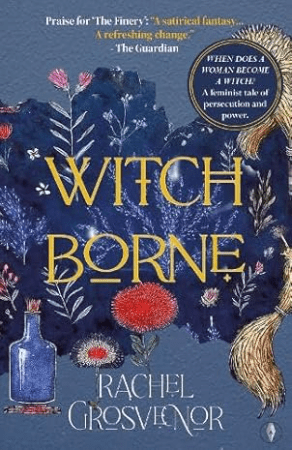
Review Details
Review type: Book
Title: Witchborne
Author: Rachel Grosvenor
Publisher: Fly on the Wall Press
Release date: 1st September 2025
Reviewed by: Rima Devereaux
Other details: Paperback RRP £12.99
Witchborne by Rachel Grosvenor
Book Review
Rima Devereaux
Witchborne is set in the small town of Locklear, in a world that resembles medieval Western society in many ways, but where, instead of God, ‘Gods’ are worshipped, and the priest-figure is called the ‘Grothi’. Agnes is a young woman who, as a spring-born child, was given a gift by the Grothi. Her gift is unique – she can touch fire without being burned – and so her family hide it to avoid her being condemned as a witch. Her brother left home to take part in the rebellion against the kingdom, and this is another thing the family needs to hide. So it is imperative that Agnes makes a good match.
Saskia, Agnes’s best friend, marries someone much more obviously appealing than the husband – a tanner, a classically smelly job as it involved the use of human urine – that Agnes ends up with. And Agnes compares herself unfavourably to Saskia throughout the novel. Saskia perhaps represents the woman who can ‘play the system’, manipulating it so that she can exert a power of her own within the strict confines of women’s roles as they are defined in the society. Agnes, by contrast, is honest and straightforward. She doesn’t lack guile, however, and the way in which she seeks out the Widow Sewall and asks for help in conceiving a child to improve her status in her new family is a key plot element.
The story’s hesitation about the identity of the child’s mother allows the author to explore questions relating to a mother’s power in such a society. Men call all the shots, and women’s voices are silenced. The various ‘widows’, who practise such crafts as herb lore and midwifery, stand outside society in the sense that they are semi-independent women, yet they too can be asked to pay dearly for that. Agnes is essentially a servant in her new home and she is shown no love. The oppressive nature of her husband’s household does not make for easy reading, but in the end it seems that Agnes does get the one thing she wished for in her life.
The worldbuilding is rich, but I found the blurb misleading, as it led me to expect a genuinely medieval setting, whereas the book is in fact set in a Secondary World. I also wondered about the title: Witchborne (meaning, perhaps, ‘carried or brought forth by a witch’), rather than Witchborn (indicating ‘born a witch’). I wondered whether the choice of the second spelling, which does change the meaning as I’ve said, was deliberate and intended to convey the idea, suggested by Agnes’s story, that witches are constructed by the misogynistic society around them rather than born as inherently ‘witchy’ to start with. The book does effectively contrast these two beliefs.
In summary, Witchborne is vividly written and will be enjoyed by readers looking for a feminist approach or who appreciate the fairytale settings of Naomi Novik and M. A. Kuzniar.
Tags: FantasyFeministFly on the WallWitches
Category: Book Review
All reviews
Latest Reviews:
- Januaries by Olivie Blake
- Basic Roleplaying: Creatures
- Five Mini-Adventures – PDF (Shadowdark RPG)
- Cursed Scroll Zine, Vol. 1: Diablerie! RPG Zine
- Empire of the Dawn by Jay Kristoff
- The God and the Gumiho by Sophie Kim
- Citadel of the Moon by Mike Chinn
- Hemlock and Silver by T. Kingfisher
- Thirsty by Lucy Lehane
- Solodark RPG
Review tags:
Action (49) Adventure (70) Contemporary Fantasy (18) Fantasy (120) Gothic Horror (12) Harper Voyager (12) Historical Fantasy (14) Hodderscape (12) Horror (76) Orbit Books (33) Romance (28) Romantasy (13) Science Fiction (35) Titan Books (36) TorDotCom (12)
Leave a Reply