The shortlisted works across all 13 categories of the British Fantasy Awards have been announced! Find out who’s in the mix over on our blog. Winners announced at Fantasycon in October.

For all things fantasy, horror, and speculative fiction
-
Announcement:
Review Details
Review type: Book
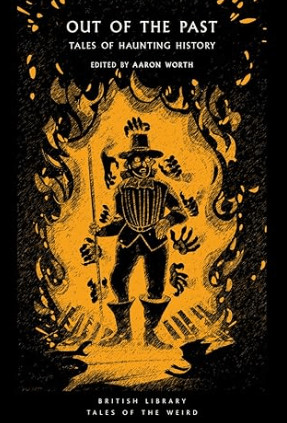
Title: Out of the Past
Editor: Aaron Worth
Publisher: British Library Publishing
Release date: 21st April 2024
Reviewed by: Pauline Morgan
Other details: Paperback RRP £9.99
Out of the Past by Aaron Worth
Book Review
Pauline Morgan
We have a fascination with the past. Life has the appearance of being simpler without the intrusions of modern technology, and we tend to forget the privations that life held for the majority of people. For writers of horror and ghost stories, there is scope for atmospheric and creepy settings without the shadow dispelling electric lights or the rational, scientific explanations. Somehow, these stories are more acceptable without the pressures of reality. So, it is not surprising that writers may choose to set their stories in the past. There are many eras to visit, and some delve there many times.
In this volume, there are two stories from Marjorie Bowen set in different eras. ‘Pride’ (1913) the opening story of this volume is set in late medieval France and centres around Isabeau, the French queen. There were rumours that she dabbled in black magic, and this story uses that in its telling. Bowen’s other story ‘The Confession Of Beau Sekforde’ (1919) by contrast, is set in London in the reign of Queen Anne in 1710. Sekforde is an aging roué. He gets by by gambling and has remarried in the belief that his new wife has money and will pay his debts. He is haunted by his first wife, who would always keep the house tidy, and after death is still tidying up after him.
Frederick Cowles also has two stories in this volume. ‘The Witch-Finder’ (1938) is set in the reign of James II. A witch-finder travelling in East Anglia is tortured by the ghosts of two of his victims. It is a revenge story, as is ‘The Pink Columbine’ (1936), Cowles’ other story in this volume. This time, the setting is France during the French Revolution. The Commissioner of the Committee of Public Safety is intent on revenge on the local Marquise by abusing her. He hadn’t bargained for her ghost to lure him to her own revenge.
It is not just the past that inspires writers of dark stories but also places that they may have visited on their travels. ‘A Wedding Chest’ (1904) by Vernon Lee is set in 15th century Umbria. This is another revenge story. An artist, Desiderio, is commissioned to paint the panels of a wedding chest by Troilo, a local aristocrat. When Troilo abducts, rapes and kills the fiancée of the artist, Desiderio plans to kill him.
Also with two stories in this volume is Aaron Worth, the editor, making them the most recently published. ‘The Translation Of Aqbar’ (2017) is set in the Victorian world of stage magicians. A private performance is illicitly watched by two children and has unfortunate effect on one of them. The other story, ‘The Theatre Of Ovid’ (2018) has similarities with the first. The setting is of a similar time period, though this latter takes place on Romania. Both have characters that are, or are to become familiar with asylums, and both have strong threads of theatrical transformations.
M.P. Shiel uses a common device of a found document. In ‘Dark Lot Of One Saul’ (1912) the document relates the story of an Elizabethan sailor who, during a storm is sucked into a maelstrom is sucked down into an underground cavern and spends years in the dark, the only light being from fires he manages to kindle.
‘Verschoyle’s House’ (1907) by Vincent O‘Sullivan takes us back to the English Civil War. It is the longest story in this volume. It tends to be wordy but tells of a young girl, Paola, married off to the old man, Mr Verschoyle, despite being already betrothed to Edward Morvan. Verschoyle is a cruel man and reputed to be a sorcerer and views Morvan as a rival, who he is determined to get rid of.
Bernard Capes’ ‘The Black Reaper’ (1899) is an allegory as it is set at the time of the Black Death. A harbinger of death visits a village and it killed by the inhabitants. He returns to take his revenge by scything them down. They are saved by the children.
‘Come, Follow!’ (1982) by Sheila Hodgson is an M.R.James-style story set in the Sussex countryside in which there is a supernatural presence which kills. It is another story with a Victorian setting, something that has proved popular amongst writers of historically based horror who were not actually born within its time range. The earlier stories in this volume have earlier settings in order to qualify as historical fiction. Like other volumes in this series, this is a valuable glimpse at the way writers developed the tropes that we now take for granted. It also gives readers a chance to explore the short fiction of writers whose output in no longer easily available. Just as these authors have delved into the past for inspiration for their stories, so it is important that we have access to ideas from our past. If anything, I would have liked to see a greater range of time periods visited, but generally, the whole series is well worth exploring.
All reviews
Latest Reviews:
- The Henchperson’s Guide to Unionizing by Marshall J. Moore
- Ballad of the Bone Road by A.C. Wise
- Bodies of Magic by Freya Marske
- The Big Bad Book of Kaiju ed by Jonathan Maberry and Henry Herz
- Wolf Worm by T. Kingfisher
- Tales From The Territory by Travis Baldree
- God’s Vengeance by Theresa Derwin
- An Empire in the Clouds by Ai Jang
- Warhammer: the Old World Roleplaying Game Player’s Guide
- Warhammer: the Old World Roleplaying Game, Gamemaster’s Guide
Review tags:
Action (51) Adventure (74) Contemporary Fantasy (20) Fantasy (134) Harper Voyager (17) Historical Fantasy (21) Horror (94) Mystery (15) Orbit Books (34) Romance (31) Romantasy (16) Science Fiction (41) Short story collection (17) Titan Books (51) Tor (18)
Leave a Reply